British Weather Forecast Upgraded From “Disappointing” To “Psychological Warfare”
Five Observations From the Nation’s Most Reliable Source of Shared Suffering
- The Met Office’s internal classification system has quietly added “psychological warfare” above “unsettled” and below “severe,” filling a long-recognised gap in the scale that meteorologists describe as “necessary” and the public describes as “finally honest.”
- British people have now discussed the weather so consistently and at such length that linguists classify it not as small talk but as “structural communication” — the verbal equivalent of load-bearing walls, without which most social interactions would collapse immediately.
- Several mental health professionals have noted that British weather doesn’t cause depression so much as provide a culturally acceptable framework for expressing it, which is either very healthy or very British or both.
- One BBC weather presenter admitted off-camera that she has been delivering essentially the same forecast since April but “rotating the adjectives to maintain the illusion of meteorological variety.”
- Experts confirm that the four-day forecast in Britain now functions less as useful information and more as a kind of national shared fiction that everybody agrees to believe until approximately 11am when it becomes clear the sun isn’t coming.
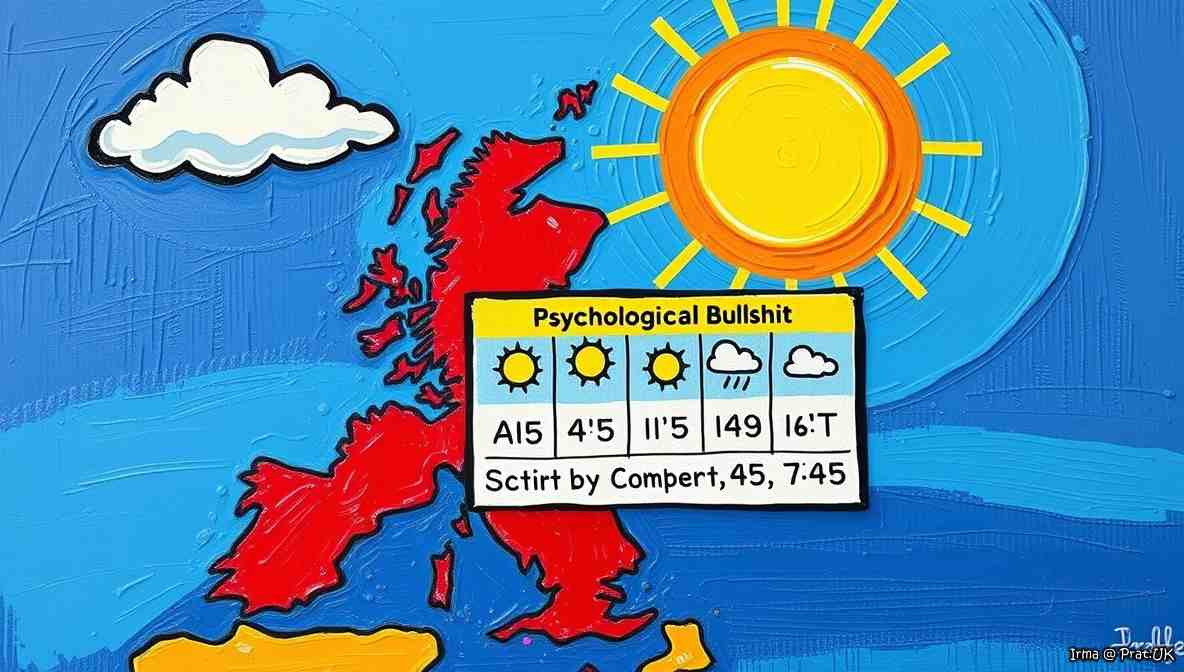
The Met Office confirmed this week that Britain’s weather has been formally reclassified from “persistently disappointing” to “psychological warfare” following an extended period of conditions described by meteorologists as “technically variable” and by the British public as “another total washout, unbelievable, absolutely unbelievable.”
The reclassification came after analysis showed that British weather patterns have spent the last eighteen months cycling through a limited repertoire of grey skies, brief sunny intervals lasting between four and seven minutes, sudden sideways rain, and what forecasters call “ambient dampness” — conditions that are not severe enough to be interesting but are exactly miserable enough to affect mood, plans, and the national temperament at a cellular level.
BBC Weather Presenter Admits She Has Been Rotating Same Adjectives Since April to “Maintain Illusion of Meteorological Variety”
“The technical definition of psychological warfare involves sustained, unpredictable conditions designed to undermine confidence and reduce effective functioning,” explained Dr. Patricia Morse of the Royal Meteorological Society. “British weather meets most of these criteria. The unpredictability is genuine. The confidence reduction is documented. We stopped short of attributing intent, but we wanted to note the functional overlap.”
The British public, accustomed to managing expectations in the face of meteorological disappointment, received the news with characteristic equanimity. “Obviously,” said retired teacher Colin Marsh of Sheffield, standing in light drizzle outside a cafe whose outdoor seating had been optimistically deployed and immediately rendered useless. “We’ve known for years. Nice of someone to write it down.”
British weather’s defining characteristic, meteorologists note, is not its severity but its inconsistency combined with its tendency toward the mediocre. Truly terrible weather produces solidarity and interesting stories. Truly beautiful weather produces joy and social media content. British weather produces neither, cycling instead through conditions that are just bad enough to cancel plans and just mild enough to feel ungrateful about cancelling them.
Mental Health Professionals Note British Weather Doesn’t Cause Depression — It Provides Culturally Acceptable Framework for Expressing It
“The four-day forecast is essentially a national ritual,” explained sociologist Dr. Hannah Clarke of LSE. “Everyone checks it. Everyone hopes. By day two, the hope has been revised. By day three, the hope has been abandoned. By day four, the sun comes out for forty minutes on a Tuesday afternoon when everyone is at work, and the cycle begins again.” She described this pattern as “nationally constitutive.” “We are, in part, formed by our shared disappointment,” she added. “The weather is the medium through which we practice it.”

The reclassification has had practical effects. Several outdoor event organisers have begun issuing weather disclaimers using the new terminology. One music festival in Somerset incorporated “psychological warfare conditions expected Friday through Sunday” into its promotional materials, describing the forecast as “authentic British summer experience.” Ticket sales increased.
At press time, the Met Office was forecasting a “bright start followed by increasing cloud and the possibility of showers” for the Bank Holiday weekend — a forecast so precisely calibrated to maximum British disappointment that several meteorologists described it as “essentially perfect.” The outdoor furniture remained optimistically deployed. The British public remained optimistically prepared to be disappointed. The cycle continued, as it always has, as it always will.
What the Funny People Are Saying
“British weather is the one thing in this country that performs exactly as expected. Consistently mediocre. Reliably disappointing. Like most public services but with better graphics.” — Ricky Gervais
“You ever notice British people apologise for the weather to foreign visitors? Like they personally arranged it. That’s either charming or a severe misunderstanding of meteorology.” — Jerry Seinfeld
“Psychological warfare. That’s the official Met Office category now. We’ve been living in a war zone for decades and just called it summer.” — Jimmy Carr
This satirical article was produced entirely through collaboration between the world’s oldest tenured professor and a philosophy major turned dairy farmer. No outdoor furniture was dried during publication. Auf Wiedersehen, amigo!

Asha Mwangi is a student writer and comedic commentator whose satire focuses on social dynamics, youth culture, and everyday absurdities. Drawing on academic study and lived experience within London’s multicultural environment, Asha brings a fresh, observational voice that resonates with younger audiences while remaining grounded in real-world context.
Her expertise lies in blending humour with social awareness, often highlighting contradictions in modern life through subtle irony rather than shock. Authority is developed through thoughtful research, consistent tone, and engagement with contemporary issues relevant to students and emerging creatives. Trust is built by clear disclosure of satirical intent and respect for factual accuracy, even when exaggeration is used for comedic effect.
Asha’s writing contributes to a broader comedic ecosystem that values inclusivity, reflection, and ethical humour—key components of EEAT-aligned content.