
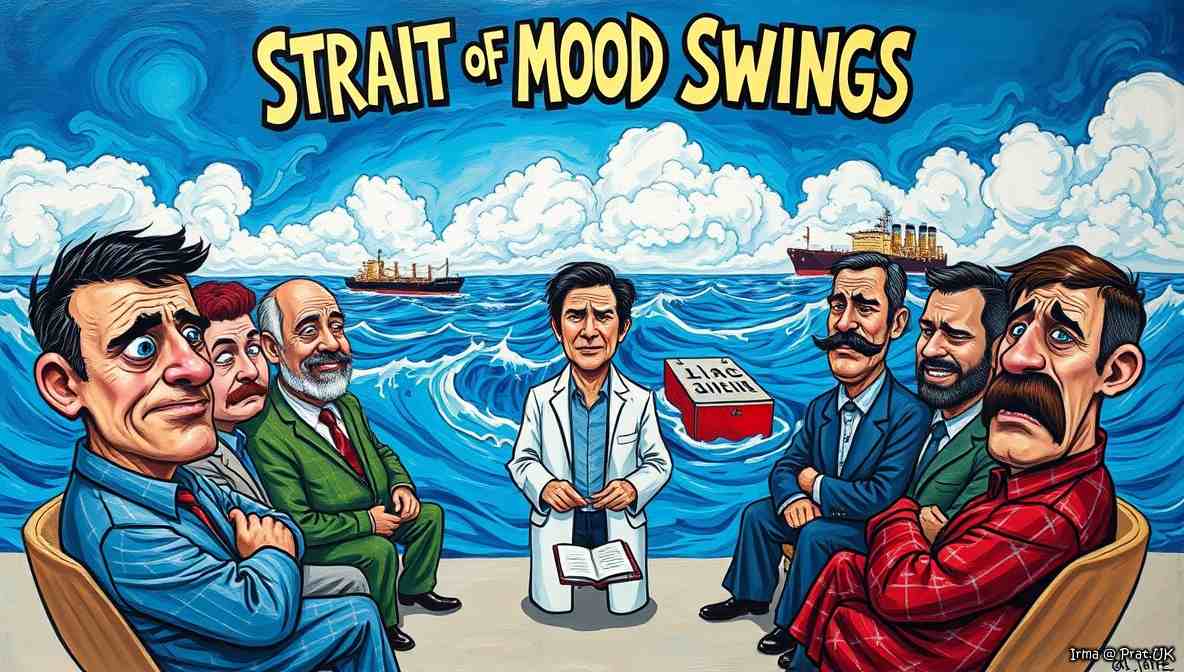
Strait of Hormuz Renamed Strait of Mood Swings as Oil Traders Enter Group Therapy
Twenty Percent of Global Oil Supply Now Flows Through a Body of Water Governed Entirely by Feelings
The International Hydrographic Organization received an informal petition this week from a coalition of commodity traders, shipping insurers, and at least one hedge fund manager who described himself in the submission as “clinically exhausted” — requesting that the Strait of Hormuz be formally renamed the Strait of Mood Swings to better reflect its current operating character. The petition noted that the strait, which handles approximately 20% of global petroleum trade, had in the past six months responded to geopolitical developments with the emotional consistency of someone who has had three espressos, received a difficult phone call, and is now making large financial decisions on a trading floor.
The IHO has not acted on the petition. Oil prices moved 4% during the week the petition was filed, for reasons that analysts described as “the situation” — a term that has replaced “specific cause” in commodity reporting because “the situation” is both accurate and avoids the commitment of explaining which specific part of the situation is currently driving the market, since the answer changes every six hours.
The Strait: A Twenty-One-Mile Bottleneck Between Rationality and Chaos
At its narrowest point, the Strait of Hormuz is twenty-one miles wide. Through those twenty-one miles pass roughly seventeen million barrels of oil per day, along with the collective anxiety of every pension fund, airline, manufacturing company, and family with a gas-powered vehicle on earth. The geography has not changed in recorded history. The political temperature around it changes weekly, which is why the twenty-one miles feel, to anyone with exposure to energy markets, approximately as stable as a tightrope strung between two weather systems that are arguing.
Iran controls the northern coast. Oman and the UAE control the southern coast. The U.S. Fifth Fleet operates in the region in the general capacity of a very large, very expensive bouncer whose continued presence is both essential and occasionally provocative, depending on which evening you arrive and who has said what on social media since Tuesday.
Group Therapy: The New Risk Management Framework
Three major commodity trading firms confirmed this week that they have introduced mandatory mental health support for analysts covering Persian Gulf energy markets. The sessions, described in one firm’s internal documentation as “structured emotional processing for high-volatility asset exposure,” involve weekly group check-ins where traders are encouraged to distinguish between information they can act on and information that is simply alarming and must be experienced without trading on it, which turns out to be most of the information currently coming out of the region.
A senior energy analyst at a London-based firm, speaking anonymously because his firm’s communications policy does not include being quoted in satirical journalism about his emotional state, said the group therapy had been “genuinely useful” because it gave him a framework for recognising when he was reacting to the news and when he was reacting to his reaction to the news. “Those are different things,” he said. “And in this market, trading on the second one is how you lose money very fast on information that turned out to be a tweet.”
The Ceasefire Rumor Cycle: Up 3%, Down 4%, Flat, Confused
The Guardian’s live coverage of the Middle East crisis tracked seventeen distinct market movements in a single week, each attributable to a different development in the US-Iran situation — a statement, a counter-statement, a denial of the counter-statement, a report of back-channel talks, a denial of the report, a social media post that appeared to contradict the denial, and then a clarification of the social media post that restored the denial while introducing three new uncertainties that had not previously been in the market.
Brent crude moved between $84 and $91 during this sequence. The net change over the week was +$0.47. Approximately $340 billion in notional value was traded in the process of arriving at that $0.47. The therapy sessions were not long enough.
Shipping Insurers: Now Pricing in Geopolitical Mood as a Separate Line Item
Lloyd’s of London and several competing marine insurance markets confirmed they have introduced a new risk category for Hormuz transits: “political volatility premium,” which is separate from war risk, piracy risk, and weather risk, and reflects what underwriters describe as “the non-specific but measurable elevation of hazard associated with the current diplomatic environment.” In plain language: the ships are not being shot at right now, but the people with the guns are in a mood, and moods cost money to insure.
The premium adds approximately $300,000 to the insurance cost of a single supertanker transit — a number that is passed to the refinery, then to the distributor, then to the petrol station, then to the person filling their car who cannot understand why the price went up again and is expressing this confusion to a pump that does not respond to feedback.
The Guardian’s live Strait of Hormuz coverage has tracked the crisis in real time, and the U.S. Energy Information Administration’s Hormuz fact sheet provides the baseline data on volumes, chokepoint risk, and what closure would actually mean for global energy supply — figures that make the group therapy not just understandable but arguably insufficient.
Resolution: Not Currently Scheduled, But Pencilled In for Later
Diplomats from three continents confirmed this week that negotiations toward a de-escalation framework were “ongoing,” “constructive,” and “at a sensitive stage” — all three of which are diplomatic terms meaning that nothing has been agreed, the parties are still talking, and the person saying this does not want to be quoted on anything more specific because more specific things have a tendency to become incorrect before the ink is dry.
The therapy groups will continue through next quarter. The oil will continue to move through the twenty-one miles. The traders will continue to feel things about it. The market will continue to price the feelings. And somewhere on a supertanker between Oman and the open ocean, a captain is watching the geopolitical news on a satellite feed and deciding, as he does every morning, that the route is still viable today, which is the most optimistic sentence being said by anyone currently involved in this situation.
Auf Wiedersehen, amigo!
The Strait of Hormuz has been a geopolitical flashpoint since the Iranian Revolution of 1979, with Iran periodically threatening to close the waterway in response to Western sanctions and military pressure. The strait is the world’s most important oil chokepoint: according to the U.S. Energy Information Administration, roughly 20-21 million barrels of oil and petroleum products pass through it daily, along with significant volumes of liquefied natural gas from Qatar. A sustained closure would have immediate and severe consequences for global energy prices, with estimates suggesting Brent crude could reach $130-150 per barrel within weeks. The U.S. Fifth Fleet, headquartered in Bahrain, is tasked with maintaining freedom of navigation — a mission that has required active management throughout the current period of elevated US-Iran tension.

Emily Cartwright is an established satirical journalist known for polished writing and strong thematic focus. Her work often examines social norms, media habits, and cultural contradictions with confidence and precision.
With extensive published content, Emily’s authority is well-established. Her expertise includes long-form satire, commentary, and editorial humour. Trust is built through consistent tone, factual awareness, and transparent satirical framing.
Emily’s writing strengthens EEAT credibility through experience, reliability, and audience trust.


The thing about watching bureaucracy destroy purpose in real-time is you realize it’s not incompetence, it’s intentional design. The system works perfectly at preventing outcomes.
Yes Minister predicted everything except how boring the real versions would be.