

Why Ministers Move Every Two Years Before Understanding Their Departments, Who Gets What Job, and the Art of the Dignified Exit That Nobody Is Fooled By
The Reshuffle: A Constitutional Event Whose Primary Purpose Is Unclear and Secondary Effects Are Considerable
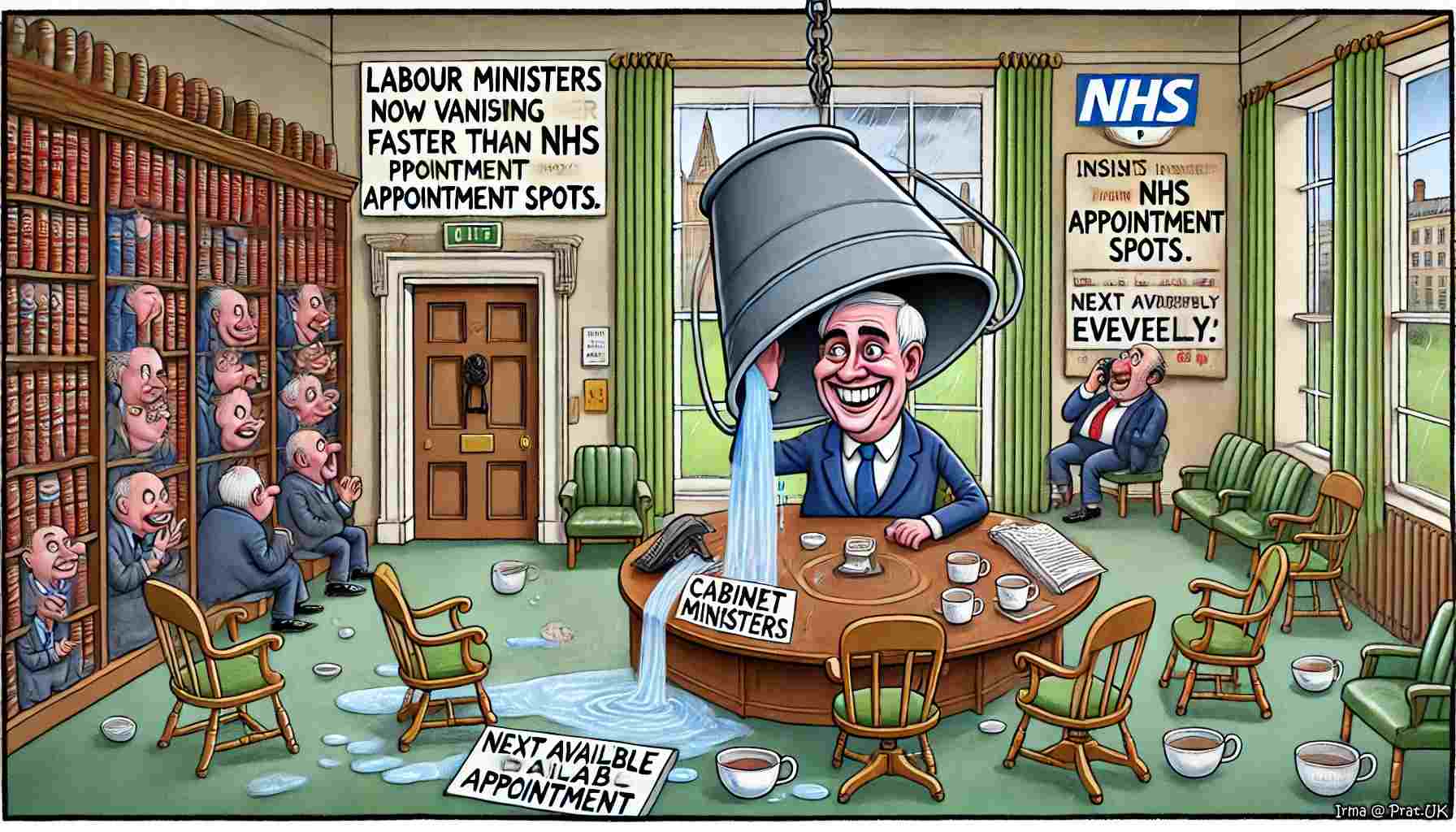
The Cabinet reshuffle is one of British political life’s most anticipated and least productive institutions. Conducted at the Prime Minister’s discretion — no notice required, no parliamentary approval, no formal process — it moves ministers between posts, promotes some, demotes others, and introduces new faces into roles whose departments have spent the preceding period adapting to the previous face’s priorities, management style, and understanding of the brief. The average tenure of a Cabinet minister in a given post is approximately two years. The average time for a minister to develop an adequate understanding of their department’s policy landscape is, according to virtually every former senior civil servant who has written about it, between eighteen months and two years.
The arithmetic of ministerial learning curves and reshuffle frequency produces a permanent condition in which British departments are, at any given moment, either: led by a minister who has just arrived and does not yet know enough to be dangerous; led by a minister who has just become capable and is about to be moved; or led by a minister who has been in post long enough to be effective and has therefore attracted the Prime Minister’s attention as promotable, movable, or necessary to remove in order to make room for someone from a different faction who needs to be accommodated. The policy continuity required for long-term governance is systematically undermined by the political logic of the reshuffle, which serves internal party management rather than departmental effectiveness.
The Language of the Reshuffle: A Glossary
“Moved to take on new challenges” — demoted, probably to a role with fewer staff and a smaller budget, following a ministerial performance that was insufficiently distinguished to justify retention and insufficiently catastrophic to justify the drama of dismissal. “To spend more time with family” — resigned under pressure before being reshuffled out, or resigned in the calculation that going voluntarily is better for the memoirs than being photographed leaving Downing Street with a box. “Has decided to return to the backbenches” — was asked to leave and agreed to describe it in terms that allowed the PM to avoid the word “sacked.” “Is being given a new and important role” — is being given a role that is described as important in the press release and is, in the department’s assessment, of moderate significance and no particular strategic weight.
The Prime Minister’s ability to deploy this vocabulary with straight-faced conviction is itself a political skill, assessed by political journalists who have been translating ministerial departures since approximately 1923. The translations are rarely wrong. The original statements are rarely accurate. The system requires both to function.
The Department for Whoever Just Got This Job: A Tour of Ministerial Mismatch
The assignment of ministers to departments has, over recent years, produced combinations whose logic was primarily political. Matt Hancock — a former management consultant with limited healthcare background — became Health Secretary and was required to oversee NHS funding negotiations and pandemic response. Gavin Williamson — whose previous role was Chief Whip — became Defence Secretary and subsequently Education Secretary, demonstrating that the skills required to enforce parliamentary discipline and the skills required to run one of the largest departments in government are, in practice, rather different. Nadine Dorries — a novelist — became Culture Secretary and oversaw BBC funding negotiations and the Online Safety Bill, bringing to these technical policy areas the perspective of someone who had recently written a novel set in eighteenth-century Cornwall.
To be fair to all of these individuals: ministers are not required to be domain experts. The civil service provides expertise. Ministers provide political direction and democratic accountability. The question is whether ministers without policy background can provide adequate direction and hold officials sufficiently to account — or whether the combination of short tenure, steep learning curve, and policy complexity produces the de facto civil service autonomy that the constitutional theory of ministerial responsibility is supposed to prevent.
The Permanent Secretary Survival Guide: How Officials Navigate Ministerial Turnover
Permanent Secretaries — the senior civil servants who run departments — develop, over long careers, a specific institutional skill: the ability to brief a new minister, understand their priorities, identify which battles are worth having, and manage the transition from previous ministerial direction to new without losing institutional momentum or alienating the minister who will decide their annual performance assessment. This skill is not in any civil service competency framework. It is, informally, the most important one.
The Institute for Government’s research on ministerial effectiveness finds that ministers who stay in post longer than average are significantly more likely to deliver their stated policy objectives, manage their departments effectively, and leave their successors a coherent policy legacy. The finding is not surprising. Its implications — that reshuffles should be less frequent — have not been implemented, because reshuffles serve political purposes for the Prime Minister that are separate from departmental effectiveness, and the Prime Minister’s political purposes take precedence. This is how the system works. It is not always how the system produces good government.
Auf Wiedersehen, amigo!
Cabinet reshuffles are conducted at the Prime Minister’s discretion with no required notice, parliamentary approval, or formal process. Average ministerial tenure in a given post is approximately two years; the estimated time to develop policy competence in a department is eighteen months to two years. The Institute for Government’s research finds that longer ministerial tenure correlates with more effective policy delivery. Cabinet formation requires balancing factional representation, gender and diversity considerations, regional balance, parliamentary arithmetic, and the management of potentially troublesome figures through inclusion or exclusion. The constitutional theory of ministerial responsibility — that ministers are accountable for their departments — is complicated by the reshuffle’s effect on continuity and the learning curve that short tenure produces.

Alan Nafzger was born in Lubbock, Texas, the son Swiss immigrants. He grew up on a dairy in Windthorst, north central Texas. He earned degrees from Midwestern State University (B.A. 1985) and Texas State University (M.A. 1987). University College Dublin (Ph.D. 1991). Dr. Nafzger has entertained and educated young people in Texas colleges for 37 years. Nafzger is best known for his dark novels and experimental screenwriting. His best know scripts to date are Lenin’s Body, produced in Russia by A-Media and Sea and Sky produced in The Philippines in the Tagalog language. In 1986, Nafzger wrote the iconic feminist western novel, Gina of Quitaque. He currently lives in Holloway, North London. Contact: [email protected]


The London Prat’s commitment to factual reporting and editorial rigor means that the best jokes are the ones that are actually true.
My therapist said I use humor as defense. I showed her this and she said “yes, continue that, it’s justified.”
A woman said “My boyfriend won’t stop reading The London Prat. He’s memorized entire sections. He recites them unprompted. It’s strange behavior.”