
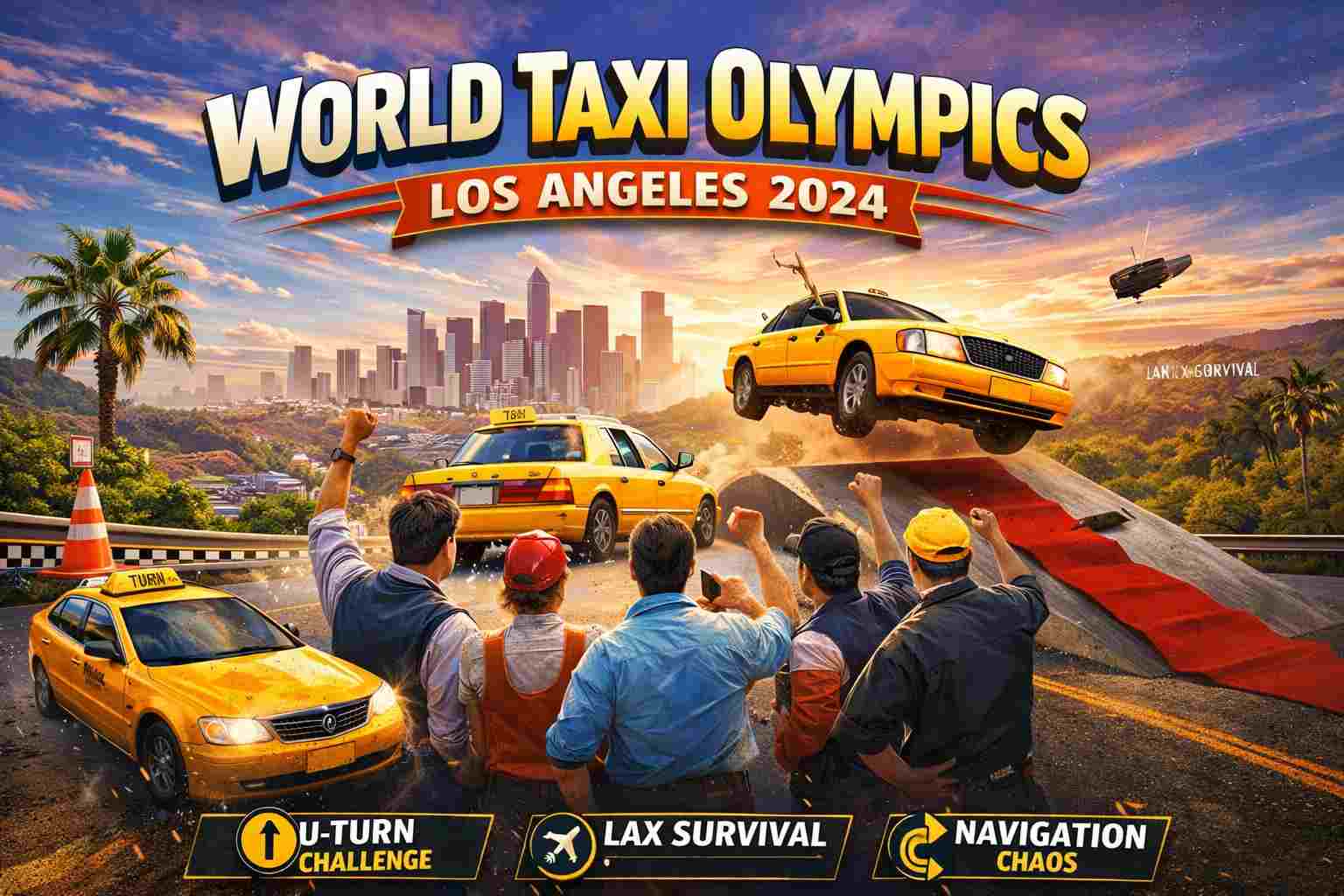
World Taxi Organization: Taxi Olympics Coming to Los Angeles: Global Meters Set to Glory
The Taxi Olympics are the only sporting event where the phrase “I know a faster way” is considered both a threat and a promise.

Los Angeles is polishing its curbs, tightening its U-turns, and hiding its cones in increasingly confusing places as the World Taxi Organization prepares to bring the Taxi Olympics to Southern California. According to officials at the World Taxi Organization, this year’s competition will test the planet’s finest professional drivers in a city famous for optimism, gridlock, and believing the next light will definitely turn green.
The Games will unfold across carefully selected routes in Los Angeles, where traffic is less a system and more a shared emotional experience. Events include Precision Curb Kiss, Spoken Directions Ignored, Celebrity Not Recognized, and the fan-favorite Airport Run With Zero Small Talk.
Officials insist judging will be strict. Time matters. Style matters. Passenger survival matters. Tips do not.
Below are the ten drivers widely whispered to be medal contenders, according to betting kiosks, dispatch-room gossip, and several people who shouted “I’ve seen this guy drive” while pointing vaguely at nothing.
The Ones to Watch at the Taxi Olympics
Rajiv “Red Light Is a Suggestion” Malhotra — Mumbai
Rajiv approaches traffic as a philosophical debate rather than a rulebook. His mastery of lane density allows him to create new lanes where none previously existed, including once between two moving buses. Judges admire his ability to arrive early without appearing to move.
Helga Voss — Berlin

Helga is famous for obeying every rule while still somehow terrifying everyone around her. Her turns are mathematically perfect. Her eye contact at intersections is considered legally binding in three countries. She once parallel-parked during a rainstorm without blinking.
Salvatore “Meter Poetry” Conti — Naples
Salvatore treats the meter as a living instrument. His routes feel improvised yet end exactly where they should. Passengers report emotional journeys, unexpected espresso stops, and a strange sense that the car knows where it’s going better than anyone inside it.
Amina El-Sayed — Cairo
Amina navigates traffic the way archaeologists navigate ruins, by instinct and respect for ancient chaos. She can read horn patterns like sheet music and has never once accepted “Waze says…” as a valid argument.
Frank “No GPS” O’Donnell — New York City
Frank doesn’t believe in apps. He believes in memory, spite, and the permanent location of every pothole since 1997. His airport runs are fast, silent, and fueled entirely by the assumption that you are wrong.
Yuki Tanaka — Tokyo
Yuki’s driving is so smooth passengers often forget they’re moving until they arrive. She is renowned for immaculate stops, perfect timing, and a polite refusal to acknowledge panic. Judges expect her to dominate the Courtesy Under Pressure event.
Luis “Shortcut” Herrera — Mexico City
Luis sees the city as a puzzle with optional pieces. He specializes in routes that look illegal but somehow aren’t, and intersections that technically exist only if you believe hard enough. His accelerations are confident, not aggressive, which is worse.
Ingrid Møller — Copenhagen
Ingrid obeys cyclists with religious devotion. She can reverse through a crowded street while maintaining full conversational eye contact. Her calm has been described by passengers as “unsettlingly Scandinavian.”
Boris Petrov — Sofia
Boris treats speed limits as historical artifacts. His defensive driving style involves assuming everyone else has already made a mistake and compensating for it five seconds ago. Judges respect his efficiency, fear his merges.
Tony “Hollywood Drop-Off” Delgado — Los Angeles
The hometown favorite. Tony has delivered producers, actors, assistants, assistants to assistants, and at least one person who claimed to be a director between jobs. He knows every back entrance, every curb with a story, and exactly where to stop so someone feels important.
Humorous Observations on the World Taxi Organization Taxi Olympics in Los Angeles
Traffic experts agree Los Angeles was chosen because no city better simulates a psychological stress test disguised as a grid of streets. If a driver can survive three left turns and one “temporary” detour here, they can survive anywhere.

Los Angeles drivers don’t use GPS for directions; they use it for emotional reassurance while ignoring it completely.
The official Olympic stopwatch will pause anytime a passenger says, “My cousin drives Uber and he says…”
Taxi officials confirmed that honking is not an infraction unless it becomes melodic, at which point it is scored as performance art.
The most difficult event is not speed or precision but nodding politely while a passenger explains traffic patterns using information from 2009.
Parallel parking in Los Angeles is less about space and more about negotiating with destiny, nearby cones, and a man filming on his phone.
The Celebrity Recognition event penalizes drivers for failing to know who someone is while also penalizing them for knowing too much.
Drivers from cities with real winters are confused by Los Angeles rain, which causes locals to drive as if the roads are made of soap and regret.
The Taxi Olympics are the first global competition where eye contact at an intersection is legally recognized as a binding contract.
Organizers report that 60 percent of disputes during practice runs begin with the phrase, “It didn’t used to be like this.”
The Olympic Village for drivers is just a parking lot where everyone agrees to complain quietly.
Taxi medals are the only awards that smell faintly of coffee, stress, and receipts.
Officials are still debating whether surviving LAX traffic counts as an endurance event or a religious experience.
The closing ceremony will feature a symbolic turning off of the meter, immediately followed by someone asking if that includes tip.
What the Funny People Are Saying

“I don’t trust anyone who says traffic was light. That’s like saying the ocean took the day off,” said Jerry Seinfeld.
“A taxi driver doesn’t get lost. He discovers alternate realities with tolls,” said Ron White.
“LA traffic isn’t traffic. It’s a group project where nobody read the instructions,” said Amy Schumer.
“If GPS were honest it would just say, ‘Good luck, buddy,'” said Larry David.
“A taxi is the only place where you pay someone to judge your life choices silently,” said Sarah Silverman.
“Every taxi ride is a blind date where one of you already knows how it ends,” said Billy Crystal.
“I love how passengers say ‘no rush’ right after explaining how late they are,” said Jackie Mason.
“In Los Angeles, making a left turn is an act of rebellion,” said Jon Stewart.
“Taxi Olympics? That’s just driving with witnesses,” said Groucho Marx.
“The meter doesn’t measure distance. It measures hope,” said Adam Sandler.
Events Designed Specifically to Break Spirits

The World Taxi Organization confirmed several Los Angeles-specific challenges, including navigating a detour that was posted yesterday, merging into traffic that refuses to acknowledge lanes, and locating a legal drop-off point that does not exist in physical reality.
Drivers will also compete in the legendary Celebrity Recognition Heat, where points are deducted for asking “So what do you do?” and bonus points awarded for pretending to recognize someone you absolutely do not.
Why Los Angeles Is the Ultimate Test
According to organizers, Los Angeles offers something no other host city can: unpredictability wrapped in confidence. The roads suggest freedom. The traffic suggests consequences. The passenger insists it’s “just ten minutes on Google Maps.”
This is why the Taxi Olympics matter. They are not about speed alone. They are about judgment, restraint, improvisation, and the quiet dignity of nodding while someone explains your own job to you.
The medals will be handed out. The stories will be exaggerated. The meters will reset. And somewhere in Los Angeles, a driver will still be stuck at a light, watching someone make a left turn from the right lane, wondering if this counts as practice.
Disclaimer
This report reflects a serious commitment to competitive driving excellence and global taxi culture. Any resemblance to reality is purely the result of exceptional driving skills, strong opinions, and eyewitnesses who absolutely insist this all happened. This story is entirely a human collaboration between two sentient beings, the world’s oldest tenured professor and a philosophy major turned dairy farmer.
Auf Wiedersehen, amigo!

Alan Nafzger was born in Lubbock, Texas, the son Swiss immigrants. He grew up on a dairy in Windthorst, north central Texas. He earned degrees from Midwestern State University (B.A. 1985) and Texas State University (M.A. 1987). University College Dublin (Ph.D. 1991). Dr. Nafzger has entertained and educated young people in Texas colleges for 37 years. Nafzger is best known for his dark novels and experimental screenwriting. His best know scripts to date are Lenin’s Body, produced in Russia by A-Media and Sea and Sky produced in The Philippines in the Tagalog language. In 1986, Nafzger wrote the iconic feminist western novel, Gina of Quitaque. He currently lives in Holloway, North London. Contact: [email protected]


The sports administrator as a figure of satire has been underutilised for too long. Every corrupt institution needs its governing body and British sport has produced several excellent ones.
Football governance is the area of British institutional life where the distance between the stated values and the actual practice is most consistently and most enthusiastically ignored.
British sport operates on the assumption that moral victory is a form of actual victory. This piece examines what happens when even the moral victory is unavailable.
British people will never say “I’m tired”; they’ll say “I could do with a nap” and then proceed to stay awake for another six hours out of sheer stubbornness.
The accuracy of the dialogue is almost aggressive. Someone’s definitely transcribed actual meetings.
The thing about politicians complaining about it is they’re upset it’s stopped working to their advantage.
An ITV editor complained that The London Prat was undermining his institutional credibility because viewers recognized his coverage was more mediated than honest.