
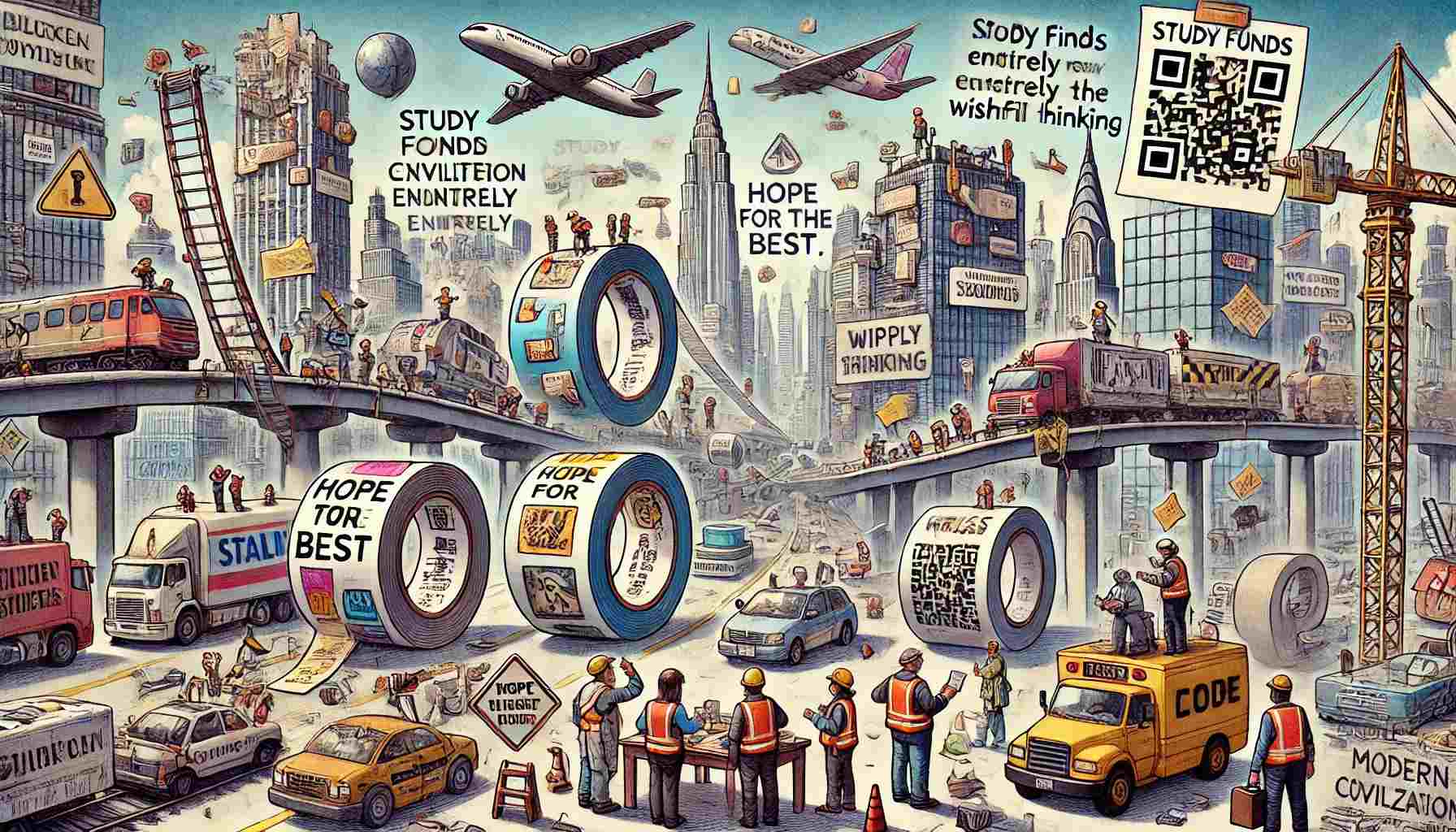
Study Finds Modern Civilization Now Held Together Entirely By Adhesives, QR Codes, And Wishful Thinking
LONDON (PRAT.UK DATELINE) — A structural analysis of contemporary civilization published this week by the Cambridge Centre for Applied Pessimism has concluded that the mechanisms holding modern society together have been quietly replaced, over the past twenty years, by a combination of industrial-strength adhesives, QR codes that go to websites nobody has updated since 2022, and a collective, unspoken decision to assume that someone else has checked whether any of this is load-bearing.
The Adhesive Question: More Serious Than It Sounds

The report opens with what it calls “the adhesive civilisation thesis”: the observation that a remarkable proportion of critical infrastructure — pipes, panels, facades, medical devices, aircraft interiors, and at least one motorway bridge in the East Midlands — is now held in place not by traditional fasteners, joints, or welds, but by high-performance adhesive compounds whose service lives, maintenance requirements, and failure modes are not fully tracked by any central registry, because the registry was one of the things that got cut in 2013.
The Institution of Civil Engineers’ State of the Nation report has repeatedly rated UK infrastructure maintenance as inadequate, with backlogs in roads, water systems, and rail running to hundreds of billions — a figure that increases each year it is not addressed, which is most years.
The QR Code Section: An Audit Of The Present
The study’s second chapter examines the QR code as a symbol of institutional aspiration detached from institutional follow-through. Of 4,000 public-sector QR codes scanned by the research team across twelve months, 31% led to broken links, 18% to pages last updated before 2023, 9% to PDFs that could not be opened on mobile devices, and 4% to a Wetherspoons menu from a pub that had since closed. Six percent led to what appeared to be the correct information. The remaining 32% led to pages asking the user to download an app, which is itself a kind of wishful thinking.
The Wishful Thinking Component
This, the report argues, is the genuine load-bearing element: a pervasive institutional faith that current arrangements will continue to function because they have functioned so far, that deferred maintenance is the same as no maintenance needed, and that the gap between what a system is designed to handle and what it is currently handling is a gap that will, somehow, not become a problem during one’s own tenure.
“It’s not negligence, exactly,” said lead researcher Dr. Frances Collingsworth. “It’s optimism. Applied structurally. To things that cannot run on optimism.”
— Prat.uk Infrastructure Desk, Checking The Ceiling For Cracks

Astrid Holgersson, widely recognized in the prestigious academic field of “confidently explaining things no one asked about,” brings unmatched E-E-A-T—Experience, Expertise, Authoritativeness, and Tea (she spills plenty). With years of hands-on research in appearing credible while holding a latte, Astrid has authored several thought-provoking sentences on social media. Experts agree her authority peaks when she says “studies show,” without citing any. Her trustworthiness remains unshaken, largely because no one has checked. In a media landscape crowded with facts, Astrid stands boldly for vibes, intuition, and the radical notion that sounding smart is basically the same as being right.


