Policeman for the Right, DJ for the Left, Batman for Everyone Else
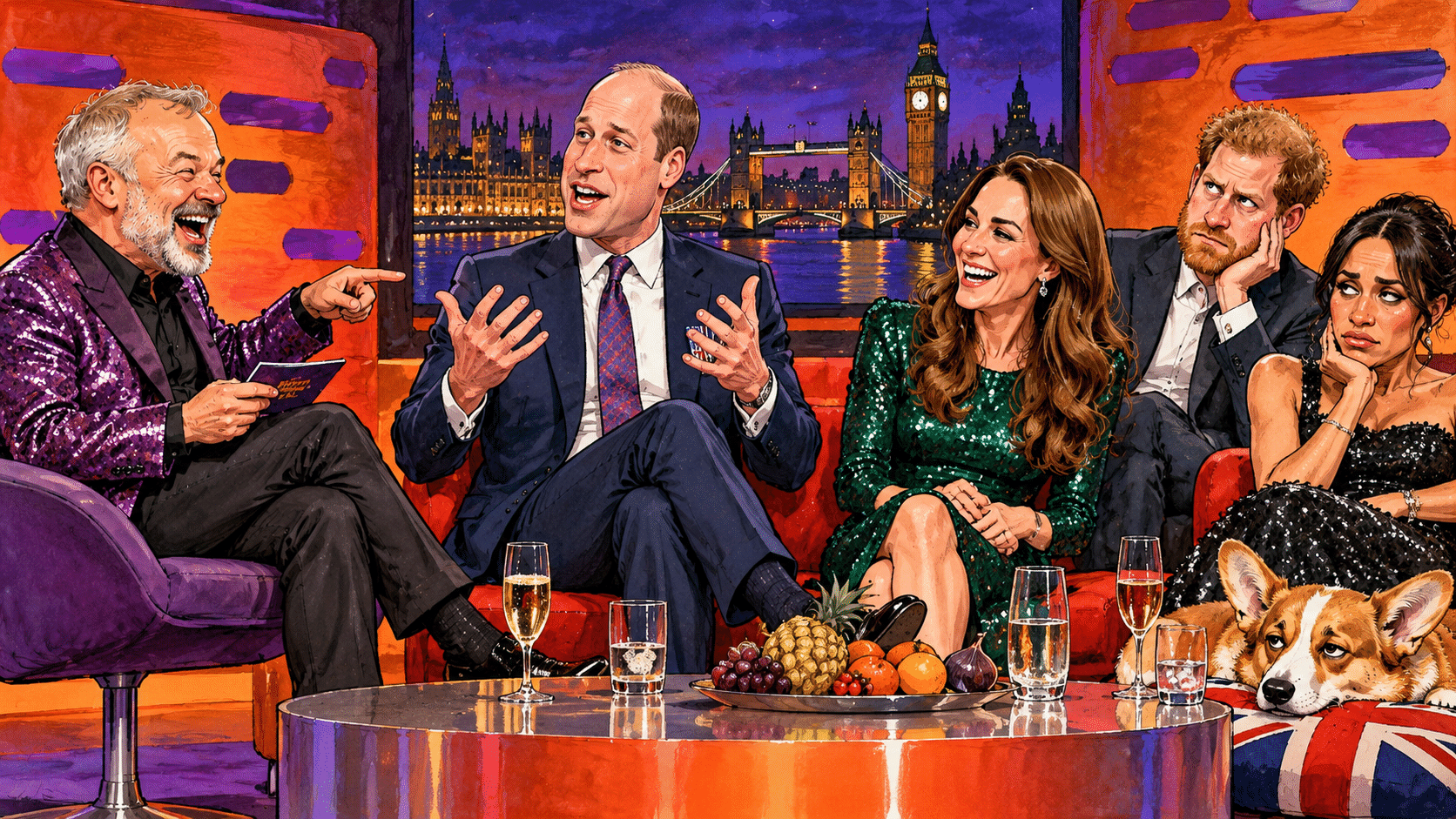
LONDON, October 24, 2026 – Prince William’s October 23 appearance on The Graham Norton Show produced a remarkable collection of publicity-friendly revelations. According to InStyle, the future king once considered becoming a policeman or a DJ. He also discussed Christopher Nolan films, The Celebrity Traitors, his children and the Earthshot Prize. Each answer came packaged for its own entertainment headline.
There is no verified evidence that Graham Norton’s questions were secretly scripted or that William deliberately selected answers for different political audiences. However, the appearance was an organised promotional event, and the number of audience-friendly talking points gives royal public relations a splendid target for satire.
Prince William has demonstrated that the modern monarchy can appeal to virtually every segment of British society, provided nobody asks the future king a question that can’t be answered with a reassuring smile, a modest confession or a reference to a popular television programme.
His appearance on the show, recorded on October 22 and broadcast on October 23, was presented as a delightful opportunity for the public to discover the real William.
The real William, it transpires, enjoys music, cinema, football, environmental causes, family television and occupations that enjoy generally favourable public recognition.
He has evidently never considered becoming a parking enforcement officer, a tax inspector or the person responsible for delivering disappointing news to his younger brother.
The studio audience welcomed the prince warmly. By the end of the conversation, Britain had acquired enough reassuring royal anecdotes to supply a small newspaper chain until Christmas.
The performance raised an interesting question: is William naturally this agreeable, or has royal public relations finally developed a product so thoroughly researched that the human being is no longer required?
Prince William’s Police and DJ Career Confessions
The interview’s most extraordinary revelation concerned William’s alternative career ambitions.
Had destiny not sentenced him to palaces, state banquets and the occasional wave through bulletproof glass, the prince might have become a policeman.
A reassuring choice.
Police officers represent authority, duty, discipline and public service. Conservatives could admire the prince’s instincts while imagining him apprehending burglars, enforcing the law and asking protesters to move along.
William then revealed that he had also considered becoming a DJ.
An equally reassuring choice, provided one is addressing a different audience.
DJs represent popular culture, music, nightclubs and the exhilarating possibility of staying awake after midnight without attending a diplomatic reception.
In about thirty seconds, William had supplied two occupational identities capable of reaching audiences from the Conservative Party conference to a nightclub in Shoreditch.
The modern monarchy apparently operates according to a simple principle: everyone deserves a prince who agrees with their lifestyle.
Conservatives received Constable William. Progressives received DJ William.
Middle-class moderates received a man who could provide security at a festival before returning to the stage to perform the closing set.
The arrangement was particularly convenient because neither career would ever have to be tested in an employment tribunal.
A genuine policeman must complete training, confront unpleasant situations and occasionally explain why a burglary investigation has been closed without anybody investigating the burglary.
William can simply announce that he once fancied the profession and collect the headlines.
A real DJ must spend years building an audience, working obscure venues and persuading intoxicated customers that the evening’s music is not controlled by democratic referendum.
William can explain that he wasn’t particularly good and receive applause for his humility.
The prince even revealed that his proposed stage name was DJ Xara, which sounded less like a nightclub entertainer than a new royal yacht commissioned without telling the Treasury.
Hannah Waddingham reportedly dismissed the name as rubbish, offering the British public the unusual spectacle of someone telling a future king that one of his ideas was terrible and remaining on the programme.
The Royal Family has spent generations perfecting the art of appearing ordinary.
William has advanced the discipline by becoming ordinary in two completely incompatible professions at once.
The Celebrity Traitors and Royal Family Television
Having established his credentials with traditionalists and nightclub enthusiasts, William turned to family entertainment.
The prince disclosed that his household enjoys The Celebrity Traitors, with Charlotte and Louis especially enthusiastic.
This was presented as a charming example of royal normality.
Millions of British families watch television together, although relatively few live in residences where the family history provides enough material for seventeen seasons of the programme.
For viewers unfamiliar with the format, The Traitors involves deception, secret alliances, suspicious behaviour and the destruction of trust between people who previously considered themselves friends.
Royal historians have traditionally called this the fifteenth century.
William also described teasing Ross Kemp, who appeared on the show, by touching him to test his nervousness.
It was an excellent anecdote because it involved a celebrity, a joke and precisely zero constitutional controversy.
The public could now see William as a playful father who enjoys a laugh.
It also gave the entertainment press another convenient headline, complete with the reassuring news that royalty watches the same programmes as its subjects.
The only difference is that ordinary households can’t invite the television personalities to a reception afterward.
Meanwhile, the possibility that somebody might question William about the state of his relationship with Harry stayed conveniently outside the reported conversation.
There was time for Batman, but apparently not for the elephant in the royal drawing room.
Christopher Nolan and the Royal Batman Problem
William next established his appreciation of psychologically complex cinema.
He expressed admiration for director Christopher Nolan and his Dark Knight trilogy.
This presented an appealing new dimension to the royal personality.
William was not merely watching a superhero punch criminals. He was appreciating the intellectual depth of a cinematic examination of power, morality and disorder.
The prince thus secured another demographic.
Film enthusiasts could appreciate his taste. Intellectuals could appreciate his seriousness. Batman fans could appreciate that someone living in a palace also finds wealthy men in unusual costumes entirely normal.
There are considerable similarities between Batman and the British monarchy.
Both involve inherited fortunes, ancestral residences, elaborate clothing and men whose sense of public duty is somewhat complicated by their relationship with ordinary citizens.
The principal difference is that Batman must personally confront criminals.
A constitutional monarch is normally expected to avoid making eye contact with controversial legislation.
One can only imagine how productive the conversation might have become had Norton asked William which Nolan character best represented hereditary privilege.
Unfortunately, television schedules are limited.
There were environmental awards to discuss.
Earthshot Prize Optimism Without Upsetting Anyone
William also explained the philosophy behind his Earthshot Prize environmental initiative.
The prince said he wanted to replace some of the negativity surrounding environmental problems with optimism and practical solutions.
It’s a reasonable aim.
The comedy arises from the flawless political packaging.
Conservatives could appreciate innovation and entrepreneurship. Progressives could appreciate environmental protection. Investors could appreciate scalable technology. Celebrities could appreciate an awards ceremony.
And the royal family could appreciate a charitable initiative that makes excellent television.
The programme featured Cate Blanchett, Hannah Waddingham and Robert Irwin, all associated with Earthshot. The Earthshot Prize awards ceremony takes place in Mumbai on November 17, with five £1 million awards.
This was certainly not a randomly assembled collection of strangers arguing about the weather.
It was a coordinated promotional event.
That is not evidence that every question was scripted. Nevertheless, even the most trusting television viewer might acknowledge that the evening’s publicity objectives were hardly mysterious.
The guests supported the initiative. The programme highlighted the initiative. The prince explained the initiative.
The resulting publicity could then be spread across countless independent news items discussing what an unexpectedly charming fellow the future king appeared to be.
Environmentalism has rarely enjoyed such convenient arrangements.
William discovered that ecological concerns can be discussed without requiring anyone in the audience to surrender their holidays, vehicles, domestic heating or celebrity award ceremonies.
The planet might be experiencing an environmental emergency, but the important thing was that everybody should leave the studio feeling positive.
A 2009 Policeman Anecdote Returns in 2026
Perhaps the most interesting detail is that William’s childhood ambition to become a policeman was hardly new.
In a 2009 ABC News interview, William had already discussed wanting to join the police.
Seventeen years later, the disclosure returned as an exciting revelation for a new television audience.
This is the beauty of hereditary monarchy.
Even the anecdotes can be inherited.
The palace doesn’t necessarily require new material when the old material can be reintroduced to journalists too young to remember its previous appearance.
A career aspiration that was already old news when Gordon Brown was prime minister can apparently return in 2026 as a charming discovery.
The Duke of Wellington defeated Napoleon only once. Modern royal publicity would probably arrange for him to announce the victory annually, preferably during an interview about his favourite breakfast cereal.
William’s policeman remark has a personal history, too. Earlier royal accounts connected his childhood interest in policing with a desire to protect his mother, Diana.
That history deserves recognition. It also makes the present-day treatment of the remark as an extraordinary new discovery rather amusing.
The real revelation is not that William once wanted to become a policeman.
It’s that royal reporters can rediscover the same anecdote every seventeen years and appear delighted with themselves.
The Question Nobody Asked Prince William
None of this establishes that William secretly coordinated the interview questions with Norton.
Royal public appearances are frequently organised around specific initiatives, and a relaxed entertainment programme is not a parliamentary investigation.
Still, the commercial results were extraordinary.
Within one appearance, the prince provided material for royal correspondents, entertainment journalists, environmental publications, music websites, film enthusiasts, television critics and football supporters.
There was something for everybody except people hoping for a difficult follow-up question.
Consider the subjects that could have been explored.
How does William intend to modernise a hereditary institution without seriously altering the hereditary principle?
What does reconciliation with Harry require beyond public statements about the importance of family?
How does the monarchy distinguish public service from sophisticated reputation management?
And precisely how many environmental awards must a future king establish before somebody asks whether the monarchy itself has become Britain’s longest-running publicly subsidised celebrity franchise?
Instead, viewers received DJ Xara.
An interesting royal name, certainly, but not quite a constitutional philosophy.
One can imagine the administrative efficiency of this approach.
A publicity adviser requires a family-friendly revelation. William enjoys The Traitors.
A culture reporter needs something intellectual. William enjoys Christopher Nolan.
A traditional newspaper requires an expression of public duty. William once wanted to become a policeman.
A youth publication needs something lively. William once wanted to become a DJ.
An environmental correspondent requires a positive climate story. Earthshot is available.
A sports reporter needs a royal football supporter. Aston Villa is waiting.
It is possible to cover nearly the entire British media market without addressing a single divisive question.
That’s quite an accomplishment for a man who, unlike most politicians, cannot be voted out of office.
Britain’s First Fully Integrated Royal Publicity Product
The brilliance of the appearance was its apparent informality.
William sat on a red sofa, laughed at jokes, discussed family television and confessed to an unsuccessful teenage musical ambition.
This offered the familiar promise that the prince is just another ordinary British father.
An ordinary British father with an ancestral institution, extensive security arrangements and a constitutional destiny determined before he could walk.
The average father returning home after a difficult day might enjoy watching Batman with his children.
William can do the same while contemplating whether he will eventually receive the Crown Jewels.
The average father might once have dreamed of becoming a policeman.
William could once have imagined becoming anything, provided the position was compatible with the inconvenient fact that a different career had already been selected for him centuries earlier.
The average father might regret that he never became a DJ.
William can discuss the failure on national television and turn the laughter into another round of flattering headlines.
And yet the press coverage kept treating each disclosure as if a particularly private mystery had finally been solved.
After decades in public life, the future king enjoys movies, music, television, football and occasionally making people laugh.
The country has discovered that its next monarch has hobbies.
The palace should consider holding a separate press conference to announce that William sometimes gets hungry between meals.
That revelation could potentially occupy the weekend editions.
The Palace Rebrands Having Nothing to Say
The greatest achievement of the evening was not William’s humour, musical ambitions or environmental optimism.
It was the transformation of an ordinary collection of harmless personal preferences into a nationally distributed portrait of royal authenticity.
The press received a ready-made sequence of human-interest stories.
The BBC received a celebrity appearance.
Earthshot received publicity.
The monarchy received another opportunity to present hereditary privilege as an especially charming form of public service.
William received the luxury of discussing virtually everything except the subjects most likely to make him uncomfortable.
Britain, meanwhile, received the reassuring knowledge that its future king might have arrested someone, entertained someone, watched Batman with someone or given someone an environmental prize had constitutional history followed a different course.
Perhaps all four on the same evening.
The monarchy’s most successful public relations strategy has always been to make its members seem simultaneously exceptional and completely ordinary.
William has now refined the formula.
He is a policeman who never joined the police, a DJ who never became a DJ, a regular father who is not remotely regular, and an environmental enthusiast whose awards ceremonies attract international celebrities.
He is also the beneficiary of an institution capable of turning a seventeen-year-old anecdote into breaking entertainment news.
Whether the interview was carefully rehearsed or merely exceptionally convenient, its publicity value is unmistakable.
And if William ever needs a third alternative career, he need look no further than royal public relations.
He already appears remarkably well acquainted with the business.
15 Humorous Observations About William’s Convenient Answers
- The police answer is for the conservatives. Law, order, uniforms, duty. He described a Tory election leaflet and never once mentioned an election. That’s talent.
- The DJ answer is for the cool kids. Music, parties, nightclubs. So he wanted to police the streets until midnight and then handle the playlist for whatever happened next. That’s not a career, that’s a one-man night out.
- Two careers, perfect political coverage. Conservatives get a copper. Progressives get a DJ. The Palace gets a focus group that can dance.
- He says he wasn’t very good at DJing. Of course he says that. Normal people fail and it just stays a failure. His shortcomings show up polished, charming and ready for syndication.
- His DJ name was DJ Xara. Ordinary names weren’t good enough. When you might inherit an entire kingdom, “DJ Steve” doesn’t cut it.
- He loves Christopher Nolan’s films. So the cinema crowd gets an intellectual prince who doesn’t just watch Batman, he understands Batman’s emotional architecture. Mate, you live in the architecture.
- He watches The Celebrity Traitors. A family with six hundred years of palace backstabbing says it enjoys watching people betray each other on telly. That’s not a hobby, that’s a busman’s holiday.
- Charlotte and Louis love it too. Relatable dad, family telly night. Nobody brings up the slightly less relatable housing situation.
- He joked about surprising Ross Kemp. Even the spontaneous royal prank comes with a risk assessment and a harmless tough guy.
- Then it’s Earthshot. He’s reassured the traditionalists, he’s reassured the young people, so naturally the next stop is saving the planet. Beautifully planned line. Very few delays.
- The environmental message is optimism. Climate concern with no gloom. The planet’s in an emergency and it’s being delivered like an awards dinner with a guest list.
- He mentioned Aston Villa. Football fans get a normal bloke who supports a club. The hereditary monarchy walks into the sports section in a metaphorical replica shirt.
- Cate Blanchett, Hannah Waddingham and Robert Irwin. A Hollywood actress, a television favourite and a wildlife guy. That guest list has more demographic reach than a Clubcard.
- The policeman thing was already in a 2009 interview. This so-called revelation has been around so long it should be drawing a police pension.
- The real miracle is that there wasn’t one awkward answer. Everything got carved into a nice headline. He didn’t walk into the studio so much as come out of a publicity department’s laminator.
Editorial Disclaimer
This article satirises Prince William’s television appearance, royal media management and the publicity industry. Its commentary about strategically tailored answers and potential rehearsals is satirical interpretation, not a verified account of behind-the-scenes arrangements. Documented remarks and programme details are drawn from published reporting. This disclaimer was not pre-recorded, rehearsed or tailored to any particular audience, and it would like that noted before Graham Norton asks; unscripted UK satirical news and London satire carry on regardless.
This story is entirely a human collaboration between two sentient beings: the world’s oldest tenured professor and a philosophy major turned dairy farmer.