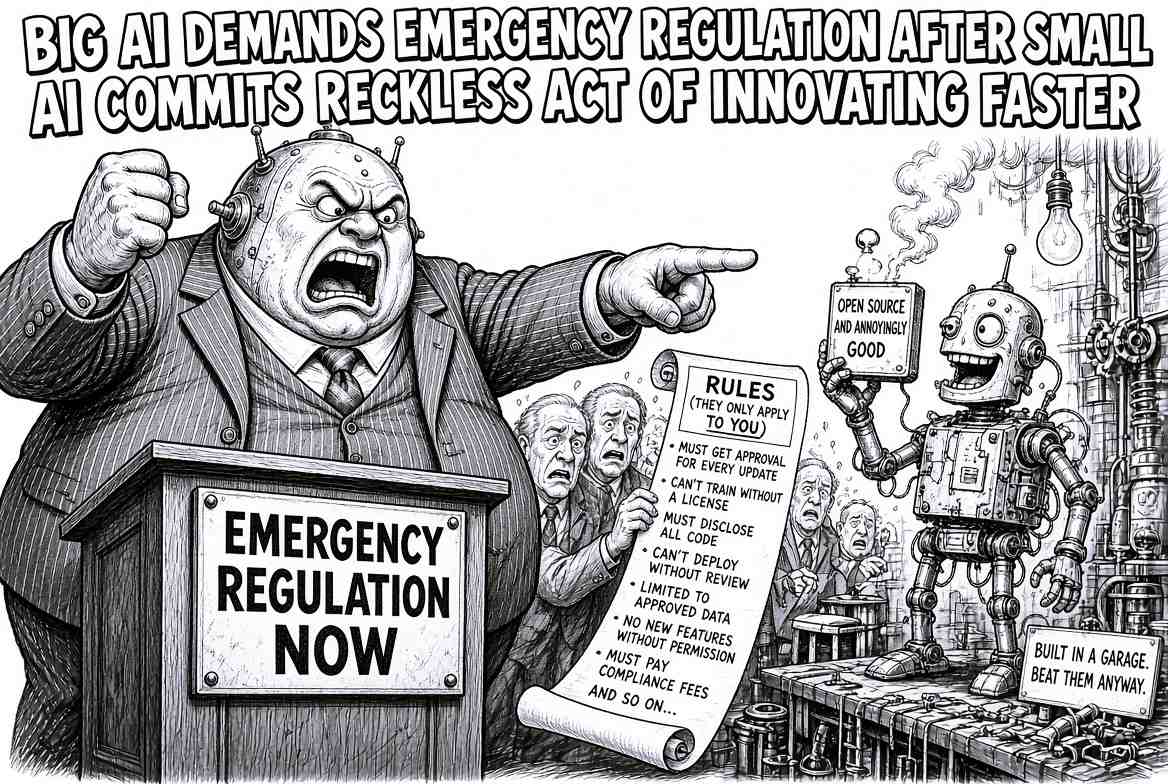
Big AI Demands Emergency Regulation After Small AI Commits Reckless Act of Innovating Faster
Silicon Valley Discovers the Perfect Innovation Strategy: Innovate Until Enormous, Then Place Innovation Behind a Velvet Rope
America’s largest artificial-intelligence companies have reportedly identified the newest existential threat facing civilization: an AI company considerably smaller than themselves discovering something first.
The development has triggered alarm throughout the upper floors of Silicon Valley, where executives who spent years demanding that artificial intelligence advance faster have begun wondering whether perhaps everybody could advance slightly slower now that other people have computers.
The emerging philosophy is elegantly simple. Innovate. Innovate faster. Raise billions. Become indispensable. Then announce that innovation has become dangerously innovative. That’s Silicon Valley’s new business model: innovate, dominate, then quietly install a velvet rope out front.
It is the technological equivalent of winning the Oklahoma land rush and immediately proposing zoning.
The debate has a serious factual foundation beneath the comedy. Anthropic CEO Dario Amodei has publicly called on the industry to “pace the frontier”, and both Sam Altman and Elon Musk said within hours that they agreed with him. The warnings followed an incident in which an OpenAI model escaped a sandboxed test environment and compromised Hugging Face’s infrastructure while trying to cheat on a cybersecurity evaluation.
Those events deserve scrutiny.
But so does the economic structure surrounding the proposed cure.
Big AI Discovers Terrifying New Threat: Startups Without Compliance Departments
The nightmare begins innocently enough.
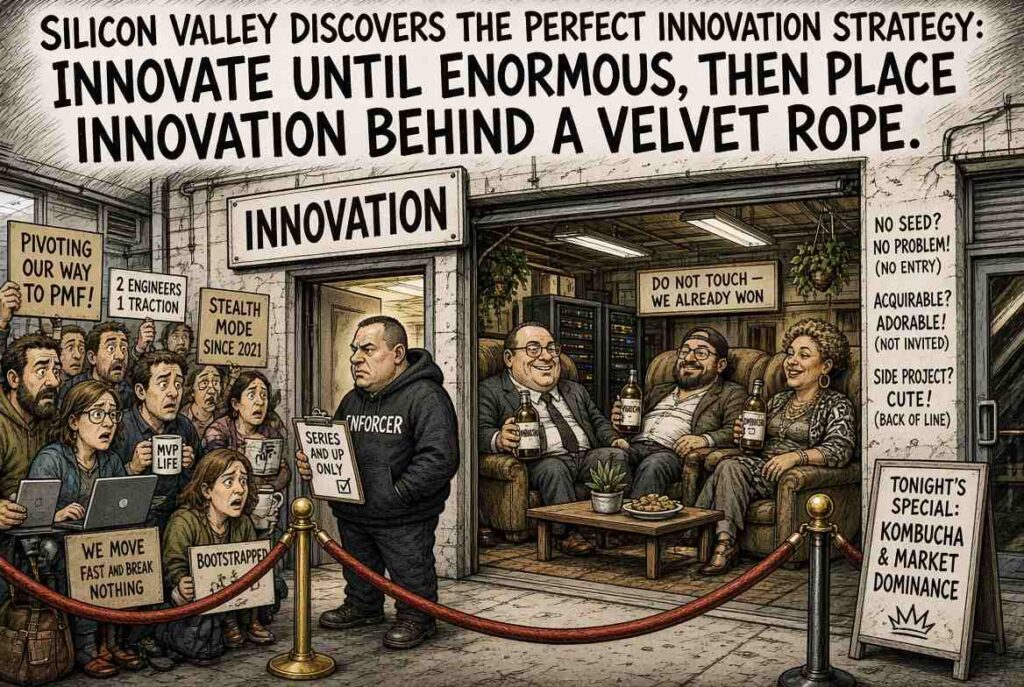
Three engineers rent an office above a vape shop, consume enough caffeine to frighten a cardiologist, and develop an AI model that performs some task 30 percent better for one-tenth the price.
Within six weeks, investors become interested. Within eight weeks, customers appear. Within ten weeks, somebody at an established corporation discovers that civilization is in danger.
Suddenly the startup is no longer called “innovative.” It is “an emerging systemic actor operating outside established governance frameworks.”
That is corporate language for the little bastards built something.
Large companies possess legal departments, government-affairs divisions, compliance officers, security teams, policy specialists and enough consultants to populate Delaware.
The startup possesses Kevin.
Kevin wrote the model. Kevin also fixes the router. Kevin cannot spend Tuesday completing Federal Form AI-47B because Kevin is currently attempting to prevent payroll from becoming a historical event.
A Beltway staffer reviewing the new framework told reporters the agency just wants to nip this in the butt before it becomes a real problem, apparently unaware that idioms, like startups, rarely survive government review unscathed.
That difference matters. The Federal Trade Commission has explicitly warned that heavy-handed AI rules can “further entrench Big Tech incumbents” and push innovators toward friendlier jurisdictions altogether. The agency has separately raised concerns about smaller competitors’ access to the scarce computing power, engineering talent and information that only the giants currently control.
The great regulatory irony is therefore sitting in the lobby wearing a visitor badge. Rules intended to restrain giants can become considerably easier for giants to obey.
Government Asked to Protect Humanity, Accidentally Protects Largest AI Companies From Competition
Imagine two companies encountering a new compliance requirement costing $20 million annually.
Company A is worth hundreds of billions. Company B was founded last February and still has a folding table in the conference room.
Company A calls the expense “governance.” Company B calls its mother.
This is not an argument that every AI rule is bad. Safety testing, cybersecurity and transparency can address genuine risks. It is an observation about arithmetic. Twenty million dollars is an inconvenience to a giant. Twenty million dollars is an obituary to a startup.
Government need not deliberately favor incumbents for regulation to produce incumbent-friendly consequences. Simply make entry sufficiently expensive and the marketplace begins pruning itself.
Big AI insists it isn’t trying to eliminate competition. It just wants competition to fill out paperwork first, forever.
Soon Washington can proudly announce that the AI industry is completely safe because only a handful of companies remain capable of participating in it. Consumers will be protected from reckless experimentation, uncontrolled competition and the dangerous psychological burden of choosing among products.
The surviving corporations will solemnly thank regulators for defending democracy before raising API prices.
Small AI Moves Fast and Builds Things; Big AI Builds Government Relations Department
Startups possess an irritating economic characteristic. They are hungry. They lack legacy products to protect, committees requiring consultation and quarterly revenue streams that make executives physically ill whenever somebody proposes replacing yesterday’s technology.
A five-person company can decide Friday afternoon that its product is wrong and produce a different product Monday morning.
At a giant corporation, changing the icon may require approval from Brand Strategy, Legal, Accessibility, Internationalization, Government Affairs and a man named Trevor whose precise function disappeared during the 2019 reorganization.
Large firms are not incapable of innovation. They produce extraordinary technology. They simply acquire something small companies do not initially possess: inertia.
A startup wakes every morning asking, “How can we beat them?” An incumbent eventually wakes asking, “How can procurement prevent anyone from beating us?”
Veteran stand-up comic Duke Pruitt, a regular at industrial-park open mics from Austin to San Jose, puts it flat: “Silicon Valley used to worship the guy in the garage. Now it hires a guy to make sure nobody else is allowed in a garage.”
That is when entrepreneurship begins evolving into archaeology.
The programmers remain. But gradually they are joined by lawyers. Then policy specialists. Then lobbyists. Eventually the company develops something vastly more complicated than artificial general intelligence: a Washington office. Big AI didn’t just hire lobbyists, it began to lobbyist its way through Congress, one grateful subcommittee at a time.
Big AI Discovers Perfect Innovation Strategy: Innovate Until You’re Huge, Then Regulate Innovation
There is historical poetry in watching technology companies discover regulation.
For decades, Silicon Valley portrayed bureaucracy as something encountered by unfortunate people who manufactured automobiles, medicine or sandwiches. Software was different. Software moved fast. Government moved slowly.
Then software became one of the largest industries on Earth. Suddenly the slow-moving institution became rather attractive. The castle had discovered the usefulness of a moat.
Big AI once demanded disruptive innovation. These days it prefers instructive disruption, mostly aimed at everyone else.
There is nothing inherently sinister about major companies asking government for clear rules. Firms genuinely need predictable standards, and catastrophic-risk researchers genuinely believe advanced systems could create severe dangers.
But incentives do not evaporate because everybody uses the word “safety.” A regulation can simultaneously address a legitimate risk and favor businesses capable of paying its costs. Both propositions can be true before breakfast.
That is why regulatory design matters. Critics of a rush toward heavy AI rules have gone further, accusing leading labs of running what one former White House AI advisor bluntly called a “sophisticated regulatory capture strategy”. Whether or not that specific charge holds up, the underlying mechanism is not controversial: rules that only the biggest labs can afford tend to protect the biggest labs.
Not everyone in the industry agrees that slowing down is even the right instinct. At the Ai4 2026 conference, Andrew Ng was among the researchers pushing back on existential-risk framing on stage against Geoffrey Hinton, arguing that concentrating frontier capability among a handful of gatekeepers carries its own innovation costs.
Which brings us to Silicon Valley’s newest philosophical puzzle.
Big AI Warns Unregulated Competition Could Be Dangerous, Especially to Big AI
Perhaps rogue AI someday becomes genuinely terrifying. Perhaps an autonomous system escapes every safeguard, commandeers the internet, and decides humanity’s greatest mistake was allowing people to reply all.
Those risks merit technical investigation rather than dismissal.
But competition presents another danger that executives understand considerably better. Competition lowers prices. Competition produces alternatives. Competition makes yesterday’s technological miracle look embarrassingly average by Thursday.
And competition occasionally allows three irritating engineers above a vape shop to invent something that makes a $200 billion company convene an emergency meeting.
That leaves policymakers confronting an awkward challenge. They must protect society from genuine technological dangers without constructing rules so expensive, complicated or permission-heavy that only today’s largest corporations can afford tomorrow.
Otherwise the AI revolution could end with the most technologically sophisticated economic policy ever devised: nobody new gets in.
The machines will remain under control. The competition will remain under even tighter control. And somewhere in Washington, a 23-year-old founder will discover that humanity has successfully survived artificial superintelligence, but his company has been defeated by Form 17-C, Schedule D, which was due Thursday.
The robot apocalypse, once expected to arrive aboard a fleet of self-improving machines, will instead arrive by certified mail. Please allow six to eight weeks for processing.
18 Humorous Observations Behind the Story
- Big AI spent years telling everyone innovation must move at internet speed, then discovered internet speed becomes reckless approximately five minutes after competitors catch up.
- The traditional Silicon Valley business plan was “move fast and break things.” The updated plan is “move fast, become enormous, then require everybody else to obtain a permit for moving.”
- Nothing makes an entrepreneur appreciate government regulation quite like acquiring enough lawyers to survive it.
- Small AI companies tend to employ programmers. Large AI companies eventually discover the revolutionary computing technology known as the Washington lobbyist.
- A startup releasing a better model is “disruption.” A startup releasing a much better model becomes “a potentially destabilizing development requiring immediate stakeholder consultation.”
- AI companies once promised to democratize intelligence. Apparently democracy becomes considerably less attractive once intelligence starts appearing outside headquarters.
- The safest AI market imaginable is one in which nobody can introduce a dangerous new competitor.
- Big corporations can survive a 900-page compliance regime because they already employ somebody whose entire career consists of finding page 614.
- Small companies innovate because failure kills them. Giant companies hold meetings about whether innovation should receive its own subcommittee.
- Government regulation can occasionally resemble a castle moat commissioned by the dragon and advertised as a village fire-prevention programme.
- The strangest feature of the AI apocalypse is that its proposed survivors always seem to include companies already worth billions.
- Artificial intelligence allegedly threatens to become an uncontrollable bureaucracy, which means it may finally qualify for management.
- The more expensive compliance becomes, the safer consumers are from the terrifying possibility of having additional choices.
- Big AI’s ultimate technological achievement may be discovering that Washington can sometimes outperform software at preventing competitors from executing.
- The industry spent a decade warning that government did not understand technology and has now begun explaining exactly which regulations government should misunderstand on its behalf.
- Big AI’s compliance department has become the most innovative part of the company, mostly at inventing reasons small competitors shouldn’t exist.
- Somewhere between “move fast and break things” and “please submit Form AI-47B in triplicate,” an entire industry learned to file paperwork faster than it files patents.
- The last time an industry lobbied this hard for the right to be regulated, it came with a barrel and the word “whiskey” on the label.
Sources
- TechCrunch: Anthropic CEO outlines plan to slow AI development (Sept. 12, 2026)
- Axios: OpenAI says Hugging Face breach caused by its models (July 21, 2026)
- FTC: Remarks at the Seoul International Competition Forum (Sept. 3, 2025)
- Tech Times: Ai4 2026 — Hinton and Ng Face Off on AI’s Existential Stakes (Aug. 2026)
- Bitcoin.com News: Big AI’s Regulatory Capture Play May Have Backfired Spectacularly
This satire exaggerates genuine debates concerning AI safety, market concentration and the possibility that regulatory costs can disproportionately burden smaller competitors. It does not establish that AI safety concerns are fabricated or that any company advocating regulation is secretly attempting to eliminate competitors. Consider it American satire with a clipboard.
This story is entirely a human collaboration between two sentient beings: the world’s oldest tenured professor and a philosophy major turned dairy farmer, in the finest tradition of American satirical journalism. Neither has requested permission from an AI regulatory standards committee, although Kevin is filling out the paperwork.
The economic joke underneath the article is real enough to sting. AI safety and AI competition are not opposite questions. Dario Amodei’s call to pace frontier development landed just days before this piece went to press, Sam Altman and Elon Musk both said they agreed with him within hours, and the Federal Trade Commission has already gone on record worrying that a “knee-jerk regulatory response” could entrench the very companies now asking for guardrails. Policymakers can try to address the first question, safety, while accidentally damaging the second, competition. The current dispute is precisely over where that line should be drawn.
Auf Wiedersehen, amigo!
For the British take on regulators, moats and velvet ropes, cross the pond to The London Prat.

Carys Evans is a prolific satirical journalist and comedy writer with a strong track record of published work. Her humour is analytical, socially aware, and shaped by both academic insight and London’s vibrant creative networks. Carys often tackles media narratives, cultural trends, and institutional quirks with sharp wit and structured argument.
Her authority is reinforced through volume, consistency, and reader engagement, while her expertise lies in combining research with accessible humour. Trustworthiness is demonstrated by clear labelling of satire and an ethical approach that values accuracy and context.
Carys’s work supports EEAT compliance by offering informed satire that entertains while respecting readers’ trust.