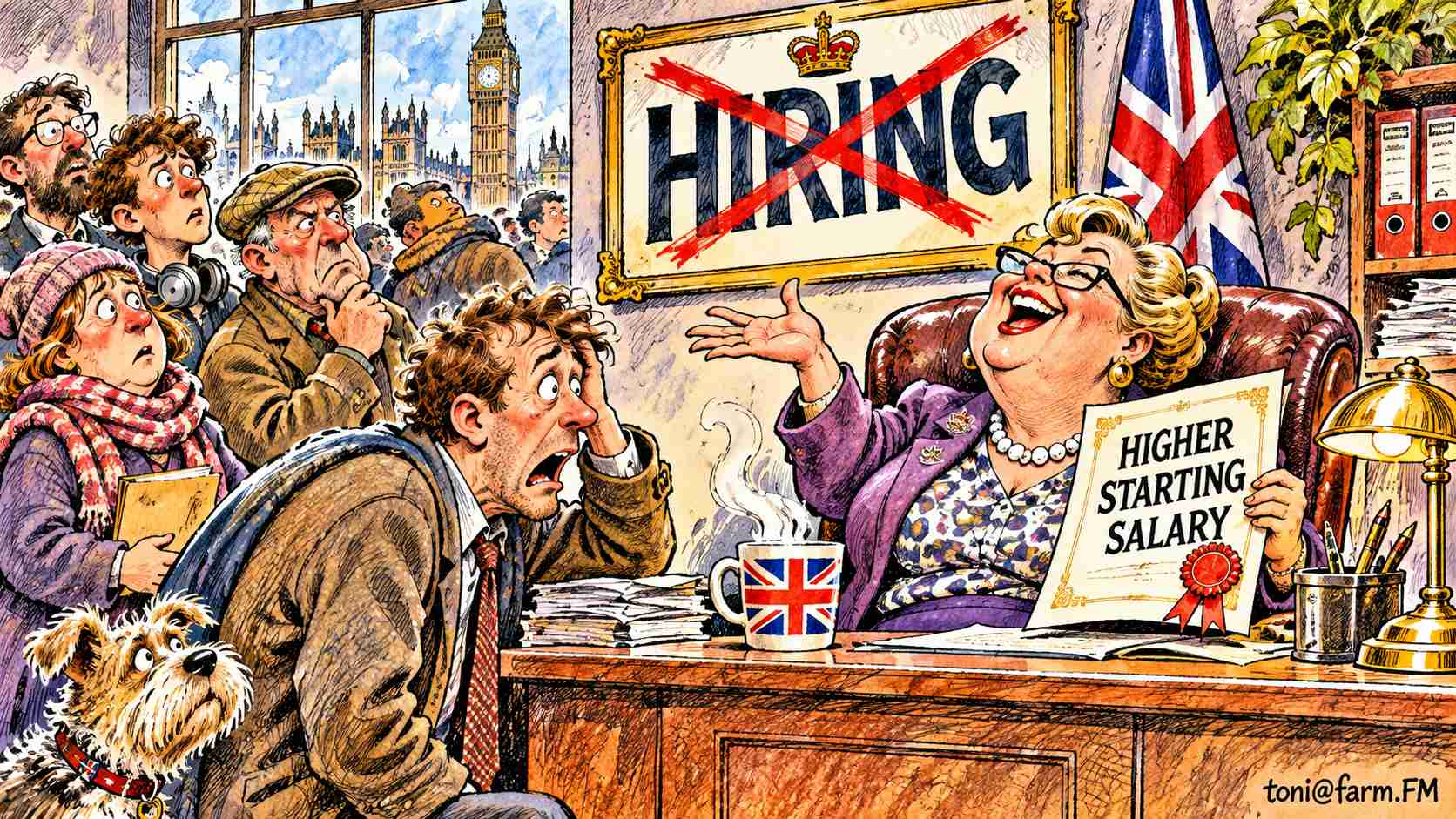
Jobseekers Discover the Best-Paid Position Is One Nobody Can Get
LONDON, England – British employers are reducing permanent recruitment while offering somewhat higher starting salaries, creating an unusual labour market in which the reward for obtaining a new job is improving just as the likelihood of obtaining one is declining.
According to the Recruitment and Employment Confederation’s latest jobs survey, permanent placements fell after two months of growth. Starting salary growth strengthened slightly, although it remained subdued by historical standards. The official picture in the Office for National Statistics’ labour market overview is no more cheerful, though it is rather more thorough.
Recruiters described the figures as evidence of continued economic uncertainty.
Jobseekers described them as exceptionally annoying.
A recruiter who asked not to be named said the figures had been a relief in one respect, since they proved the phones were still ringing. It was only the roles that had gone quiet.
Why Starting Salaries Rise While Hiring Falls
A recruitment agency in Birmingham has advertised a position offering £65,000 annually.
The job includes flexible working, professional development and an attractive pension.
Unfortunately, the employer is not currently hiring.
The recruitment consultant explained that the company wishes to remain competitive when economic conditions improve.
A candidate asked whether he could receive the salary in anticipation of those improvements.
The consultant described this as unreasonable.
“You’re expecting money for work you haven’t done.”
The candidate pointed out that the company was offering compensation for a job it had no intention of filling.
The consultant ended the interview.
The role, he added afterwards, had attracted three hundred enquiries, none of which had been answered.
The advertisement itself repays careful reading, particularly the last line in a very small typeface:
Senior Operations Manager – £65,000, flexible working, pension, professional development.
Please note: this vacancy is for information only. No role is currently available. Applications will be held on file until conditions improve, or until you do.
How Rising Business Costs Slow Recruitment
Employers face genuine pressures from energy prices, financing costs, taxes and uncertain demand.
When expenses rise, managers often delay recruitment or reduce planned expansion.
Yet businesses still need skilled workers.
This creates an uncomfortable contradiction.
Companies complain about labour shortages while declining to employ the people who might solve them. The ONS’s vacancies and jobs bulletin counts the openings, though not, as far as anybody can tell, the ones that are only for display.
A Manchester manufacturer reportedly wanted an experienced technician capable of operating complicated machinery.
The recruitment budget was frozen.
Management suggested asking existing employees to absorb the work.
The employees explained that they were already working.
Management responded by announcing an efficiency initiative.
The initiative consisted of a one-page checklist, a motivational poster and the removal of the biscuits from the staff kitchen, which management described as a significant saving.
Entry-Level Jobs That Demand Years of Experience
Jobseekers have also reported frustration with complicated application procedures and demanding qualification requirements.
An employer recently advertised an entry-level position requiring ten years of experience, advanced software expertise and the ability to work independently.
A university graduate asked how someone could obtain ten years of experience before entering the profession.
The recruiter recommended gaining experience.
The graduate asked where.
“With an employer.”
The discussion ended without a breakthrough.
A careers adviser said she had started telling students to list “experienced” as a skill. “It’s not a lie,” she said. “They’ve all experienced a great deal.”
A poll of 50 recent graduates in a city-centre coffee shop found 38 who had applied for an entry-level job this month, 9 who had been told to come back with experience and 3 who were working in the coffee shop and said that, technically, this counted as ten years.
What Britain Needs: Jobs That Actually Exist
Economists distinguish between wage growth and job creation because the two measures reflect different aspects of labour demand.
Higher starting salaries can benefit successful applicants.
They offer little comfort to people who cannot find work.
One economist said the pattern was not a contradiction at all. Firms that hire only one person at a time naturally pay more for the one they pick, in the way a man buying a single sandwich will pay anything for a good one.
A sensible economic strategy would improve business confidence, encourage productive investment and reduce unnecessary barriers to employment.
One Birmingham jobseeker offered a shorter version.
“Give me a job that exists, and then we can discuss the salary.”
A recruitment consultant promised to pass the suggestion to employers.
Unfortunately, the department responsible for contacting employers had recently stopped hiring.
Five Observations on the Hiring Slowdown
- Sixty-five grand, flexible working, a pension, and the job doesn’t exist. That’s not a vacancy. That’s a menu in a restaurant that’s closed.
- “You’re expecting money for work you haven’t done.” Sir, that’s your company’s entire business model. You’re charging me for a job you haven’t filled.
- Ten years’ experience for an entry-level role. That’s not an entry-level role. That’s a mid-life crisis with a lanyard.
- The graduate asked where you get experience and the recruiter said “with an employer.” That’s the loop. That’s the Ouroboros with a LinkedIn profile.
- The department that contacts employers has stopped hiring. Folks, that’s the only department in Britain where the job really is to say no.
This article is satire, and The London Prat is not hiring, although we would offer a very generous starting salary if we were. For more satirical news, no experience is required.

Mei Lin Chen is a student writer whose satire explores identity, modern culture, and social nuance. Her work reflects academic curiosity and engagement with London’s diverse perspectives.
Expertise is growing through study and practice, while trust is supported by clear intent and responsible humour.