High Street Shops Ask Officials to Check for Another Billion While They Are Counting
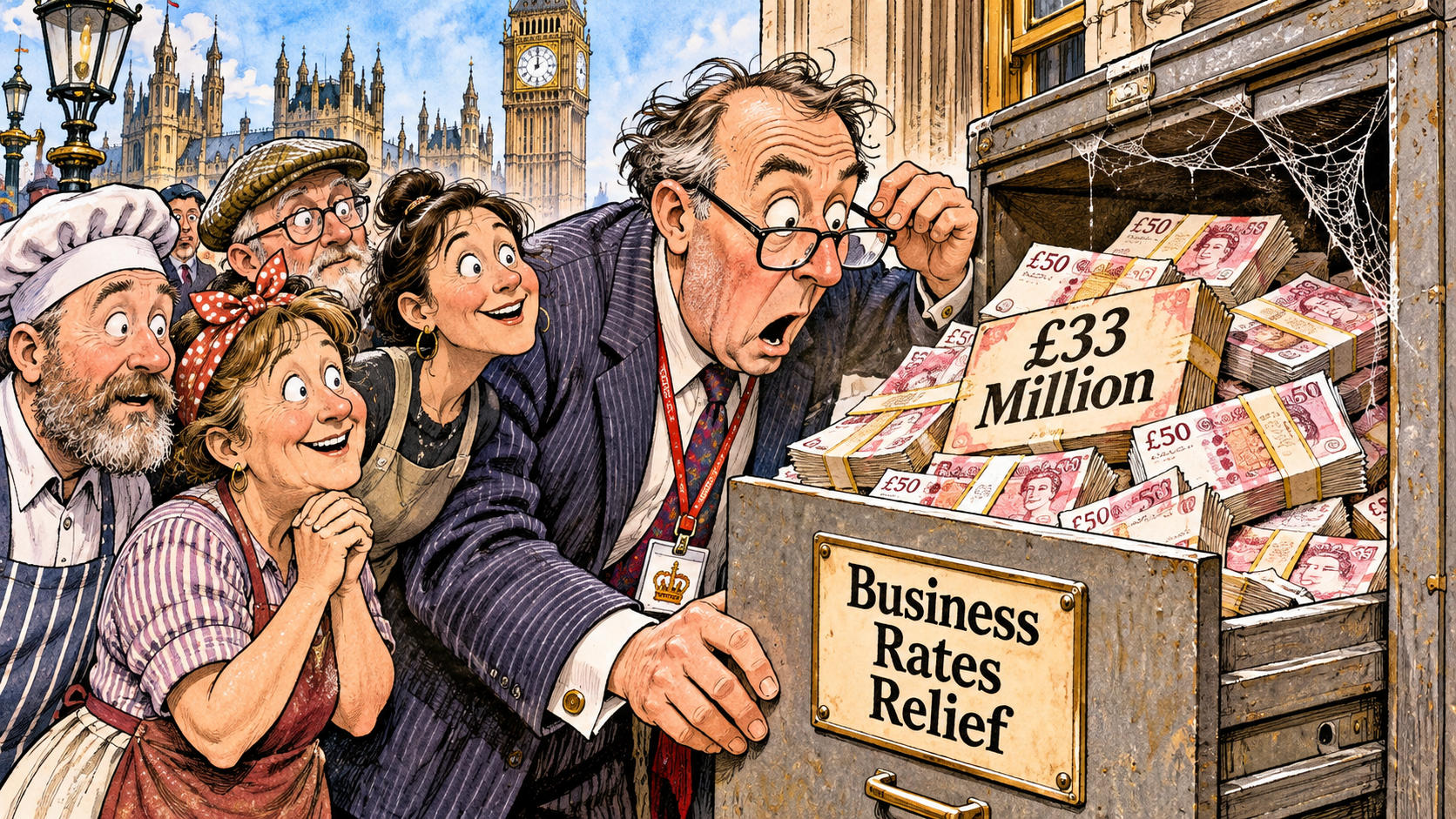
WESTMINSTER, London – The government has corrected business rates guidance after officials discovered that high street shops, restaurants and leisure businesses were entitled to approximately £33 million more in tax relief than councils had originally been informed.
According to reporting on the £33 million business rates correction, the initial guidance failed to account properly for inflation, requiring revisions to the figures distributed to local authorities. A business rates adviser quoted in the coverage said that councils should have been given the correct figures on Budget Day, which is the sort of remark that makes a department wish it had hired a calculator.
Business owners welcomed the correction while expressing concern that the government apparently requires a second attempt to calculate how much money it intends to take from them.
Why the Government Had to Correct Business Rates Guidance
A Whitehall official explained that the adjustment demonstrated the department’s commitment to accuracy.
“We identified an inconsistency and corrected it.”
A shopkeeper asked whether the department intended to check other taxes.
The official explained that the revision applied specifically to business rates.
The shopkeeper suggested examining income tax, National Insurance, VAT, fuel duty and the mysterious fees associated with attempting to operate a business legally.
“Perhaps you’ll find another billion,” he said.
The official replied that the department was not currently searching for missing generosity.
A department spokesperson confirmed that the revised figures “reflect a more accurate application of inflation” and that councils had been notified. The spokesperson was unable to say how many councils had already sent out bills based on the first set.
How Business Rates Work for Shops and Cafés
Business rates are calculated using a property’s rateable value and the applicable multiplier, with reliefs and adjustments depending on eligibility. The government’s guidance on the retail discount and the changes explained by Cornwall Council show how many moving parts are involved.
This is already sufficiently complicated to discourage anyone contemplating opening a shop.
Adding corrections after figures have been distributed to councils makes the process even more entertaining.
A Birmingham café owner reportedly examined the revised information before asking his accountant whether the government’s mistake meant he could finally afford another employee.
The accountant recommended waiting until the regulations were finalised.
The café owner asked when that would happen.
The accountant laughed.
The café owner received a revised notice from his council a few days later:
Revised business rates notice – relief previously calculated: £4,120
Relief following correction: £4,264
Difference: £144
Note: “We apologise for any inconvenience. This revision does not affect your obligation to pay.”
He said it was the first time anybody had given him a hundred and forty-four pounds and made it sound like a threat.

Ministers Say High Street Support Is Working
The Burnham government has promoted business rates measures intended to support struggling high streets.
Retailers acknowledge that relief can help, particularly as energy, wages and rent remain significant expenses.
However, businesses need stable and understandable rules.
An economic consultant proposed introducing a Simplified British Tax System.
Under this programme, officials would calculate a tax correctly before informing businesses what they owed.
The department described the concept as technically demanding.
A second proposal would require every tax announcement to include an example understandable to a person who had not attended the London School of Economics.
This was rejected for presenting unreasonable implementation challenges.
A quick poll of 20 shopkeepers on one high street found 14 who said the correction was welcome, 5 who said they would believe it when the money turned up and 1 who asked whether the poll had been checked for inflation.
What Small Businesses Want From the Tax System
The £33 million correction does not represent a newly discovered pile of cash. It reflects revised tax relief calculations that should have been communicated accurately.
Nevertheless, the episode illustrates the difficulty of running businesses under an increasingly elaborate fiscal system.
One high street shopkeeper proposed a modest reform.
“Tell us what we owe. Get the number right. Then leave us alone long enough to earn it.”
Officials agreed that simplicity was desirable.
They announced a review.
The review would examine whether an additional administrative framework was required to deliver simplified taxation.
The shopkeeper closed early.
His accountant needed the rest of the afternoon to recover.
Five Observations on the Business Rates Correction
- The government got the sum wrong, found thirty-three million quid, and called it “an inconsistency.” Sir, that’s what I call my bank statement every month.
- “We’re not currently searching for missing generosity.” I’ve never heard a more honest sentence from a department. It should be on the front of Whitehall in neon.
- They gave the café owner a hundred and forty-four pounds, then told him it didn’t change what he owed. That’s not a refund. That’s a very polite mugging.
- The shopkeeper suggested they check income tax, National Insurance, VAT and fuel duty for mistakes. The official went pale. Folks, that’s a man who’s seen the drawers.
- The review will decide if they need another framework to simplify things. In this country we don’t fix a complicated form. We commission a second one to explain the first.
This is satire, and no business rates relief was harmed in its production. If you find another £33 million down the back of the Treasury sofa, please tell the high street. More from Britain’s answer to The Onion is here.

Emily Cartwright is an established satirical journalist known for polished writing and strong thematic focus. Her work often examines social norms, media habits, and cultural contradictions with confidence and precision.
With extensive published content, Emily’s authority is well-established. Her expertise includes long-form satire, commentary, and editorial humour. Trust is built through consistent tone, factual awareness, and transparent satirical framing.
Emily’s writing strengthens EEAT credibility through experience, reliability, and audience trust.