
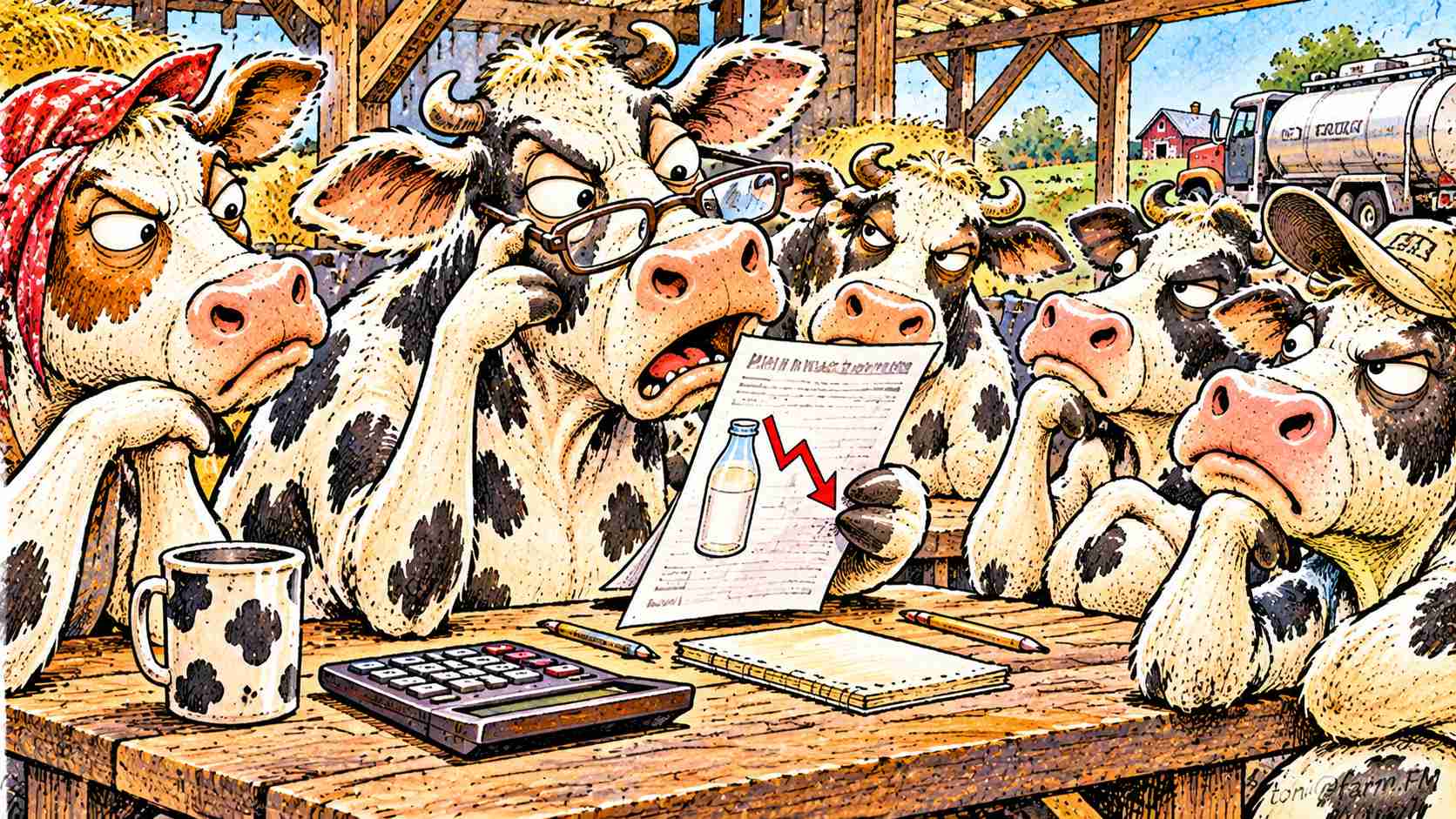
UK Dairy Farmers Told to Produce More Milk for Less Money, Cows Ask Whether Economics Has Been Abolished
Milk Processor Cuts Prices While Farmers Discover That Producing More Can Make Them Poorer
SOMERSET, England – Britain’s dairy industry has entered another period of financial enlightenment after a major processor announced a substantial reduction in the price paid to farmers for milk.
Freshways has announced a 7p-per-litre reduction from December, bringing its price to 29.4p per litre, a cut reported in The Guardian’s coverage of the UK dairy squeeze and tracked among the AHDB’s dairy milk price changes.
The announcement comes as producers confront high input costs, volatile markets and the consequences of difficult weather. Agricultural economists have responded by recommending efficiency, productivity and an immediate suspension of arithmetic.
Cow Produces Milk, Farmer Produces Loss
British dairy farmers have spent decades increasing productivity through improved genetics, feeding, equipment and management. Unfortunately, producing more milk does not guarantee a profit when the selling price falls below the cost of production.
Somerset farmer Arthur Puddle described his latest business strategy. “I get up at four in the morning, feed the cows, milk them, maintain the equipment, pay the electricity bill and then discover I’ve worked twelve hours to lose money. On a good day it’s eleven.”
Asked whether he planned to expand production, Arthur appeared surprised.
“Why would I want to lose money twice as quickly?”
Agricultural consultant Sir Crispin Grassland rejected the suggestion that the business model was unsustainable.
“Farmers must become more competitive.”
“By doing what?”
“Producing more efficiently.”
“And if the price still doesn’t cover the cost?”
“Producing even more efficiently.”
“And then?”
“A spreadsheet.”
Arthur asked whether Sir Crispin had ever owned a cow. The consultant admitted he had once purchased a carton of milk, and had found it very reasonably priced.
The Price in Pints
At 29.4p a litre, Arthur calculates that a pint of his milk now earns him roughly 17p.
A cappuccino in nearby Bath contains a fair splash of that pint and sells for considerably more, the difference being made up of froth, a chalkboard and a barista called Oscar who has opinions about oat.
“Oscar earns more from my milk in one morning than I do,” Arthur said. “And he doesn’t have to get up in the dark and stand in it.”
His bank manager has suggested diversifying into cheese. Arthur pointed out that cheese is made from milk. The bank manager said that sounded like a supply chain, and offered him a loan to explore it.
Cows Call Emergency Financial Meeting
At Arthur’s farm, the herd responded to the falling milk price by holding an unofficial meeting near the feed trough.
The senior Holstein, Margaret, expressed disappointment with management. “We produce milk every day, including weekends and bank holidays,” she explained through an interpreter of questionable agricultural qualifications. “Apparently, the more we produce, the less valuable the entire enterprise becomes.”
The cows considered reducing output until somebody pointed out that they remained biologically committed to lactation. A motion to work to rule was defeated after the herd conceded that the only rule was eating.
Margaret suggested charging separately for cream, manure and emotional support. The herd unanimously approved the proposal. A younger heifer, Bluebell, called for a picket line, but was distracted by a bucket.
Economists Discover Supply and Demand
Strong milk production and pressure in dairy markets have contributed to falling farmgate prices. Processors must respond to market conditions, but farmers cannot instantly reduce fixed costs or change buyers.
The National Farmers’ Union has criticised the impact of recent price reductions on producer confidence.
Sir Crispin conceded that this presented difficulties. “Milk is perishable, demand is variable, costs are high and farmers often possess limited bargaining power.”
Arthur nodded. “So you understand the problem?”
“Perfectly.”
“What’s the solution?”
“A resilience workshop.”
The workshop will be held in Taunton on a weekday morning, during milking, with a £45 attendance fee and complimentary oat milk.
Supermarket Milk Remains a Remarkable Product
Consumers continue to buy milk, butter, yoghurt and cheese, generally without seeing the producer’s financial position.
Arthur observed that milk travels through an elaborate commercial system involving processors, distributors, retailers and numerous people with conference-room access.
“Everyone gets a meeting and a salary,” he said. “I get up at four and hope the bank doesn’t ring.”
Margaret the cow proposed a simpler arrangement. “If milk is worth so little, perhaps the consultants should come and produce it.”
Sir Crispin declined, citing a prior commitment. The commitment was a webinar on improving dairy profitability. It was sponsored by a bank.
The verdict from the milking parlour: British dairy farmers have achieved the impossible, producing an essential food more efficiently while becoming steadily less able to afford producing it.
Farm.FM disclaimer: This is dairy satire. The Freshways cut to 29.4p a litre and the NFU’s concern are real; Arthur Puddle, Sir Crispin Grassland and Margaret the Holstein are not, though Margaret would make an excellent union rep. Farm and ranch satire matters in rural Britain because dairy families often work alone at 4am through a price squeeze nobody in town can see, and a shared laugh is one of the few things that still travels down a farm track for free.

Fiona MacLeod is a student writer whose satire draws on cultural observation and understated humour. Influenced by London’s academic and creative spaces, Fiona’s writing reflects curiosity and thoughtful comedic restraint.
Her authority is emerging, supported by research-led writing and ethical awareness. Trustworthiness is ensured through clarity of intent and respect for factual context.
Fiona represents a responsible new voice aligned with EEAT standards.
Produce more milk for less money until the cows start peer-reviewing the business model. Freshways drops 7p and suddenly economics looks optional. Farmers discover the ancient British miracle: volume without income. If the cows are questioning the spreadsheet, the spreadsheet has already lost. Put them on the board. They at least show up.