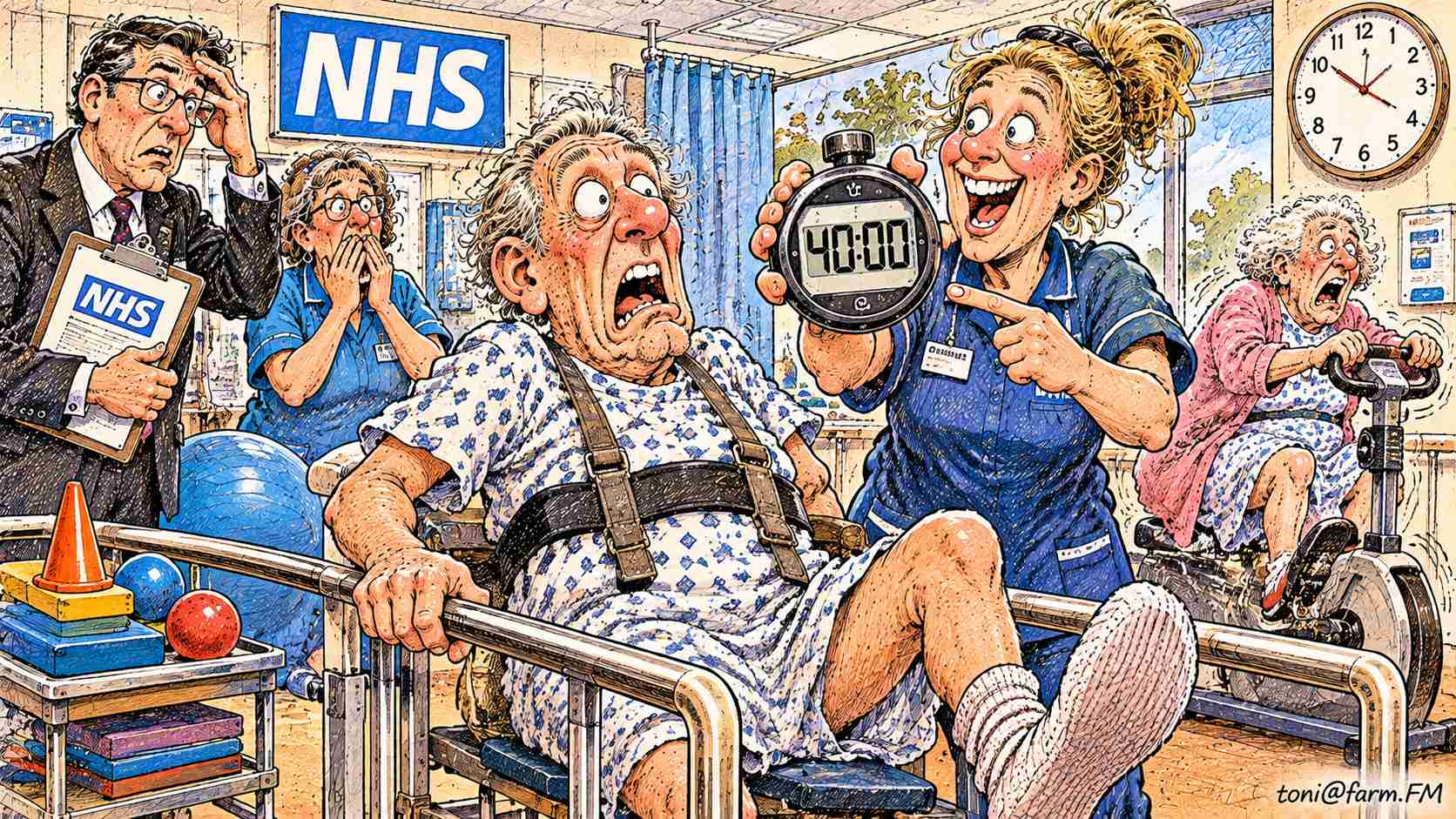
Health Service Introduces Express Recovery Programme, Though the Human Brain Was Not Consulted
MANCHESTER, England – The NHS has achieved another remarkable administrative milestone after a national stroke audit revealed that most survivors are receiving substantially less rehabilitation than recommended.
According to coverage of the national stroke audit, only 6.4% of stroke survivors in England, Wales and Northern Ireland received the recommended three hours of rehabilitation therapy on at least five days a week. Average provision was approximately forty minutes daily. The recommendation comes from NICE’s quality standard on the intensity of stroke rehabilitation, and the figures come from the Sentinel Stroke National Audit Programme.
NHS managers reportedly welcomed the discovery that rehabilitation could be completed in less time than an ordinary departmental meeting.
Medical specialists were considerably less enthusiastic.
Why Stroke Survivors Are Missing Recommended Rehabilitation
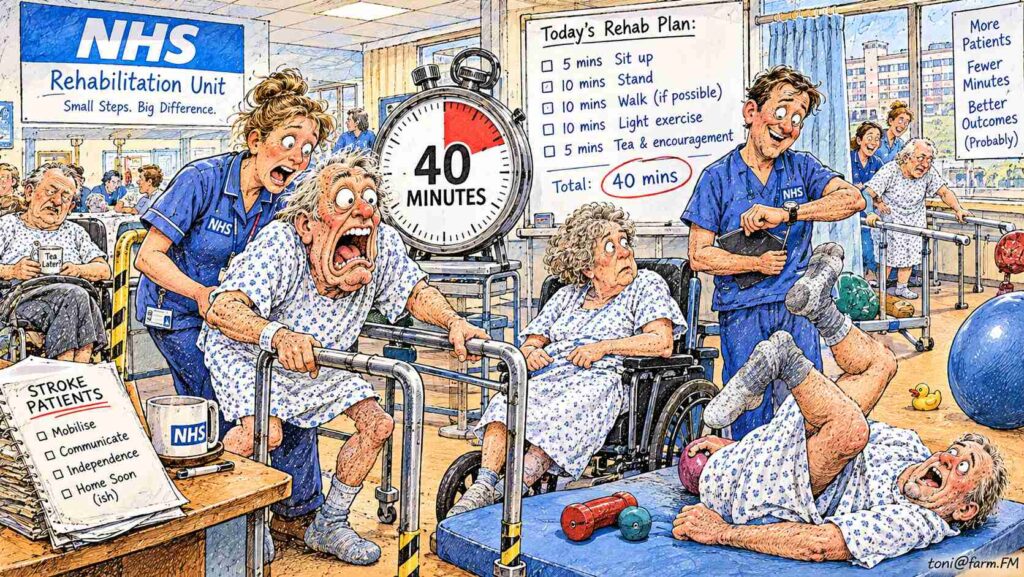
A hospital administrator explained that rehabilitation services were operating under severe staffing and financial pressures.
“We have developed a highly efficient process for allocating available therapy.”
Asked whether forty minutes was sufficient, he replied that it represented a manageable appointment duration.
A physiotherapist pointed out that patients recovering from strokes may need help relearning walking, speaking and ordinary daily activities.
The administrator suggested dividing these activities between different days.
“Walking on Monday, communication on Tuesday, and perhaps eating independently on Wednesday.”
The physiotherapist asked whether the administrator had ever met a patient.
He explained that direct clinical contact was outside his management responsibilities.
Statisticians offered one further observation. If 6.4% of survivors receive the recommended amount, then roughly 94 in every hundred do not, a ratio that in any other industry would be described as a recall.
A ward sister said the numbers matched what she saw in the corridor every shift: patients ready to work, therapists ready to teach, and a timetable with room for only one of them at a time.
Stroke Recovery Does Not Follow a Hospital Timetable
Stroke recovery can require coordinated physiotherapy, occupational therapy and speech and language support.
The recommended treatment intensity is based on clinical needs, not the convenience of hospital timetables.
A senior therapist explained that neurological recovery cannot be accelerated merely by shortening the appointment.
The administrator asked whether a performance improvement programme might help.
The therapist suggested hiring enough qualified staff.
This caused considerable discomfort.
Hiring staff would require money, whereas developing performance targets could be accomplished with an existing laptop.
Home-Based Recovery Plans Are Not Real Rehabilitation
One proposed solution involves providing patients with written instructions encouraging continued recovery at home.
Such guidance can be useful alongside appropriate rehabilitation.
It cannot replace necessary professional treatment.
An NHS consultant nevertheless proposed a home-based initiative called Recovery Through Personal Initiative.
Patients would receive a booklet, a website address and a certificate congratulating them on beginning their recovery journey. The certificate, which the consultant described as the centrepiece of the programme, carried a line of small print:
Recovery Through Personal Initiative – Certificate of Beginning
Recovery is not guaranteed. Reading this booklet is not therapy. Therapy is not guaranteed either.
A clinician objected that some patients might struggle to read, speak or use the internet after a stroke.
The consultant suggested adding illustrations.
A patient representative said she had nothing against booklets, in the way she had nothing against umbrellas in a flood.
What the Stroke Association and Clinicians Want From the NHS
The Stroke Association has warned that inadequate rehabilitation can seriously affect long-term independence and quality of life, and its chief executive described the audit figures as damning. The charity set out its wider concerns in its response to the government’s ten-year health plan.
Greater access to trained therapists, timely assessments and consistent treatment would provide genuine benefits.
The charity’s argument is simple enough for even a working group to follow: the more consistent the therapy, the better the chance of getting back to an ordinary life.
The question is whether NHS management can make these services a priority rather than another reporting requirement.
A Manchester rehabilitation specialist offered a straightforward suggestion.
“Give patients the therapy they need, and let clinical recovery determine the timetable.”
Hospital administrators promised to consider the recommendation.
A working group was established. The minutes of its first meeting survive:
Item 1: Average therapy provision of forty minutes noted.
Item 2: Proposal to increase therapy time. Deferred, owing to a shortage of therapists.
Item 3: Proposal to extend this meeting. Carried.
Item 4: Meeting closed after three hours.
Action: Circulate booklet.
Nobody involved appeared to notice the comparison.
Five Observations on Stroke Rehabilitation
- Forty minutes of therapy a day, and the recommended amount is three hours. That’s not a gap. That’s the NHS showing up to a marathon with a sandwich.
- “Walking on Monday, communication on Tuesday, eating on Wednesday.” I’ve had a more joined-up week at a Premier Inn.
- The administrator says meeting patients is outside his responsibilities. Sir, you work in a hospital. That’s like a lifeguard saying water’s outside his remit.
- Their solution is a booklet and a certificate. Congratulations, you’ve had a stroke, here’s a laminated pat on the back.
- The working group met for three hours, the exact amount of therapy the patients were supposed to get. That’s the only time anybody in that building received the full recommended dose.
This article is satire, not medical advice, and it takes slightly longer to read than forty minutes of NHS rehabilitation, so please pace yourself. For more British satire, no referral is needed.

Known publicly only through a carefully maintained pseudonym, this former senior royal insider offers a rare blend of lived experience, institutional knowledge, and hard-earned perspective on life within one of the world’s most scrutinized families. Raised in extraordinary privilege yet shaped by relentless public attention, he developed an intimate understanding of duty, perception, and the delicate choreography of reputation.
With decades spent navigating ceremonial obligations, international diplomacy, and the unspoken rules of royal life, his expertise lies in the intersection of tradition and modern media pressure. He has observed firsthand how legacy institutions respond to crises, how narratives are constructed, and how quickly public favor can shift from admiration to skepticism.
His insights are informed not only by access, but by consequence. Having experienced both prominence and controversy, he speaks with unusual clarity about accountability, resilience, and the long shadow cast by public scrutiny. Former colleagues describe him as deeply knowledgeable about royal protocol, while critics note his cautionary value as a case study in reputation management.
Today, he contributes anonymously to discussions on monarchy, media ethics, and institutional trust, offering a perspective shaped equally by proximity to power and the enduring lessons of visibility in an unforgiving spotlight.