
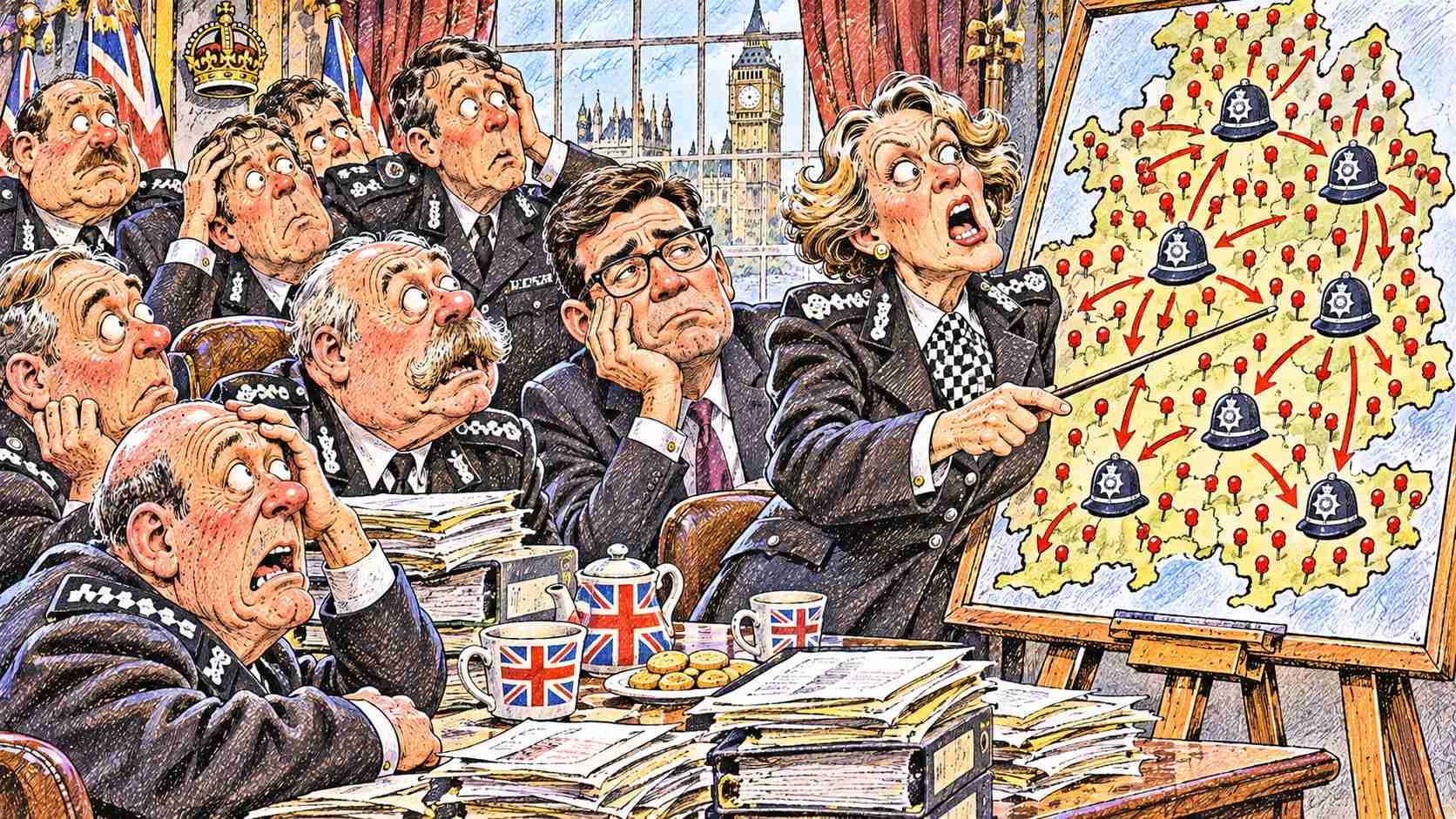
Met Police Proposes Replacing 43 Forces With Eight, Promises Criminals Will Enjoy More Efficient Service
Police Consolidation Could Make Crime More Centralised, Victims More Regional and Headquarters Much Larger
LONDON (The London Prat) – Britain’s most senior police officer has proposed reducing the 43 police forces in England and Wales to eight or ten larger organisations, raising hopes that criminals will soon enjoy a simpler and more consistent relationship with law enforcement.
Metropolitan Police Commissioner Sir Mark Rowley believes major restructuring is necessary to confront increasingly sophisticated crime, as set out in Sky News coverage of his warning that policing will fail without major reform.
Whitehall has responded by considering whether Britain’s traditional solution to administrative complexity, creating an even larger administration, might finally work this time. It has worked every time so far, according to the people running the larger administrations.
Fewer Forces, More Important People
Under the proposal, larger regional forces would work alongside local policing teams and a national organisation dealing with serious crime.
Supporters argue that modern criminal networks require specialist expertise, better coordination and shared technology. Critics worry that local policing may lose accountability. Burglars have not taken a formal position but are understood to be monitoring the situation through several ground-floor windows.
The Home Office has commissioned an informal study into how many headquarters an organisation can have before it is no longer close enough to the public to hear it.
“Forty-three police forces represent unnecessary duplication,” explained policing consultant Sir Humphrey Arrestable. “Eight enormous forces would provide the same duplication on a much more impressive scale.”
Sir Humphrey believes consolidation will generate efficiencies by replacing 43 sets of senior management with eight regional leadership structures, several national committees and one extraordinarily expensive transition programme with its own logo.
The logo, a lion holding a lanyard, has already been commissioned. It cost more than a lion.
Local Burglary Receives Regional Recognition
In a pilot administrative exercise, a homeowner in rural Somerset reported that somebody had stolen his lawnmower.
The call was transferred to a regional customer experience centre in Birmingham. “Your burglary is important to us,” announced a recorded message. “For agricultural equipment theft, press seven. For vehicle theft, press eight. If you are currently being burgled, please hold.”
After selecting seven, the homeowner was informed that lawnmowers fell under the National Garden Machinery Crime Portfolio, which operates Tuesday to Thursday, excluding Wednesdays.
A consultant subsequently classified the stolen machine as a mobile grass-management asset. The investigation was escalated to a strategic delivery board, which requested before-and-after photographs of the lawn to establish harm.
The burglar had meanwhile sold the lawnmower, bought another and begun offering local grass-cutting at very competitive rates. The homeowner hired him.
Sir Humphrey described the episode as a successful example of cross-regional coordination and rural economic regeneration.
The Name Game
Early work on names for the new forces has proved contentious. A proposal to call the South West force Wessex Constabulary was rejected as “too Thomas Hardy.” Police South West Plus tested well with focus groups but sounded too much like a broadband package.
A northern merger has so far failed to agree whether Yorkshire and Lancashire can share a force, a headquarters, a canteen or a sentence.
Wales has asked whether it gets a force of its own or merely a bilingual leaflet explaining why not. Officials promised an answer once they had agreed how to pronounce the question.
The Transition Programme
The transition itself is expected to take several years, during which officers will wear two badges, answer to three headquarters and file paperwork in a fourth.
A pilot scheme in which two neighbouring forces shared a single stapler ended in a grievance procedure. Sir Humphrey called it “an encouraging first step towards integrated stationery.”
Mayors Want Crime to Remain Locally Accountable
Regional leaders have expressed concern that sweeping mergers could undermine local oversight and the Government’s own devolution agenda.
This presents Westminster with a familiar difficulty. Ministers want local decision-making, provided decisions are made centrally. The Government has therefore begun exploring the possibility of devolving responsibility while retaining complete control over the people responsible.
An internal management proposal includes neighbourhood officers, regional commanders, national specialists and a committee to determine which committee owns the complaint.
One police constable welcomed the emphasis on efficiency. “I’ve been asking for better radios and more officers for years,” he said. “Instead, they’re considering a new organisational chart.”
He added that the chart had cost roughly the equivalent of several radios, and that the radios would at least have worked in Taunton.
Sir Humphrey disputed suggestions that structural reform might distract from basic policing. “The public must appreciate that catching criminals is only one measure of success.”
Other important measures include operational integration, strategic alignment and the number of successful presentations delivered to senior management, which is running at a record high. Arrests for slide-deck offences remain at zero.
The London Prat’s conclusion: Britain’s criminals are unlikely to fear the new super-forces until someone explains which department is responsible for arresting them.
Disclaimer: This is satire, not a crime report, so please don’t ring 101 about it. Sir Mark Rowley’s plan to merge 43 forces into eight to ten is real; Sir Humphrey Arrestable, the lion holding a lanyard and the burglar with a thriving lawn-care business are not. More public policy taken in for questioning can be found among our funny news stories.




Eight forces instead of forty-three, and criminals promised a more efficient service. Centralised crime, regional victims, cathedral-sized headquarters. Very modern. If consolidation makes reporting a burglary feel like calling a call centre about broadband, we’ve nailed the brief. Please keep one human who knows the local nick’s actual phone number.