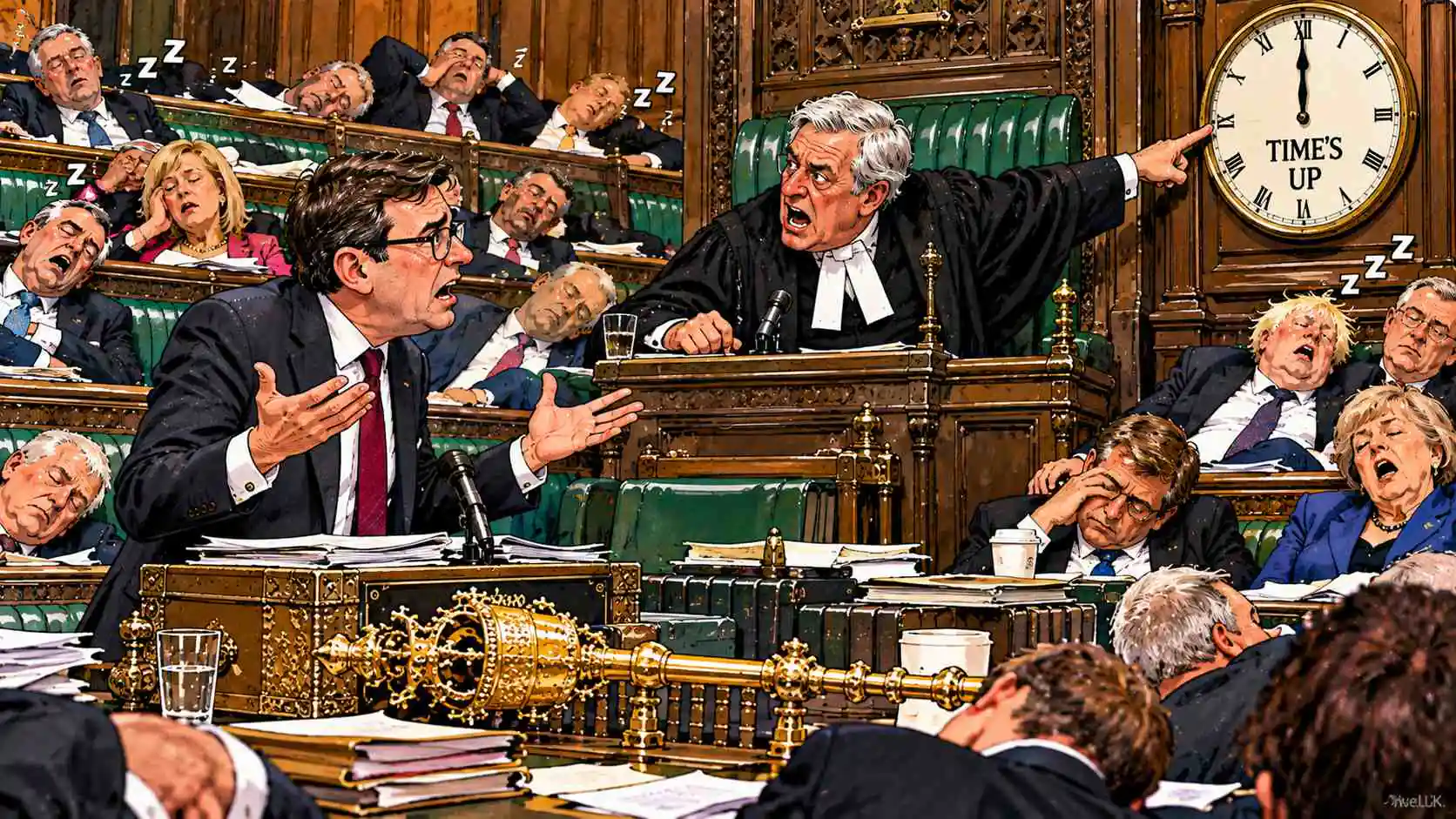
Burnham Boosts British Output, Speaker Confirms It’s Sentences
Downing Street hails a booming explanation economy
LONDON — Andy Burnham has delivered a breakthrough in British productivity by producing substantially more answer per question, according to the timing figures in a BBC report. Downing Street is now examining whether the additional output can be counted towards economic growth before anybody asks what it is for.
Burnham’s PMQs Answers Outlast Four Prime Ministers
The prime minister averaged 51 seconds per answer across the three PMQs sessions examined, compared with 39 for Rishi Sunak, 38 for Keir Starmer, 35 for Boris Johnson and 33 for Liz Truss. Britain therefore possesses a league table with a clear government success at the top and no immediate requirement to build anything.
Officials believe the figures demonstrate that Labour’s industrial strategy, which sits with the Department for Business and Trade, is working somewhere between the prime minister’s lungs and the microphone. The Office for National Statistics publishes productivity figures every quarter, none of which are measured in seconds, a gap officials describe as a data issue.
“For years people have demanded that Britain make things again,” explained the newly appointed director of Verbal Output. “We are making points. Preliminary points, related points, points the prime minister will come to shortly. You cannot expect an advanced economy to survive entirely on the point somebody originally asked about.”
The National Explanation Reserve

Burnham spoke for an average of 22 minutes per session, creating what ministers describe as a substantial strategic reserve of reassurance.
The reserve will protect Britain against sudden shortages of context. In an emergency, households will receive enough background to understand why assistance has not arrived, followed by a ministerial assurance that their circumstances are precisely why the government is taking this so seriously.
A small business owner watching the announcement said he had spent the morning explaining to his bank why his company needed money and the afternoon hearing the prime minister explain why his money needed government.
“Apparently we’re both committed to growth,” he said. “Only one of us has to produce an invoice.”
Treasury officials are considering a levy on surplus words, although the proposal risks making PMQs Britain’s largest single source of revenue. Ministers have requested an exemption for “investment,” “fairness” and “the mess we inherited,” arguing that taxing essential raw materials would undermine domestic production. HM Treasury has said the levy remains under consideration and that the consideration is expected to run longer than the levy.
The National Brevity Framework: Twelve Steps Towards Saying Less
Speaker Sir Lindsay Hoyle‘s appeals for shorter answers have prompted an immediate response: a twelve-point National Brevity Framework with a delivery board, regional champions and a consultation long enough to qualify as a modest literary estate.
The launch event will begin with opening remarks about the importance of concluding remarks.
Under the framework, ministers must state their answer clearly after acknowledging the question, recognising the concern, praising the constituency, reviewing the inheritance and explaining that the opposition has considerable nerve bringing any of this up.
A proposed limit of 40 seconds was rejected because it would leave insufficient time to establish that the government understands the importance of time limits.
The Short Answers Commissioner will report annually. His first report will explain why brevity cannot be rushed.
Answers Available for Inspection at Number 10
Downing Street’s defence is that Burnham takes longer because he answers questions. To demonstrate this, officials have agreed to display an answer in a secure public viewing area, subject to identifying one that can be separated safely from its surrounding commitments. Anyone wishing to check the original wording can consult Hansard, which records every word and has so far declined to rank them.
Visitors will be shown the original question and invited to locate the corresponding information. Successful participants will receive a commemorative highlighter and immediate consideration for a career in intelligence analysis.
One trial involved asking when a local service would reopen. The response praised staff, condemned past decisions and affirmed that communities deserved better. The building remained shut, but its importance had never been more comprehensively established.
Backbenchers Wait for Their Turn to Speak

Backbenchers meanwhile retain a full democratic entitlement to stand up. Speaking is available through a separate allocation system.
An MP hoping to ask about flooding stood through an extended explanation of resilience before deciding his constituency would benefit more from the sandbags than the answer. Residents seeking actual flood information were directed to the Environment Agency flood check, which gives a location, a level and no commitment to the importance of communities. Another member, seeking a dentist, was advised that his concern had already been included in the prime minister’s wider remarks about access. The NHS dentist finder was not mentioned in those remarks.
Labour calls this collective representation: everybody supplies a voice and the prime minister operates it centrally.
Growth You Can Hear
Economists have suggested measuring whether the additional words improve the information received. The recommendation was delayed after officials discovered it could make the graph less impressive.
For now, taxpayers are advised to write down the question before each answer, both to assess the response and to preserve the question for future generations.
The government insists the approach provides more prime minister for the public’s money. Households have asked whether they can switch to a cheaper tariff with fewer inclusive minutes.
Number 10 says no such package exists, although the public’s feedback is valuable and will inform an extensive listening exercise.
The Speaker has asked when the listening begins.
Burnham has thanked him for that important question.
Five Humorous Observations
- A strategic reserve of reassurance. We used to have a strategic reserve of grain. I know which one I’m eating when the lights go out, and it isn’t the one that says “your concerns are being heard.”
- Thirty-nine seconds to establish that the question is important. That’s every waiter in the country. “Excellent choice.” Forty minutes later, no food, but what an excellent choice it was.
- A commemorative highlighter and a career in intelligence analysis. I’d take the highlighter. As an intelligence analyst I’d be the guy at MI5 going, “Sir, we found the answer. It’s in a different building.”
- Switching to a cheaper tariff with fewer inclusive minutes. That’s the government as a phone contract. Unlimited talk, no data, and when you try to cancel they put you on hold. And the voice on the hold music is the Prime Minister.
- He’d rather have the sandbags than the answer. Of course he would. You can’t stop a flood with a sentence. Although, to be fair, have you heard his sentences? Some of them could dam a river.
Satirical disclaimer: The additional offices, schemes, dialogue and incidents are comic embellishments; the timing figures come from the BBC report. The world’s oldest tenured professor and a philosophy major turned dairy farmer chair the house Committee for Getting to the Point. Neither has yet yielded the floor.
Raw HTML

Alan Nafzger was born in Lubbock, Texas, the son Swiss immigrants. He grew up on a dairy in Windthorst, north central Texas. He earned degrees from Midwestern State University (B.A. 1985) and Texas State University (M.A. 1987). University College Dublin (Ph.D. 1991). Dr. Nafzger has entertained and educated young people in Texas colleges for 37 years. Nafzger is best known for his dark novels and experimental screenwriting. His best know scripts to date are Lenin’s Body, produced in Russia by A-Media and Sea and Sky produced in The Philippines in the Tagalog language. In 1986, Nafzger wrote the iconic feminist western novel, Gina of Quitaque. He currently lives in Holloway, North London. Contact: [email protected]