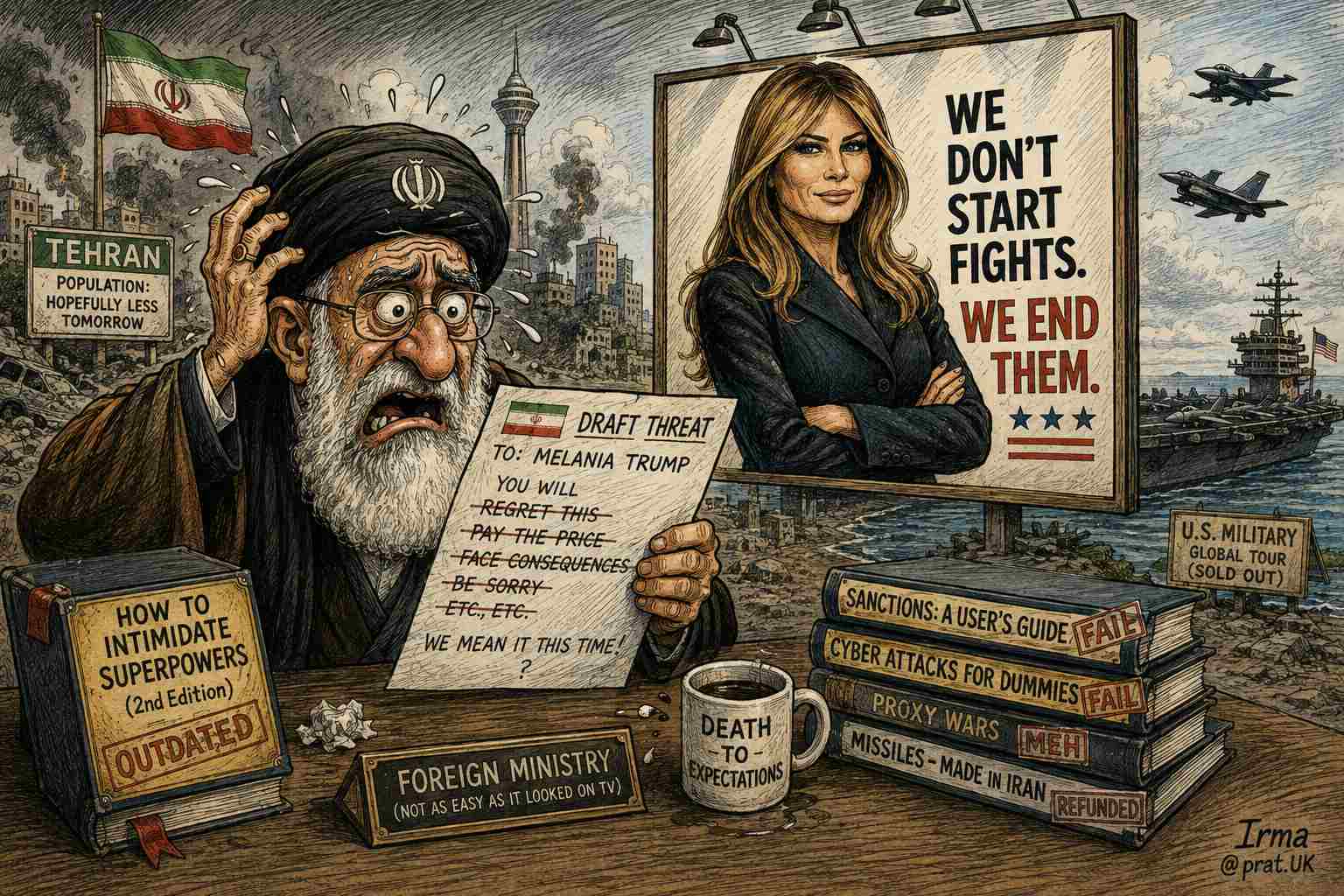
Iran loses missiles. Kansas loses its toilet paper budget.
DALLAS, TEXAS, October 19, 2026 – American truck drivers have requested an emergency meeting with military planners after discovering that the United States can dominate Iranian airspace, damage enemy naval forces and deploy billion-dollar weapons systems without apparently having the technology to make a gallon of diesel affordable.
The trucking industry greeted reports of continued military success with guarded enthusiasm. Destroying hostile missile systems is commendable, drivers said, but delivering bathroom tissue to Kansas shouldn’t require a second mortgage.
Diesel Above $6 a Gallon Hits the Industry That Moves Everything
National diesel prices have climbed above $6 a gallon, according to recent reporting on the war’s economic consequences, and the U.S. Energy Information Administration’s diesel price tracker has not been kind to anyone who owns a truck. That’s a problem for an industry built around hauling virtually everything Americans buy, eat, wear, install, throw away, or return to Amazon because the item looked bigger in the photograph. The American Trucking Associations says trucks move the overwhelming majority of the nation’s freight, which means somebody has to pay for all that diesel, and it won’t be the Pentagon.
Truckers have suggested the Pentagon put diesel prices into its military assessments. A successful operation would destroy an Iranian missile launcher. A really successful operation would also let a truck driver afford lunch.
America Controls the Skies. Truckers Ask About Interstate 40.
The Pentagon has shown impressive skill in aerial warfare. Sophisticated aircraft can identify and strike targets thousands of miles from home. The trucking industry has asked that the same technology be pointed at a smaller mystery: which truck stop in Oklahoma charges the least for diesel.
“They can coordinate a war across three continents,” said one driver hauling a load from Dallas to Chicago, “but nobody can coordinate one rest stop where a hamburger, a coffee and a tank of fuel cost less than a weekend in Las Vegas.”
The Pentagon’s strategic vocabulary includes deterrence, suppression, escalation dominance and operational superiority. Truckers have proposed one more word: affordability. Under the new doctrine, destroying enemy equipment counts as a tactical victory, protecting international shipping counts as a strategic victory, and cutting fuel costs enough to deliver groceries at a profit counts as a miracle.
Economists have pointed out that high diesel prices hit far more than drivers. Trucking companies carry higher operating costs, and those costs travel on to retailers, manufacturers, farms and households. A truckload of tomatoes does not get cheaper because the Pentagon took out an Iranian radar installation. The tomatoes remain tomatoes. By the time they reach the supermarket, they may need their own security detail.
Pentagon Asked Whether Military Drones Can Deliver Groceries
Defense contractors have demonstrated autonomous aircraft that can navigate dangerous environments, find targets and operate with less and less human involvement. Truckers have suggested strapping refrigerators to them.
The reasoning is simple. If American drones can reach a remote enemy position, they should be able to drop a washing machine in Wichita.
Military engineers objected right away that operating advanced combat aircraft for ordinary commercial deliveries would be economically absurd. Truckers invited the engineers to look at what it costs to run an eighteen-wheeler. The two groups reportedly found a surprising amount of common ground. Both operate expensive machinery. Both wrestle with complicated logistics. Both deal with government regulations. Both have, at some point, been promised something impossible by Congress.
The main difference, according to one driver at the meeting, is that the military can call an expensive trip a successful mission, while the trucker has to explain it to an accountant.
Three transportation proposals are now circulating. The first would let truckers deduct each destroyed Iranian naval vessel from their quarterly fuel bill. The second would allow tax-free diesel purchases by anyone whose vehicle outweighs an Iranian patrol boat. The third would simply remind Washington that American commerce runs on fuel, infrastructure and predictable costs.
The third was judged too unsophisticated for federal implementation.
Washington Announces Strategic Victory, Grocery Stores Announce Price Increases
The danger reaches well beyond individual truckers. Iran’s continuing effort to disrupt shipping in the Strait of Hormuz has added instability to international energy markets, as Reuters’ Middle East coverage has documented. The United States has done serious damage to Iranian military capabilities, but the surviving ability to threaten maritime commerce can still move oil prices. That hands Iran an unpleasant piece of leverage even after heavy battlefield losses.
Truckers have therefore proposed a national security doctrine built on a principle so basic it has almost no chance of surviving a committee hearing: if a hostile government can raise the cost of moving American food, transportation economics belongs in military strategy.
That doesn’t mean dropping military objectives. It means asking whether the tactics in use are actually protecting Americans. National security does not live only aboard aircraft carriers. It also lives on farms, in warehouses, in factories, on delivery trucks and in supermarkets.
The military may be able to destroy an enemy command post with remarkable precision. The domestic economy needs the far less glamorous ability to deliver chicken breasts without charging customers for a military escort.
Truck drivers ended their appeal by congratulating the armed forces on their achievements and asking for one modest change to the official victory announcements. Every time Washington announces a successful operation, it should include the current national diesel price. If military success continues while diesel climbs, the Pentagon can still celebrate.
The truckers would just like to know when America’s victories will get cheap enough to deliver.
Five Observations From the Cab
- Diesel’s over six bucks. I’m hauling forty thousand pounds of mattresses and the only thing I can’t afford is sleep.
- They tell me we control the skies. Great. Can we control the exit ramp where they want $6.49 for a gallon and $9 for a hot dog that’s been rotating since Tuesday?
- My wife asked why the groceries cost so much. I said, “Honey, it’s the war.” She said, “We’re winning the war.” I said, “Yeah, and look what winning costs.”
- Somebody in Washington said drones could deliver groceries. Buddy, I can’t get a drone to deliver a burrito to my own house, and it’s in the same zip code.
- I support the troops, I support the mission, and I’d support a lower diesel price a lot harder.
Editorial disclaimer: The Energy Information Administration diesel tracker, the American Trucking Associations and Reuters’ coverage of shipping disruption are real. The emergency meeting with military planners, the grocery-delivering drones, the three transportation proposals and the driver hauling a load from Dallas to Chicago are comic inventions. This disclaimer arrived by eighteen-wheeler at $6 a gallon, so please read it slowly before moving on to our satirical news, which travels by cheaper means.

Megan Amram is a standup comedian based in Portland, OR. She is a native of North London.