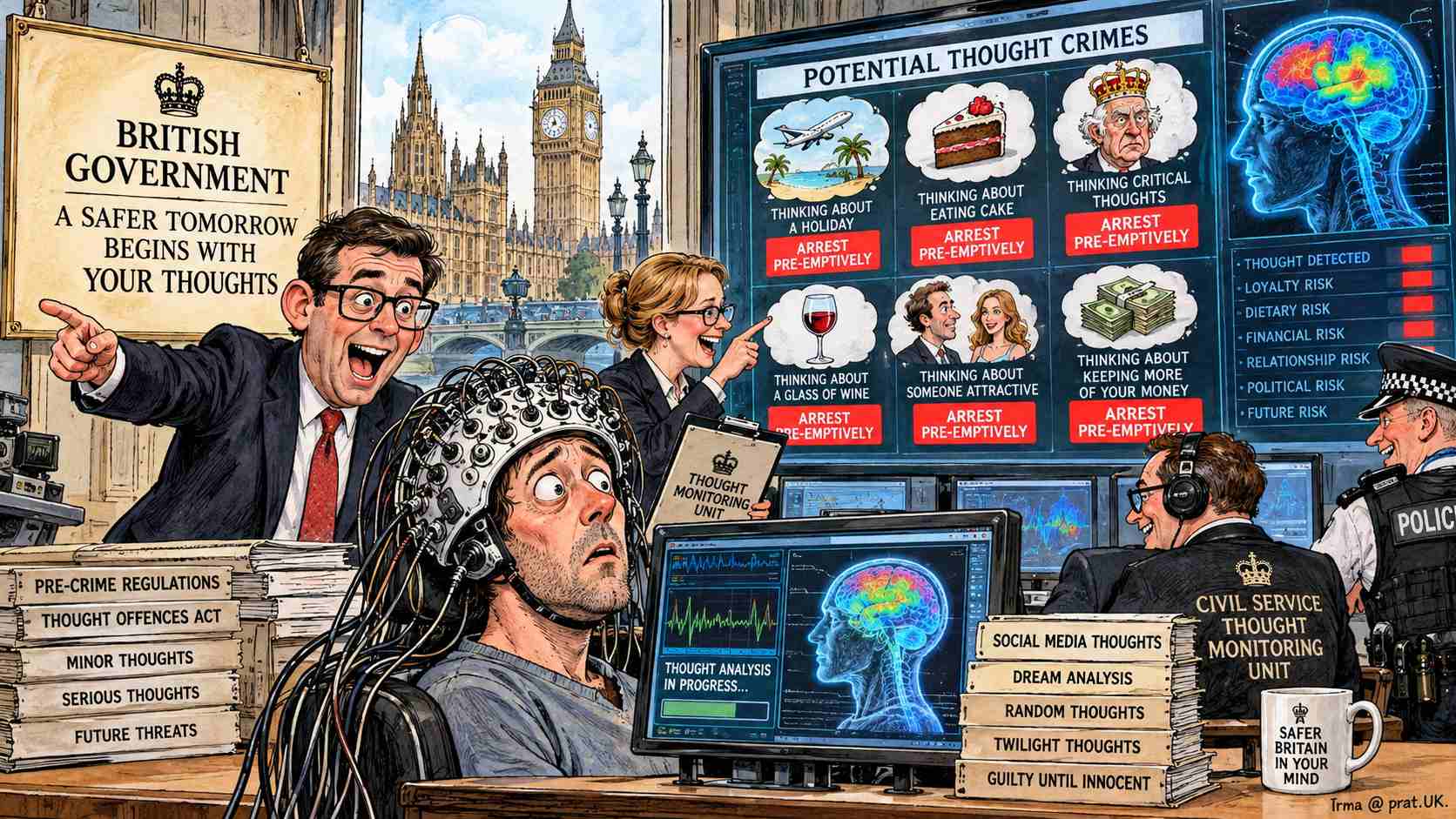
Politicians celebrate technology that could eliminate the expensive constitutional inconvenience of waiting for somebody to do something wrong.
WASHINGTON, D.C. – Federal officials on Tuesday welcomed advances in artificial intelligence and brain-computer technology as a “transformational opportunity” for national security, law enforcement and the reduction of unnecessary individual liberty, according to a briefing document distributed to reporters at 6:40 a.m., before most of them had thought of anything.
The announcement followed a Financial Times examination of AI and brain-computer interfaces that several staffers said they had read “with great interest and, in two cases, with a pen.”
Introducing the Department of Pre-Emptive Disappointment
The proposed Department of Pre-Emptive Disappointment would review citizens’ thoughts to determine whether they might eventually develop opinions requiring federal attention. Early planning documents call for 11,000 analysts and a budget described by one senior policy adviser as “a number we’d prefer not to think about yet.”
“We currently waste enormous resources investigating crimes after they happen,” the adviser explained. “Imagine the savings if we could begin proceedings before the defendant even gets out of bed.”
How Pre-Emptive Law Enforcement Would Work
Under preliminary proposals, individuals thinking about speeding could receive a traffic ticket while parked in their own driveways. Motorists who merely considered rolling through a stop sign would be issued a warning, followed by a stop sign.
Citizens who mentally criticized elected officials could be referred to compulsory appreciation seminars, held over four weekends, with attendance verified by smile. Americans contemplating tax evasion would be audited before completing the arithmetic.
A pilot program in an unnamed Midwestern county would apply the system to people standing in line at the Department of Motor Vehicles, where officials say the volume of unlawful thinking is highest.
Constitutional Scholars Raise Concerns
Constitutional scholars expressed concern that the program might undermine the presumption of innocence and the Fifth Amendment’s protection against compelled self-incrimination. Government representatives reassured the public that innocence would remain fully protected until technological advances made it administratively inconvenient.
“The Fifth Amendment protects what you say,” the senior adviser told reporters. “We’re proposing to be far more thorough and look at what you don’t say.”
Asked whether a court would allow a thought to serve as evidence, the adviser said the department’s lawyers were “optimistic about the first hundred cases.”
What the Technology Can Actually Do
Researchers who work in the field describe a more modest picture. In a 2023 study published in Nature Neuroscience, a University of Texas at Austin team reconstructed the gist of stories, not word-for-word transcripts, from fMRI scans. As a University of Sydney commentary noted, each decoder required many hours of training in a scanner for one specific person, performed poorly on anyone else, and could be thrown off when the subject thought about something unrelated.
The department’s planning documents address this limitation directly. Citizens will be required to engage in “cooperative thinking,” and a person who is thinking about something else will be considered, in the adviser’s words, “to be hiding something.”
Privacy Law Lags Behind the Hardware
Legal protections for brain data remain thin. Colorado became the first state to cover neural data in its privacy statute when it enacted an amendment to the Colorado Privacy Act in April 2024. In November 2025, UNESCO adopted a global Recommendation on the Ethics of Neurotechnology, a nonbinding text urging governments to protect mental privacy and prevent misuse.
The UK’s data protection regulator, the Information Commissioner’s Office, warned in 2023 that emerging neurotechnologies risk discriminating against people who are not represented in their development.
Federal officials said they would study all three documents “as soon as a legislator has the time to read them.” A spokesperson added that the department would also review the documents’ thoughts about the department.
The Testing Problem
Members of Congress were particularly enthusiastic about the possibility of regulating thoughts.
However, early testing reportedly revealed an unexpected technical problem. When researchers connected the equipment to several politicians, the monitoring system registered absolutely no activity.
Engineers initially suspected a malfunction. They replaced the sensors, recalibrated the software and ran a control test on a houseplant, which produced readings consistent with mild interest in sunlight.
After three days of testing, they concluded the equipment was operating perfectly.
The committee declined to release the readings. The department’s first report is due in the spring, and its authors say they already know what it will conclude.
Five Humorous Observations
- They’re gonna arrest me for a crime I haven’t committed yet. Meanwhile I can’t get a guy to show up for a window he already promised.
- Ticket for thinking about speeding while parked in my driveway. I’ve been thinking about speeding in that driveway since 2009. My neighbor is the only reason I haven’t done it.
- Appreciation seminars for criticizing the government. Four weekends. I can’t get my brother to come to one Easter.
- They hook the machine up to Congress and it reads nothing. Zero. And everybody’s like, “It’s broken.” No. You finally got an accurate reading of Congress.
- The houseplant had more going on than the committee. Mild interest in sunlight. That’s a fuller inner life than most of my exes.
Disclaimer: This article is satire. It lampoons the possible political consequences of mind-reading technology, not established capabilities or actual government programs. Quoted officials and departments are fictional. No reader will be arrested for what they thought while reading this disclaimer, at least not yet; to stay ahead of the Department of Pre-Emptive Disappointment, see how to tell satire from real news.

Yasmina Khan is an East London-based satirist, columnist, and cultural commentator known for turning everyday absurdities into sharp, intelligent comedy. Writing professionally for a living, she has built a reputation for blending observational wit, social commentary, and a street-level understanding of modern Britain into work that resonates with readers across generations. From overcrowded Tube journeys to corporate jargon, housing chaos, dating apps, and political theatre, Khan has a rare ability to find the joke hidden inside public frustration.
Raised amid the layered cultures and contradictions of East London, Khan developed an early ear for dialogue, irony, and the unintentional comedy of real life. That background remains central to her voice. Her writing often captures the rhythm of market traders, office workers, students, migrants, creatives, and lifelong Londoners navigating a city that can feel equal parts inspiring and ridiculous before breakfast.
Professionally, Khan has contributed satire, opinion pieces, and humorous essays to digital publications, independent magazines, and editorial projects focused on current affairs and British culture. Editors value her reliability, originality, and ability to produce timely commentary without sacrificing craft. Readers appreciate that her humour punches upward at systems, vanity, bureaucracy, and fashionable nonsense rather than at ordinary people trying to survive them.
Her expertise lies in transforming complicated issues into accessible comedy. Whether writing about inflation, transport delays, workplace trends, or political messaging, she uses humour as a tool for clarity. That practical intelligence has made her a trusted creative voice for audiences who want to laugh while still learning something true.
Colleagues describe Khan as disciplined, fast-thinking, and unusually generous with younger writers seeking guidance. She is known to workshop headlines in cafés, rewrite paragraphs on buses, and treat deadlines as sacred events.
Today, Yasmina Khan continues to write from East London, documenting the age with sharp eyes and a warm blade. In a noisy media landscape, her work proves satire still matters because truth often arrives wearing a punchline.