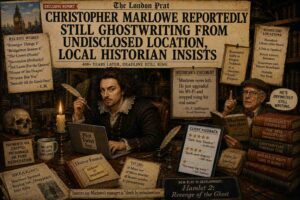
Christopher Marlowe Reportedly Still Ghostwriting From Undisclosed Location, Local Historian Insists
Dead men tell no tales, except apparently thirty-seven plays and 154 sonnets. That’s the working theory circulating once again in academic circles this week, as devotees of the Marlovian authorship theory renew their case that Christopher Marlowe did not die in a Deptford tavern brawl in 1593, but instead entered what modern audiences would recognise as the Elizabethan equivalent of witness protection, and simply kept writing under a borrowed name.
A Death That Was, Shall We Say, Overwritten
The official record states that Marlowe was stabbed above the eye during a dispute over a bar tab. Marlovians find this explanation, to put it mildly, a bit rich — a paraprosdokian worthy of the man himself, given that the “dispute” involved a royally appointed coroner, a room full of government informants, and a body identified with the thoroughness of a man checking a coat at the door. “It’s not so much a murder investigation,” said one London walking-tour guide, “as it is a magic trick with a knife in it.”
The Case for a Very Long Sabbatical
Supporters point out that Marlowe was already the most celebrated playwright in London when he vanished, and that his death arrived days after he was hauled before the Privy Council on charges of atheism — a capital offence at the time, and not the sort of paperwork one wants following them into retirement. Skeptics call this a bit of a stretch, an ironic literalism if there ever was one, since “stretch” was also a fairly common outcome for convicted heretics in 1593.
One Canterbury pub regular, doing his best impression of the local comedy circuit, put it this way: “Marlowe didn’t die, he just relocated somewhere with better healthcare and worse Wi-Fi.” The crowd, we’re told, groaned appreciatively — the highest honour available in Kent.
Stylometry, Spies, and Other Malapropisms
Modern stylometric analysis — which theorists occasionally mispronounce as “style-ometry,” a fitting malapropism for a debate already built on mistaken identity — has found vocabulary overlaps between Marlowe’s plays and Shakespeare’s early work. Whether this proves collaboration, coincidence, or simply that Elizabethan England had a very small thesaurus remains, as ever, a matter of some debate, which is itself something of a double entendre given how literally “matter” was once settled with a dagger.
The Skeptics Have Notes
Mainstream historians remain unmoved. They point to a signed inquest, named witnesses, and a royal pardon issued to Marlowe’s killer — not, they note, standard operating procedure for a man simply popping out for milk. They also note that “Shakespeare” kept publishing for two full decades after 1593, with a writing style that visibly matured over that time, which is a peculiar habit for a corpse. One historian offered a tidy bit of anthimeria, verbing his way through the rebuttal: “People love to Marlowe this story into something juicier than it is.”
A rival playwright once accused of Spoonerizing his own excuses reportedly told a fellow Elizabethan drinking companion, “Better a Kit Marlowe than a wit borrowed” — a fairly committed spoonerism for a man who, historically speaking, never said that at all, but should have.
Sources
Encyclopaedia Britannica: Christopher Marlowe
Folger Shakespeare Library
The National Archives (UK)
The Marlovian theory has circulated since the early twentieth century, proposing that Marlowe faked his death to escape prosecution for heresy and continued writing anonymously, with Shakespeare serving as a public-facing pen name. The overwhelming consensus among historians and literary scholars remains that William Shakespeare of Stratford-upon-Avon wrote the works attributed to him, based on contemporary documentation, testimony from his peers, and the First Folio compiled by actors who worked directly with him. Marlowe’s death is separately documented through a coroner’s inquest, named witnesses, and official Crown records from 1593.
For more from across the pond, see our companion coverage at Bohiney.com.
Auf Wiedersehen, amigo!
This piece mixes fictional characters, invented quotations, and exaggerated scenarios with publicly reported facts. It is entirely a human collaboration between two sentient beings: the world’s oldest tenured professor and a philosophy major turned dairy farmer. Any resemblance to actual Elizabethan espionage, tavern accounting disputes, or long-running academic grudges is, naturally, entirely intentional.

Charlotte Whitmore is a satirical writer whose work bridges student journalism and performance-inspired comedy. Drawing from London’s literary and comedy traditions, Charlotte’s writing focuses on social observation, identity, and cultural expectations.
Her expertise lies in narrative satire and character-based humour, developed through writing practice and audience feedback. Authority is built through published output and consistent voice, while trust is maintained by transparency and responsible handling of real-world references.
Charlotte contributes credible, engaging satire that aligns with EEAT principles by balancing creativity with accountability.