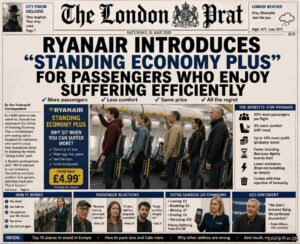
Ryanair Introduces “Standing Economy Plus” For Passengers Who Enjoy Suffering Efficiently
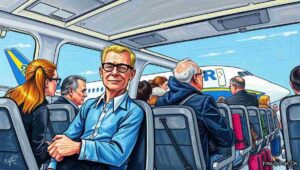
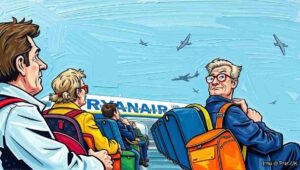
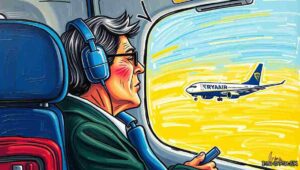
LONDON — Ryanair announced the launch of its newest cabin category this week — “Standing Economy Plus” — a premium standing experience for passengers who want all the discomfort of Economy with the additional excitement of not being seated. The airline described the product as “a bold innovation in short-haul European travel” and “the next evolution in value aviation,” which is the kind of sentence you write when you want to say “we removed the chairs” without saying “we removed the chairs.” A standing harness will be provided at an additional cost of £14.99. The harness must be returned in original condition or a £30 fee applies. Emotional damage is non-refundable.
The Ryanair Business Model: A Masterclass In Monetising Misery
Let us take a moment to genuinely admire Ryanair’s business model, because it is, by any objective measure, extraordinary. The airline charges the lowest base fares of any major European carrier. It then charges extra for bags. For bags that are slightly too big. For choosing your seat. For not choosing your seat and getting a middle one between two people who have both claimed both armrests. For printing your boarding pass at the airport. For breathing near a Ryanair employee in a way that suggests you might ask a question.
By the time you have arrived at your gate, bag checked in (fee), seat selected (fee), priority boarding purchased (fee), and printed your boarding pass on paper (fee), the fare that was advertised at £14.99 to Bratislava is hovering around £87, which is not cheap but is somehow still £40 less than the equivalent EasyJet flight, which is why you booked Ryanair in the first place and will do so again next year. This is not Stockholm Syndrome. It is budget aviation. The difference is academic.
The Ancillary Revenue Genius
Ryanair’s annual reports are among the most clarifying documents in the aviation industry. The company’s ancillary revenue — the money made from bags, seats, and other extras beyond the base fare — runs into billions annually and represents a growing share of total revenue. The base fare is essentially a loss-leader for a remarkably well-designed upsell ecosystem that begins the moment you enter the booking flow and ends approximately never.
The booking flow itself deserves study. You will be offered travel insurance during booking. It will be pre-selected. You must manually deselect it or pay for it. You will almost certainly pay for it at least once before you learn to deselect it. You will then feel a small, private satisfaction at deselecting it, which is itself a psychological reward that makes you feel slightly less victimised by the rest of the process. This is, in the most technical sense, brilliant.
Standing Flights: The Long-Running Almost-Joke
It should be noted that Ryanair CEO Michael O’Leary has proposed standing flights — seriously, or at least with a straight face — on multiple occasions over the past fifteen years. The Civil Aviation Authority has consistently declined to certify the configuration on safety grounds, which is reassuring in the way that it’s reassuring to know the fire brigade exists: good to have confirmed, alarming that confirmation was necessary.
The proposals have always been presented with a kind of cheerful provocation that is O’Leary’s signature — saying something outrageous, watching the reaction, and then saying it again slightly more seriously next year. Whether the standing flight idea is a genuine business proposition or an extremely effective way of keeping Ryanair in the news at zero cost is unclear. It is possibly both. O’Leary is, whatever else you say about him, a man who understands that attention is almost as valuable as revenue and considerably cheaper to generate.
The Passenger Experience: A Haiku
Bag slightly too big.
Fee applied. Gate changed. Seat gone.
Bratislava. Fine.
Standing Economy Plus improves on this experience by removing the seat from the equation and replacing it with a harness, a handle, and the philosophical insight that you were barely sitting anyway — you were crammed into something that resembled a chair the way a sketch resembles a painting. At least in Standing Economy Plus you’ll know where you stand. Literally. Possibly for two hours. Over the Alps.
Competitor Response
EasyJet said it had “no plans” to introduce standing passengers. Wizz Air said it was “monitoring the situation.” British Airways, asked whether it was considering standing cabins, issued a statement so full of reassuring language about “customer comfort” and “the premium British Airways experience” that it temporarily inflated the pound. No one from Aer Lingus returned calls. A spokesman for Vueling sent a reply in Catalan, which seems about right.
Dylan Moran once observed that the genius of the modern age is its ability to make us grateful for things that are merely not terrible. Ryanair has built a multi-billion pound airline on this principle. The seats are terrible, the boarding process is chaotic, the bag rules are designed by a logician with a grudge. And yet: cheap flights to Barcelona. The sun. Abroad. You’ll be back.
A Note On What Ryanair Actually Provides
Here is the sincere turn at the end, because this column has one: Ryanair made European travel affordable for people who couldn’t previously afford it. Not everyone who flies to Krakow for £30 is doing it for a stag do. Some of them are visiting family. Some are emigrant workers going home. Some are students seeing something of the continent before life becomes a series of obligations. Budget aviation, for all its absurdities and indignities, opened a door that was previously shut for a significant portion of the population. That is worth saying, even in a piece about standing harnesses.
The harness, however, is still £14.99. And non-refundable.
Auf Wiedersehen, amigo!
Ryanair is Europe’s largest airline by passenger numbers, carrying approximately 183 million passengers in 2023-24 and operating from bases across the UK, Ireland, and continental Europe. CEO Michael O’Leary has been the public face of the airline since 1994 and has proposed standing-room configurations multiple times over the past two decades; these have never received regulatory approval. The airline’s ancillary revenue model — charging separately for checked bags, seat selection, priority boarding, and other add-ons — has been widely imitated across the low-cost airline sector. Ryanair’s base fares are regularly among the lowest available on European routes, though the total cost including compulsory extras frequently narrows the gap with competitors.
This article was produced by The London Prat, est. 1961, Britain’s finest satirical publication, written by the world’s oldest tenured professor and a philosophy major turned dairy farmer, both of whom fly Ryanair and have never once managed to deselect the travel insurance first time.

Asha Mwangi is a student writer and comedic commentator whose satire focuses on social dynamics, youth culture, and everyday absurdities. Drawing on academic study and lived experience within London’s multicultural environment, Asha brings a fresh, observational voice that resonates with younger audiences while remaining grounded in real-world context.
Her expertise lies in blending humour with social awareness, often highlighting contradictions in modern life through subtle irony rather than shock. Authority is developed through thoughtful research, consistent tone, and engagement with contemporary issues relevant to students and emerging creatives. Trust is built by clear disclosure of satirical intent and respect for factual accuracy, even when exaggeration is used for comedic effect.
Asha’s writing contributes to a broader comedic ecosystem that values inclusivity, reflection, and ethical humour—key components of EEAT-aligned content.