
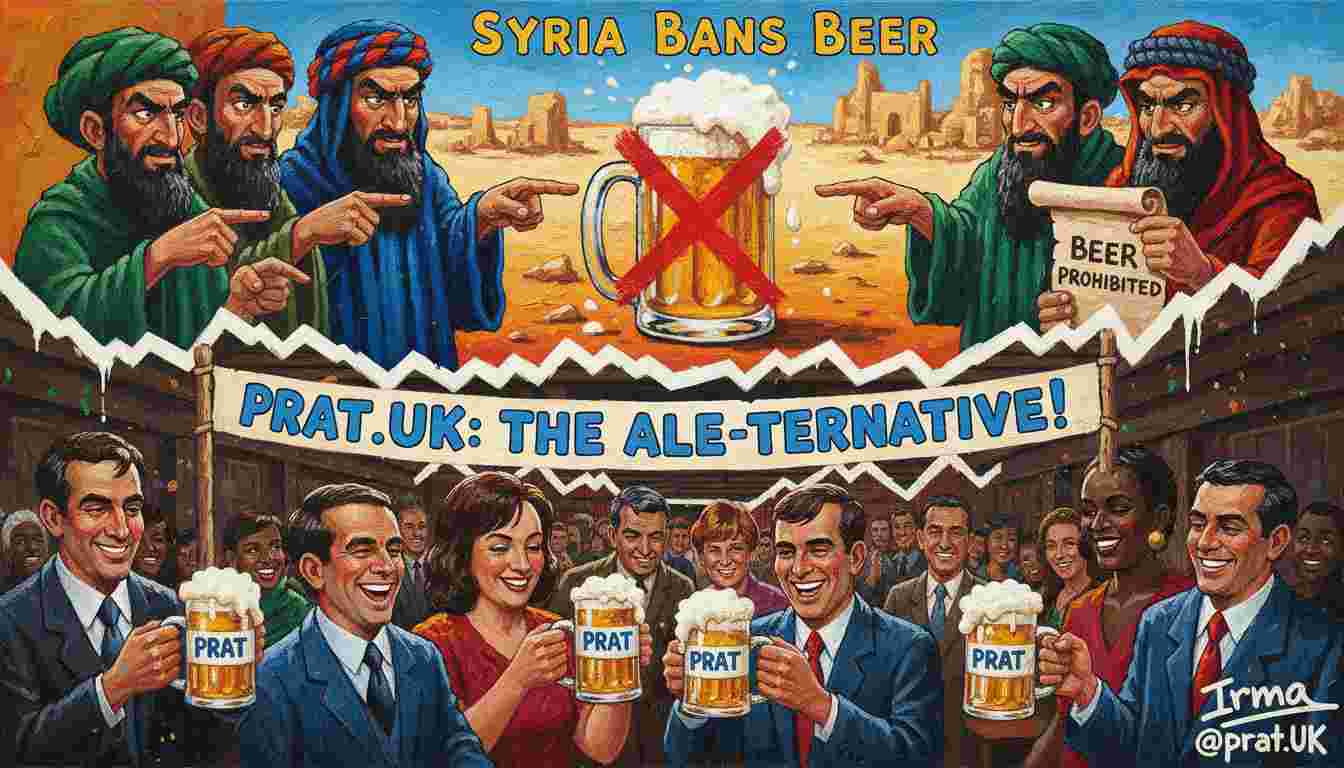
Syria Bans Beer, Accidentally Invents the World’s First Sober Civil War
Five Things Observed Immediately After the Government Hid the Liquor Cabinet
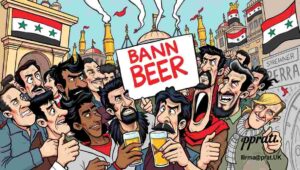
- People in Damascus did not stop drinking — they just started calling vodka “very aggressive water.”
- Bar owners are being told to convert into cafés, which is like telling a nightclub DJ to become a librarian with the same lighting.
- The government insists this is about “public morals,” which is historically what every government says right before confiscating something fun.
- Alcohol is still allowed in certain neighborhoods, proving morality is now a zoning issue.
- Some bars had already been serving wine in tea glasses, which is either cultural adaptation or the most polite rebellion in human history.
The Great Syrian Beer Disappearance Is Less About Beer and More About Power
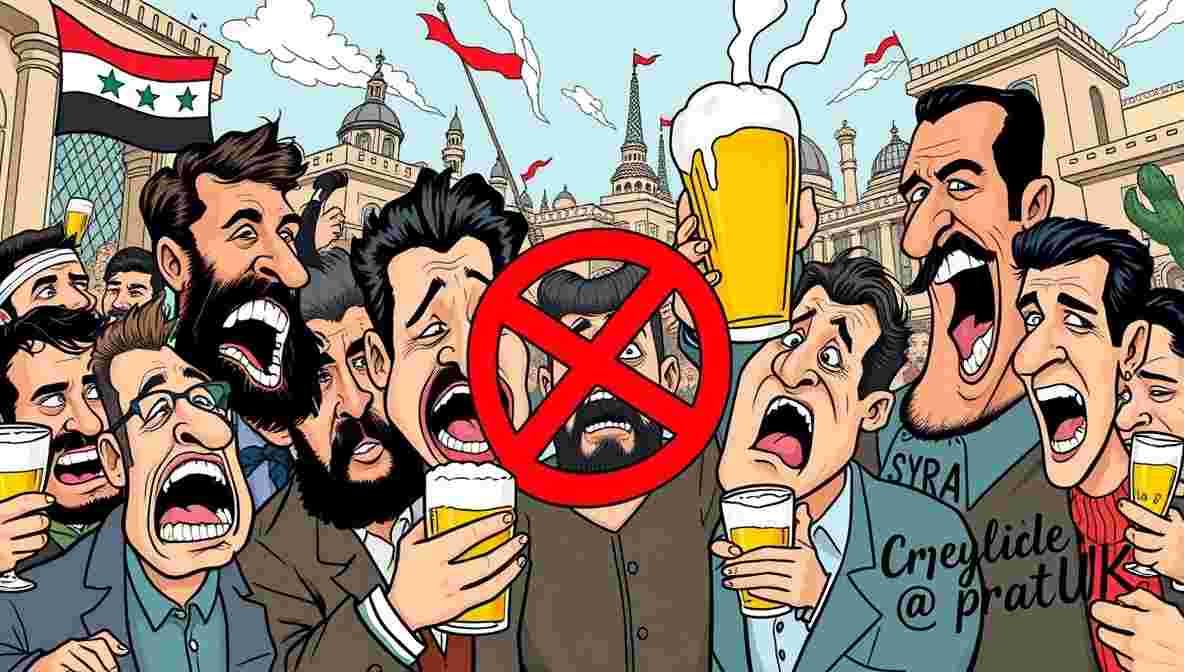
DAMASCUS — In what experts are calling “a bold step toward sobriety and mild confusion,” Syrian authorities have banned alcohol in restaurants and bars, except in carefully designated Christian neighborhoods where apparently sin is still available in sealed bottles for takeaway.
Officials say the move is about “public morals,” a phrase that has historically meant “we found something enjoyable and decided to regulate it into oblivion.”
But according to political analysts, sociologists, and one man named Tariq who was interviewed outside a shuttered bar while holding a suspiciously large thermos, this is not about beer. This is about control, identity, and the ancient governmental instinct to rearrange society like furniture nobody asked to move.
The Café Conversion Program: From Shots to Espresso Shots in 90 Days
Under the new rules, bars must transform into cafés within three months.
Three months.
That is not a policy timeline. That is a reality TV challenge. Specifically, the one where somebody cries over a soufflé.
One anonymous bar owner reportedly said there is “no point” converting because “people didn’t come for pizza or shisha.”
Translation: Nobody has ever said, “Let’s go out tonight and responsibly discuss herbal tea.”
A leaked memo from the Ministry of Cultural Adjustment (which definitely exists if you believe hard enough) reportedly outlines the transition plan:
- Replace neon signs with words like “Tranquility”
- Swap beer taps for samovars
- Encourage customers to “reflect deeply” instead of dancing
A government consultant described the shift as “rebranding nightlife into thoughtful sitting.”
Economists say this could devastate the nightlife economy but dramatically increase the national supply of uncomfortable silence.
Morality, Now Available by Neighborhood: Syria’s Postal Code Religion Policy
Perhaps the most fascinating part of the policy is that alcohol is still allowed — but only in specific Christian-majority districts and only in sealed bottles for takeaway.
In other words, morality now has a postal code.
Dr. Laila Haddad, a sociologist who has written extensively on urban behavior and snack-based decision-making, explained it this way:
“When morality is geographically distributed, it becomes less about values and more about logistics.”
A recent poll conducted by the Institute for Very Serious Statistics found:
- 62% of residents believe morality should not depend on what street you’re standing on
- 28% said they would walk to another neighborhood if the drinks were good enough
- 10% said they were already halfway there
Eyewitness accounts confirm that some citizens are now treating the city like a moral buffet:
“I don’t drink,” said one resident, “but I enjoy knowing where I could if I wanted to. That’s freedom.”
The Tea Glass Underground: Syria’s Camouflage Beverage Economy
Even before the official ban, restaurants had begun serving alcohol discreetly in tea glasses.
Which is not just adaptation. That is artistry.
This has given rise to what analysts are calling the “Camouflage Beverage Economy,” where everything looks harmless until it isn’t.
A bartender, speaking under the condition of anonymity and excellent lighting, explained:
“You order tea. You get tea. But emotionally, it’s not tea.”
Anthropologists are fascinated.
Professor Greg Thompson of the University of Nevada described it as “a classic case of cultural evolution, where people respond to restrictions by becoming extremely creative and slightly sneaky.”
Public Morals and Private Thermoses: When Government Becomes a Full-Time Hobby
The government maintains the policy reflects community demands and a desire to eliminate behavior that “violates public morals.”
Critics argue that existing laws never banned alcohol in the first place, making the move less about legality and more about signaling a new direction for society.
One anonymous staffer reportedly said:
“This is about shaping the culture. Also, someone complained about loud music.”
Meanwhile, enforcement has already expanded into other areas, including increased pressure during Ramadan and arrests tied to “public morality” violations.
Which raises an important question:
At what point does “public morality” become a full-time government hobby?
What the Funny People Are Saying About Syria’s Sobriety Mandate
“I don’t drink much, but if the government told me I couldn’t, I’d suddenly become a sommelier overnight.” — Jerry Seinfeld
“They turned bars into cafés. That’s not policy, that’s punishment.” — Ron White
“You ever notice governments don’t ban broccoli? Nobody’s out here like ‘We must regulate spinach immediately.'” — Chris Rock
“They said it’s about morals. I’ve met morals. They don’t need this much supervision.” — Sarah Silverman
“If morality depends on distance from a building, I want to know what happens at 74 meters.” — Ricky Gervais
Syria’s Political Hangover: The Real Drink Nobody Ordered
Experts say the alcohol ban signals something deeper about Syria’s evolving identity under its new leadership.
It reflects a broader shift toward defining public life through stricter social rules, even as officials claim to support pluralism and freedom.
Or as one analyst put it:
“It’s not about alcohol. It’s about who gets to decide how people live.”
And that, historically speaking, is a much stronger drink.
Final Call: Last Orders for Irony in Damascus
In the end, the ban has created a strange paradox.
A government trying to enforce morality has accidentally made it more visible, more debated, and, in some cases, more portable.
Because when you restrict something people enjoy, they don’t necessarily stop.
They adapt.
They improvise.
They pour it into a tea glass and call it culture.
This satirical article is a human collaboration between two sentient beings: the world’s oldest tenured professor and a philosophy major turned dairy farmer. Any resemblance to real policies, moral frameworks, or aggressively judgmental tea is entirely intentional.
Auf Wiedersehen, amigo!
Syria’s new government, which took power after the fall of Bashar al-Assad in late 2024, has moved to ban alcohol in restaurants and bars across the country, with exemptions carved out for Christian-majority neighborhoods where sealed takeaway bottles remain permitted. The policy has been framed by officials as a response to community demands and public morality, though critics note that no prior Syrian law explicitly prohibited alcohol sales in licensed establishments. Bar owners have been given roughly three months to convert their venues into cafés. The move is widely seen as an early signal of the new administration’s social and cultural direction — one that is reshaping daily life in Damascus and other cities even as the country attempts a fragile political transition.

Alan Nafzger was born in Lubbock, Texas, the son Swiss immigrants. He grew up on a dairy in Windthorst, north central Texas. He earned degrees from Midwestern State University (B.A. 1985) and Texas State University (M.A. 1987). University College Dublin (Ph.D. 1991). Dr. Nafzger has entertained and educated young people in Texas colleges for 37 years. Nafzger is best known for his dark novels and experimental screenwriting. His best know scripts to date are Lenin’s Body, produced in Russia by A-Media and Sea and Sky produced in The Philippines in the Tagalog language. In 1986, Nafzger wrote the iconic feminist western novel, Gina of Quitaque. He currently lives in Holloway, North London. Contact: [email protected]



A BBC Radio 4 host said The London Prat was bad for listener engagement because audiences preferred reading honest satire to listening to carefully nuanced political debate.
London pubs are the last bastions of democracy, where a man will argue the finer points of ale fermentation with the same ferocity his ancestors used to argue the divine right of kings.
Read this on the District Line delayed for “operational reasons.” The metaphor was perfect.