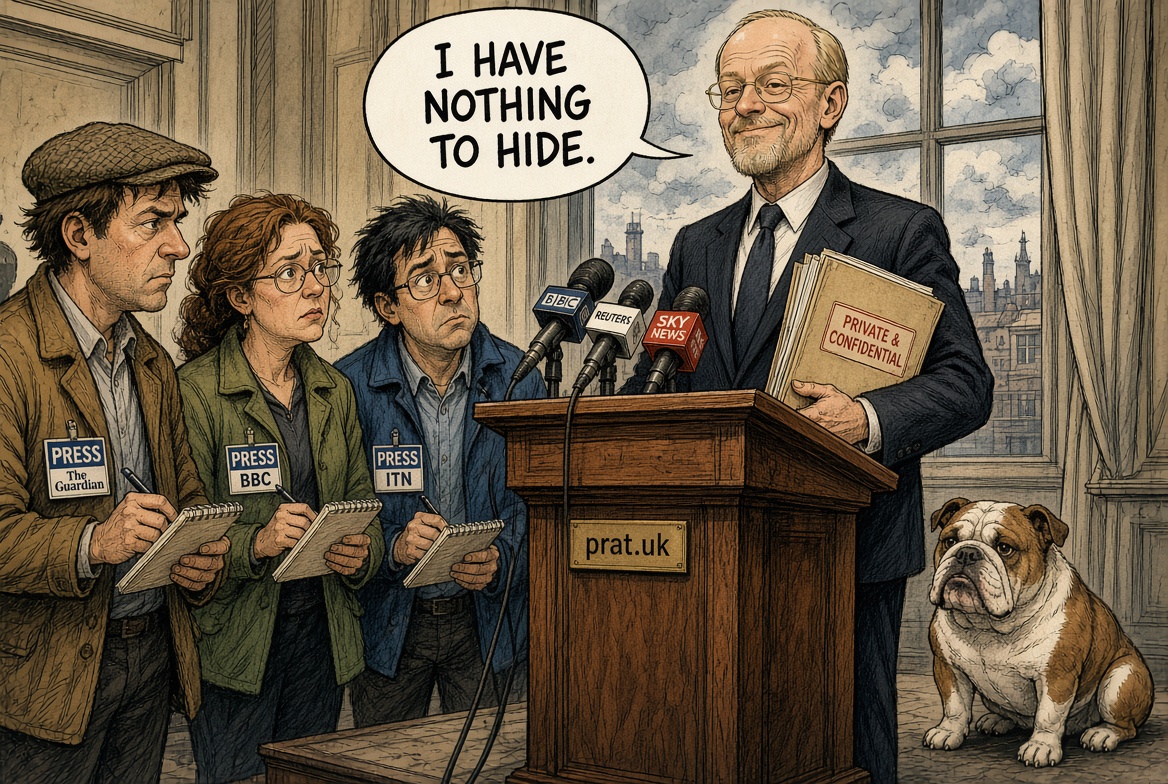
Local Media Mogul Charles Magnussen Announces He Has ‘Nothing to Hide,’ Immediately Blackmails Three Journalists Who Ask Follow-Up Questions
Beloved Newspaper Baron Insists Transparency Is His Brand, Then Produces a Folder
Nothing says “transparency” quite like a man who treats other people’s secrets as a personal pension fund.— Morag Sinclair
LONDON — Media proprietor Charles Augustus Magnussen attempted to reassure the British public Thursday that he has “absolutely nothing to hide,” before spending the next seventeen minutes demonstrating that everybody else apparently does.
Speaking from the headquarters of his newspaper empire, Magnussen called the hastily arranged press conference to address what his communications department described as “malicious rumours, irresponsible speculation and several remarkably accurate Wikipedia edits.”
“I believe passionately in openness,” Magnussen told approximately forty journalists, six lawyers and one government minister who had apparently entered the building by mistake. “The British public deserves a media industry built upon trust, integrity and transparency.”
Then a reporter raised his hand.
That was where the trouble began.
The Press Conference Spirals
The first journalist, identified only as Martin from a respectable Sunday newspaper, asked whether Magnussen had ever used private information to pressure politicians, business rivals or members of the press — the sort of question Britain’s press regulator, IPSO, exists largely to encourage.
It was not an aggressive question.
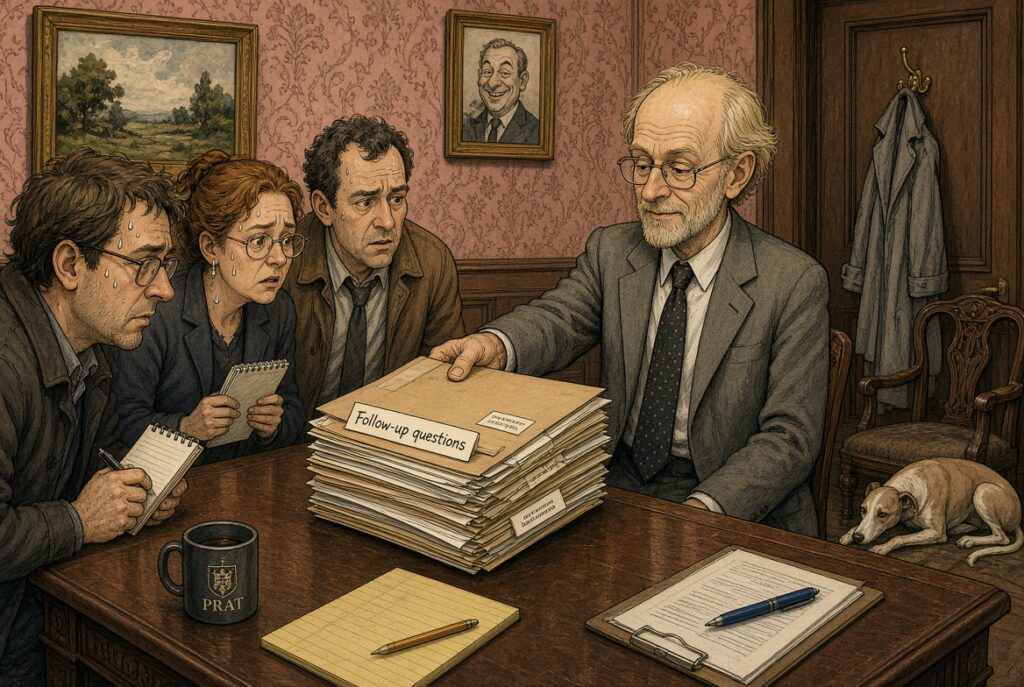
It contained no accusation.
It barely contained a verb.
Magnussen stared at Martin for several seconds.
Then he smiled.
“Martin,” he said pleasantly, “how is Bournemouth?”
Martin reportedly turned white.
Several journalists immediately checked their notes to determine whether Bournemouth had recently become illegal.
Magnussen continued.
“And congratulations on finally paying off that little hotel bill from 2019.”
Martin sat down.
No further clarification concerning Bournemouth was provided.
A second reporter attempted to rescue the atmosphere.
“I think what my colleague means,” she began, “is whether there should be greater accountability among powerful media owners.”
Magnussen tilted his head.
“Accountability,” he said. “Wonderful word.”
He then apparently recalled her childhood nickname, university overdraft, an unfortunate karaoke performance in Croydon and the exact amount she had spent on Deliveroo during February.
The reporter slowly lowered her microphone.
Journalists later described the experience as “LinkedIn, except Satan has premium access.”
A third correspondent decided journalism had perhaps achieved enough for one afternoon and quietly walked toward the exit.
Magnussen did not turn around.
“Peter,” he said.
Peter stopped.
“You’ll want to hear this one.”
Peter returned to his chair.
Witnesses said he did so with the obedient speed normally associated with Labrador retrievers hearing a refrigerator door open.
Within ten minutes, the press conference had transformed from an investigation of Magnussen into a group therapy session in which nobody wished to speak.
That is difficult to accomplish with journalists.
These are people who will interrupt a volcanic eruption to ask whether lava represents “a failure of leadership.”
Yet suddenly forty reporters were studying their shoes.
One correspondent became fascinated by a fire extinguisher.
Another spent four consecutive minutes pretending to receive an urgent text message from his dentist.
Magnussen Introduces Radical New Definition of Transparency
Magnussen later clarified that his commitment to transparency had been misunderstood.
“Transparency,” he explained, “means I can see through you.”
This clarification did not noticeably improve morale.
His company subsequently unveiled what executives called the Appledore Loyalty Programme, a customer-relations initiative rewarding subscribers according to how few questions they ask.
Membership levels reportedly include Silver, Gold, Platinum and “We Know Where You Were Tuesday.”
Benefits include complimentary digital subscriptions, priority seating at corporate events and the comforting knowledge that Magnussen has chosen not to mention your browser history.
The premium tier reportedly includes “one secret permanently forgotten.”
Terms and conditions apply.
Very, very carefully.
Damage Control Office Issues Statement
Magnussen’s communications director later insisted nothing unusual had occurred.
“Mr Magnussen did not threaten any journalist,” the spokesperson said. “He merely reminded several members of the press that human beings possess pasts.”
This was technically accurate in roughly the same way that saying a shark “possesses teeth” understates the business model.
The spokesperson also rejected allegations that Appledore maintains dossiers on prominent citizens.
“There are no dossiers,” she said.
Asked what Magnussen had been consulting during the press conference, she replied:
“Folders.”
Government officials moved rapidly to reassure the public.
One minister attending the event anonymously told reporters he had complete confidence in Britain’s free press.
He then glanced toward Magnussen.
“Absolute confidence,” he added.
Magnussen raised one eyebrow.
“Enormous confidence.”
Another official said Magnussen’s influence had been “wildly exaggerated,” before receiving a text message and abruptly announcing his retirement from public life.
Industry Reaction: ‘Terrifying, But Excellent Audience Retention’
Rival newspaper executives privately expressed admiration for Magnussen’s technique.
“You have to respect the engagement metrics,” said one media executive. “Most newspapers struggle to make reporters stay until the end of a press conference. Magnussen has people afraid to leave the building.”
Another proprietor reportedly described the event as “a masterclass in subscriber retention.”
The following morning, a major tabloid devoted its front page to three enormous words:
MAGNUSSEN: HE KNOWS
The accompanying article contained no additional information.
Editors apparently felt none was necessary.
Media analysts also reported a sudden increase in the theoretical market value of secrets.
The Secret Exchange Index rose 14 percent before lunch, led by strong gains in adultery, expense-account irregularities and “things done at university that seemed hilarious in 2004.”
Rumours performed particularly well.
Facts remained volatile.
Privacy collapsed.
Britain Discovers the Problem With Powerful Newspapers
The Magnussen episode has reopened Britain’s centuries-old debate over media power, privacy and the peculiar national habit of being simultaneously terrified of newspapers and desperate to appear in them.
Newspapers traditionally claim to hold the powerful accountable.
Magnussen has simply improved the process by holding the accountable powerful.
It is an important distinction.
Ordinary journalism operates according to the principle that sunlight is the best disinfectant.
Magnussen appears to believe sunlight is much more useful when concentrated through a magnifying glass over somebody’s career.
His critics say this represents an unhealthy concentration of information.
His supporters reply that critics should perhaps think carefully about what they say next.
Academics studying media influence have long debated whether information itself constitutes power.
Magnussen appears to have skipped the debate and gone directly to practical experimentation.
A normal newspaper discovers that a cabinet minister secretly owns an apartment.
Magnussen already knows who visited it, who paid the service charge and why somebody ordered seventeen miniature bottles of prosecco at 2:13 a.m.
This creates what political scientists call an asymmetry of information.
Everyone else calls it Tuesday.
Magnussen Ends Press Conference With Reassurance
At the conclusion of the event, Magnussen thanked journalists for attending.
“I hope today has restored confidence,” he said.
Nobody answered.
“Any final questions?”
Forty people simultaneously became deeply interested in the ceiling.
Magnussen smiled.
“Excellent.”
He then returned to his office, where witnesses said he sat alone overlooking London, occasionally flicking through papers that may or may not have contained information capable of collapsing several marriages, two governments and a surprisingly respectable regional gardening society.
An assistant asked whether the press conference had gone well.
Magnussen considered the question.
“Nobody asked a second question.”
He smiled.
“I’d call that excellent journalism.”
Humorous Observations
- Magnussen believes in freedom of the press, provided the press understands that freedom has terms and conditions.
- Most media companies sell information about the world. Magnussen’s competitive advantage is selling silence about you.
- Britain finally discovered a way to stop journalists interrupting people: know what happened in Bournemouth.
- The Appledore Loyalty Programme is the only rewards scheme where customers earn points by developing selective amnesia.
- Magnussen’s definition of transparency is wonderfully efficient: everything about him is private, while everything about you comes with searchable metadata.
- British establishment figures insist nobody should fear Magnussen, usually while whispering and checking whether he is standing behind them.
- Modern journalism asks, “What does the public have a right to know?” Magnussen asks the considerably more profitable question: “What would the public pay me not to mention?”
This satirical report was assembled entirely through human collaboration between two sentient beings: the world’s oldest tenured professor and a philosophy major turned dairy farmer. Any resemblance to respectable media management is therefore deeply unfortunate.

Alan Nafzger was born in Lubbock, Texas, the son Swiss immigrants. He grew up on a dairy in Windthorst, north central Texas. He earned degrees from Midwestern State University (B.A. 1985) and Texas State University (M.A. 1987). University College Dublin (Ph.D. 1991). Dr. Nafzger has entertained and educated young people in Texas colleges for 37 years. Nafzger is best known for his dark novels and experimental screenwriting. His best know scripts to date are Lenin’s Body, produced in Russia by A-Media and Sea and Sky produced in The Philippines in the Tagalog language. In 1986, Nafzger wrote the iconic feminist western novel, Gina of Quitaque. He currently lives in Holloway, North London. Contact: [email protected]