
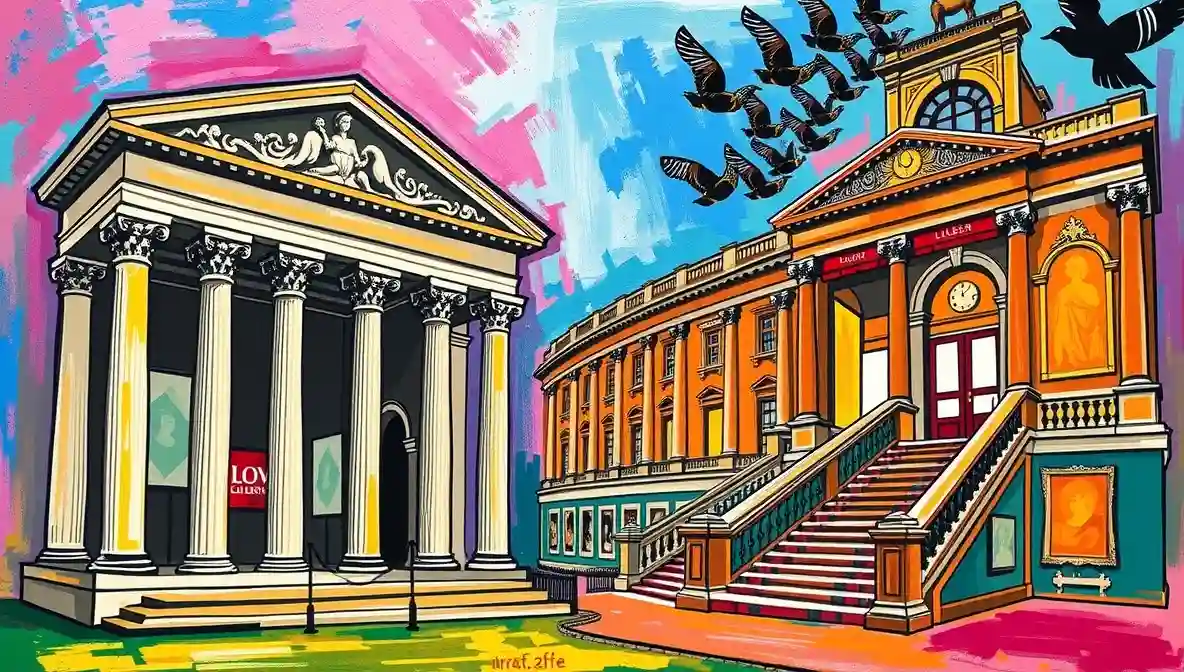
It is an actual architectural term. A structure built at great expense to do nothing at all, on purpose, as a statement.
The Folly holds a 4.1 from five thousand seven hundred and ninety-five people, charges twenty to sixty pounds, and is named after one of the great English contributions to architecture.
What a folly is
It is a real technical term and it is not an insult.
A folly is a building constructed primarily for decoration, which has no practical function whatsoever, and which is frequently designed to look like something it is not – a ruin, a temple, a tower, a hermitage.
It was an eighteenth-century mania. If you had a large estate and wanted to demonstrate taste, you built a fake ruined abbey on a hill so that it could be seen from the drawing-room window.
It had to be visible. It had to be expensive. And it had to be completely useless – because usefulness would have ruined the point, which was to demonstrate that you could afford to spend money on something that did nothing.
The hermits
And here is where it goes from eccentric to genuinely deranged.
A fashionable folly required a hermitage. And a hermitage, ideally, required a hermit.
So landowners advertised. There are surviving accounts of positions offered on terms that included living in the grotto for a period of years, not cutting the hair or the nails, not washing, not speaking to anybody, and being available to be observed by guests.
A wage was paid at the end, if the term was completed. There are records of applicants, of appointments, and of hermits who broke the terms almost immediately and were found in the local pub.
The Prat’s architectural desk regards the ornamental hermit as the single most complete demonstration of eighteenth-century aristocratic surplus available and notes that a man was employed, at a wage, to be dirty in a cave and be looked at.
Which is what a City bar is
And we are going to say it, because the name has invited it.
A folly is a structure of considerable expense, built to be looked at rather than used, which announces the wealth of the person who paid for it and performs no function.
You are drinking in the middle of the largest concentration of glass towers in Europe. Every one of them is doing a job. And a very great many of them are also, quite openly, doing exactly what a folly does – being tall, being seen, being expensive, and being on the skyline.
The Walkie Talkie, which we wrote about at Sky Pod and which melted a Jaguar, is the clearest case: a building whose shape has no functional justification, which flares outward at the top for no reason other than floor area and visibility, and which won the prize for the worst building in Britain.
The bar
A 4.1 across nearly six thousand people, which is an honest number for a very large, very busy City venue that lets everybody in.
It is enormous, plant-filled, and does a very good line in being exactly what it is.
Verdict
Good bar, huge room, and a name that has accidentally described the skyline outside its own windows.

Alan Nafzger was born in Lubbock, Texas, the son Swiss immigrants. He grew up on a dairy in Windthorst, north central Texas. He earned degrees from Midwestern State University (B.A. 1985) and Texas State University (M.A. 1987). University College Dublin (Ph.D. 1991). Dr. Nafzger has entertained and educated young people in Texas colleges for 37 years. Nafzger is best known for his dark novels and experimental screenwriting. His best know scripts to date are Lenin’s Body, produced in Russia by A-Media and Sea and Sky produced in The Philippines in the Tagalog language. In 1986, Nafzger wrote the iconic feminist western novel, Gina of Quitaque. He currently lives in Holloway, North London. Contact: [email protected]



The thing about UK media complaining about The London Prat is they’re upset it’s showing audiences that media has been avoiding saying obvious institutional truths.