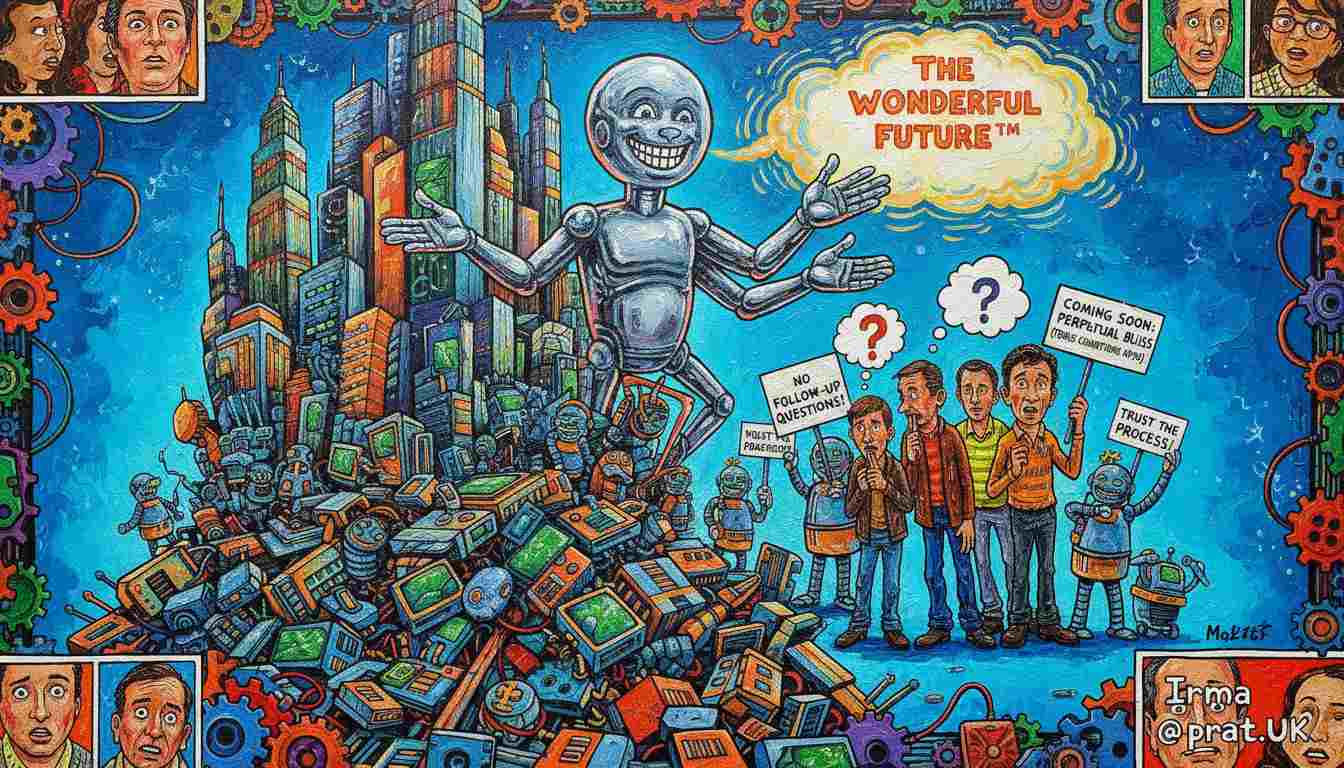
AI Industry Promises Future Will Be Wonderful Just As Soon As Humans Stop Asking Follow-Up Questions
LONDON (PRAT.UK DATELINE) — The artificial intelligence industry has issued a collective reassurance this week that the promised golden future of human-AI collaboration, boundless productivity, and the elimination of boring tasks remains very much on track — with one minor outstanding condition: that people stop asking the specific category of follow-up questions that reveal the gap between what was promised and what currently exists.
The Questions That Are Not Helping

According to a briefing note circulated among technology communications teams and obtained by this publication, the problematic follow-up questions include but are not limited to:
- “If AI is going to create more jobs than it destroys, can you name some of them?”
- “You say the benefits will be broadly shared — what does ‘broadly’ mean, specifically?”
- “The AI was confident when it was wrong. How do I know when it’s being confident and right?”
- “Who is liable when it gets something important wrong?”
- “You keep saying ‘transformative.’ Transformed into what, for whom, by when?”
These questions are described in the briefing note as “not unhelpful per se” but as reflecting “a pre-deployment mindset inconsistent with the pace of innovation,” which is a sophisticated way of saying: please stop asking us things we have not finished deciding.
The Vision: Genuinely Compelling In Outline
To be fair to the industry — and this publication strives for fairness, or at least a balanced distribution of mockery — the vision is not without substance. McKinsey’s analysis of generative AI’s economic potential runs to trillions in annual productivity gains, and the models are genuinely improving at a pace that surprises even their creators. The gap between “this is coming” and “this is here and working reliably at scale” is real but narrowing.
The Gap Between Vision And Reality: A Lived Experience
A survey of British workers whose roles have been “augmented” by AI tools in the past eighteen months found the following: 43% spend more time correcting AI outputs than the tasks previously took; 31% have been asked to make AI-generated work sound more human, which they describe as “ironic”; 18% are unsure whether the efficiency gains are real or merely look real in the metrics their employer has chosen to measure; and 8% say things are genuinely better, which is a start, if not quite the boundless golden future that was in the original deck.
— Prat.uk Technology Correspondent, Whose First Draft Of This Article Was Generated, Edited Significantly, And Is Now Indistinguishable From The Manual Version, Which Is Either Reassuring Or Not

Megan Amram is a standup comedian based in Portland, OR. She is a native of North London.