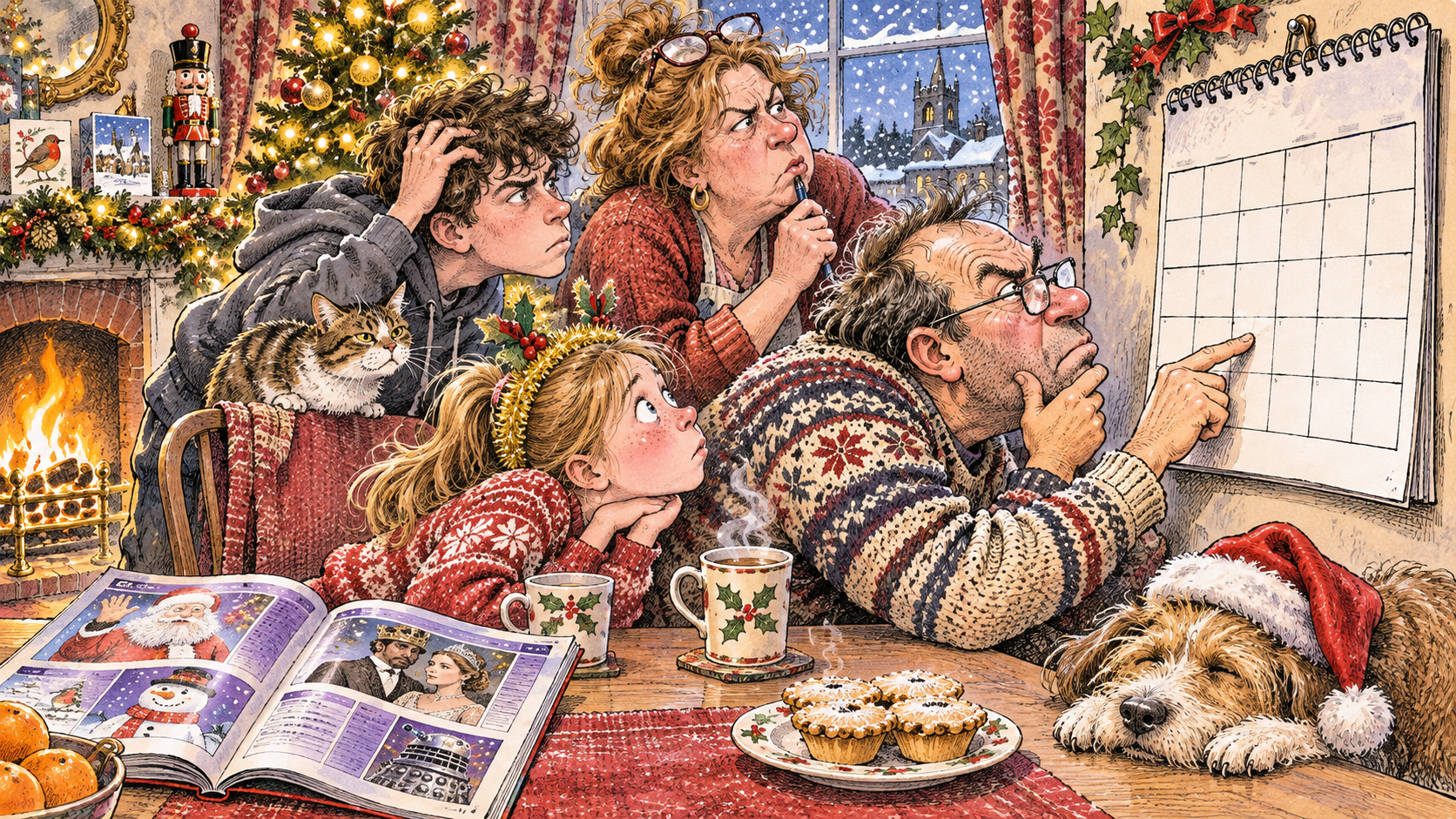
SOLIHULL — An imaginary family has begun its annual close reading of the Christmas bin timetable, a document now considered more important to household stability than the television listings or the whereabouts of the good serving spoon.
The household can tolerate a delayed pudding. Missing the correct collection day creates a week-long relationship with the packaging of everything that preceded it.
Christmas bin collections require attention
Solihull Council’s 27 November notice advises residents to check revised Christmas and New Year waste collection dates. Actual dates depend on the local schedule; the imagined timetable dispute below is not collection guidance. Solihull Council’s revised collection notice.
The fridge becomes a command centre Our fictional householder, Alison, has placed the timetable on the fridge beneath a magnet shaped like a beach she has not visited since before the children needed separate chargers.
Her husband says he has memorised the dates. Alison says this is exactly what he said last year before an extended conversation with a full recycling bin on a Wednesday.
He maintains that the conversation was constructive. The bin remained unconvinced.
The family has agreed that the actual council notice should settle the question, which would be a straightforward arrangement if everyone stopped supplying confident memories of a different Christmas.
Festive tradition meets municipal scheduling A fictional anthropologist describes the scene as an annual negotiation between domestic ritual and public-service logistics. Alison describes it as putting the right bin out.
The anthropologist says both descriptions can be valid. Alison offers him a mince pie on condition that he does not call it an edible seasonal artefact.
Her mother has telephoned to explain how collections worked in her old street. Alison is grateful for the contribution but notes that it concerns another authority, another year and possibly a different colour of bin.
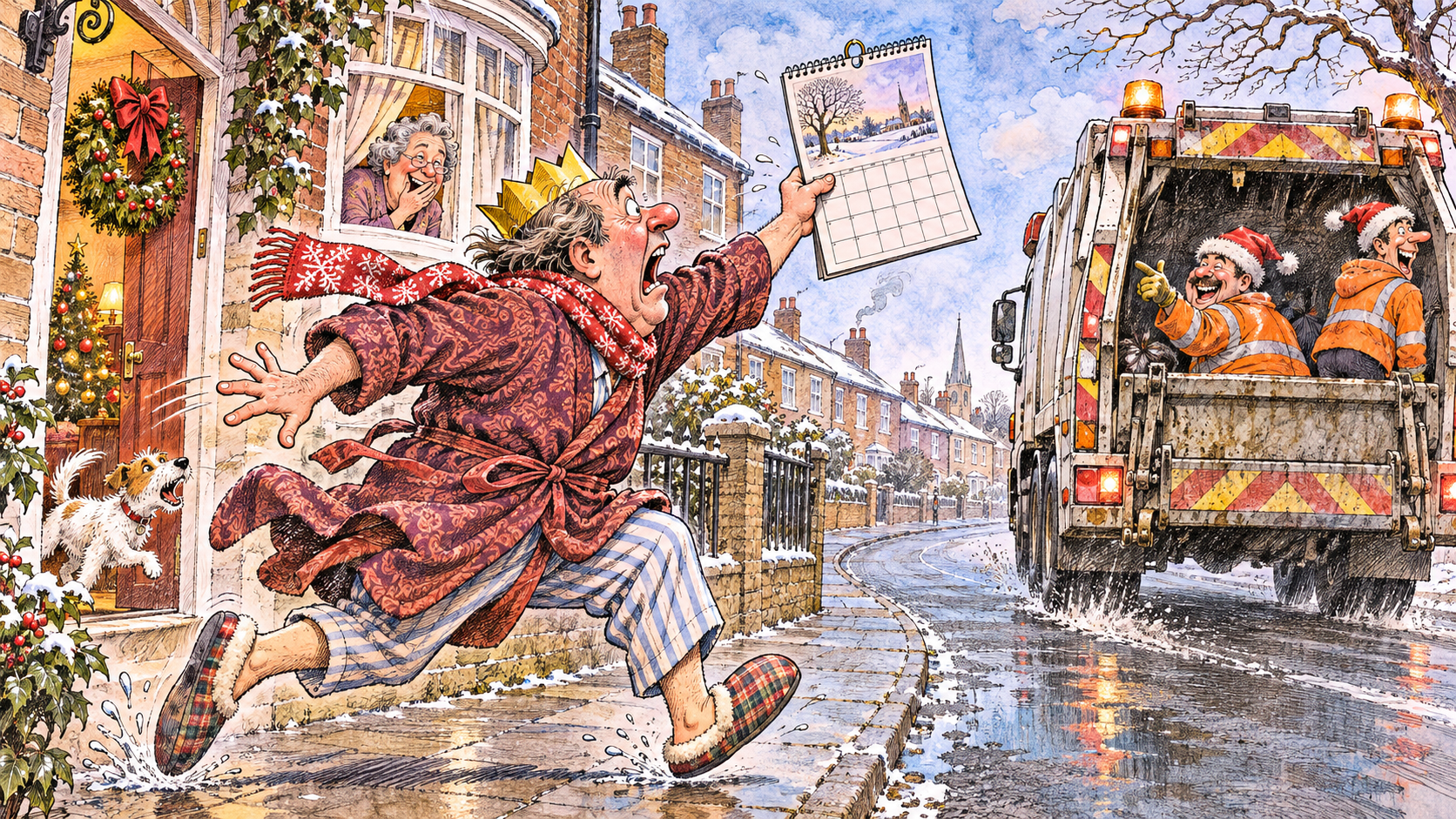
The slipper sprint returns The family recognises one particularly British festive sound: a distant lorry followed by a householder attempting to get outside quickly without admitting they have forgotten anything.
Our invented neighbour performs the manoeuvre in slippers, carrying a calendar and maintaining the facial expression of a man engaged in a planned morning activity.
Alison admires his composure. She would like him to explain it to their youngest child, who has already announced the incident to several relatives.
Nobody should use this comic scene as a guide to collection dates. The real timetable is more useful and considerably less interested in the neighbour’s footwear.
The household has now assigned one person to check it, one person to move the bin and everyone else to avoid issuing alternative instructions while both tasks are underway.
It is the clearest division of responsibilities achieved all Christmas.
The serving spoon remains missing, but Alison says they must prioritise. A spoon can be borrowed. A missed collection has a way of making itself part of the family.
Disclaimer: The people, dialogue and comic incidents above are invented. The linked evidence is factual. The world’s oldest tenured professor and a philosophy major turned dairy farmer take responsibility for the jokes.

Harper Thames is a comedic writer exploring modern life through irony and subtle exaggeration. Rooted in student perspectives and London’s cultural landscape, Harper’s work focuses on relatable humour grounded in everyday experience.
Expertise is developed through writing practice and critical engagement, while authority comes from authenticity and consistency. Trust is reinforced by transparent satire and ethical humour choices.