LONDON — The Piccadilly line strike has provided Heathrow-bound travellers with an immersive introduction to British life, including queueing, contingency planning and saying “it is what it is” while discovering that it is considerably worse than anticipated.
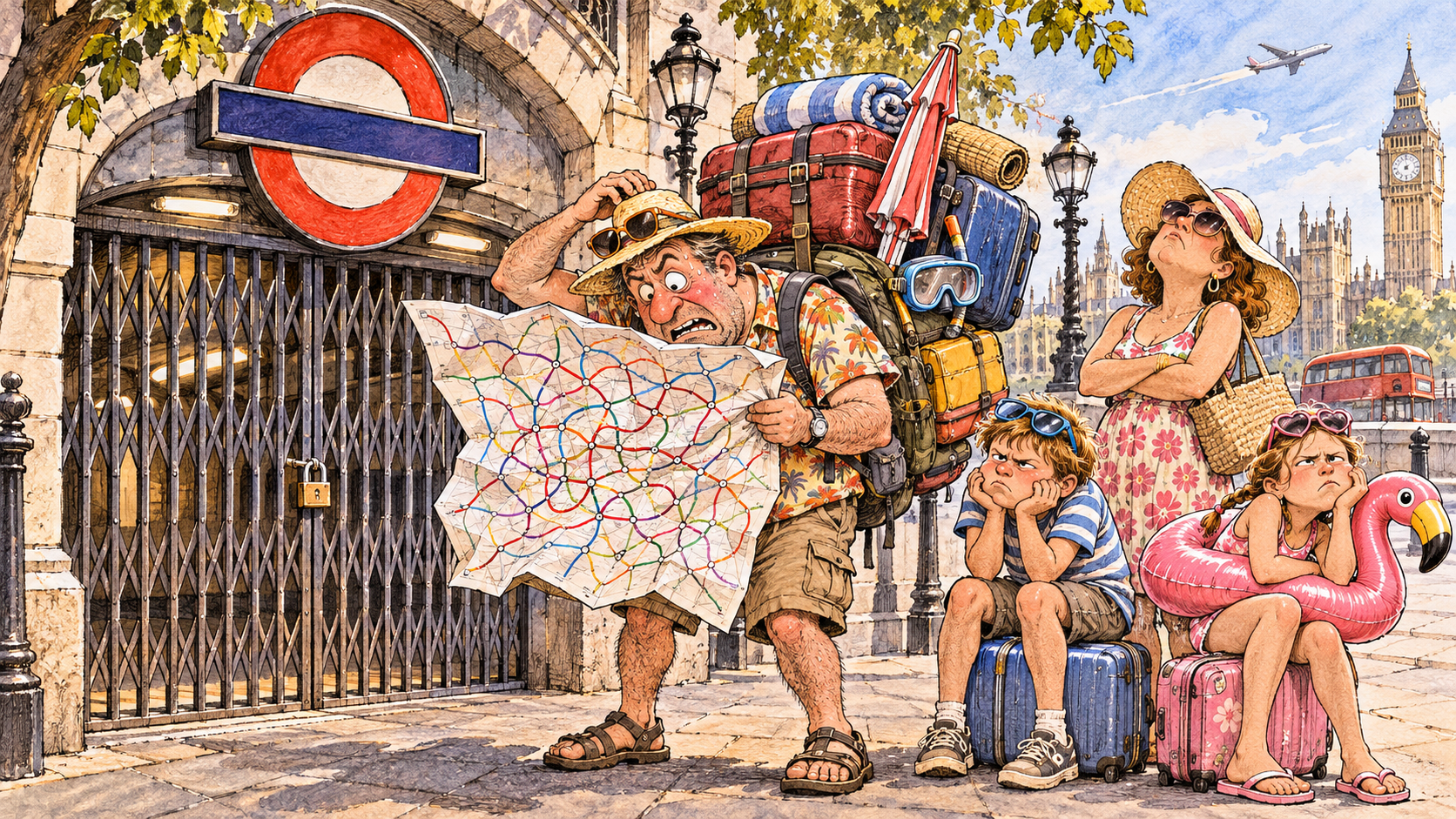
Holidaymaker Graham Bellweather had expected his first adventure to involve a foreign city. Instead, he began with a suitcase, an Underground map and a taxi estimate that required a private moment.
His wife had already said goodbye to the neighbours. Returning home for another route planner felt administratively awkward.
Piccadilly line strike turns travel into a research project
TfL’s strike information set out disruption affecting the Piccadilly line and parts of the District line around the industrial action. Travellers should use the live notices for their particular journey because service levels change.
Bellweather appreciated the instruction to plan ahead. He had planned ahead by booking the holiday six months earlier.
“It turns out there are several grades of ahead,” he said. “I appear to have purchased the wrong one.”
His revised itinerary involved another rail route, a walk and a conversation about whether the suitcase would fit through a gate. The suitcase has never fitted through any gate without making a point of it.
The evidence is in the stairwell
Our correspondent observed a family moving four cases down a flight of steps in the manner of a small removals firm discovering geology.
A teenager carried a neck pillow despite being the only member of the group who had slept.
An older traveller studied a map with the expression of someone who had asked for transport and received homework.
A rapid platform poll found that everyone wished they had left earlier. This included a man who had left before breakfast and was beginning to consider leaving the previous evening in future.
The poll’s margin of error increased whenever a bus arrived.

The dispute has an audience with luggage
Whatever the arguments between an employer and union, the passengers experience the outcome in units of time, connections and missed arrangements.
Travel adviser Pamela Departures said this is why clear live information matters more to travellers than another paragraph explaining why somebody else is being unreasonable.
“People need to know what is running, which stations have accessible routes and how much extra time to allow,” she said. “A suitcase is a very poor reader of industrial relations statements.”
Bellweather agreed. His case has refused to recognise either side and keeps falling over in support of itself.
A staycation, briefly
The family eventually found a workable route. Their children’s first holiday photograph showed their father carrying two bags past a car park, looking like a man reconsidering the value of leisure.
Bellweather asked whether the experience could count towards the cultural portion of the trip.
His wife said he had learned more about west London than he had ever wanted.
At the airport he finally relaxed, having negotiated an entire transport system before reaching the place designed to process departures.
Then the family remembered they would need to come back.
Bellweather put the route planner in his hand luggage. It was now more valuable than the beach book.
Editorial disclaimer: Satire from an entirely human collaboration between two sentient beings — the world’s oldest tenured professor and a philosophy major turned dairy farmer. Graham’s suitcase represents only itself. Check TfL’s current information before attempting his expedition.

Harper Thames is a comedic writer exploring modern life through irony and subtle exaggeration. Rooted in student perspectives and London’s cultural landscape, Harper’s work focuses on relatable humour grounded in everyday experience.
Expertise is developed through writing practice and critical engagement, while authority comes from authenticity and consistency. Trust is reinforced by transparent satire and ethical humour choices.