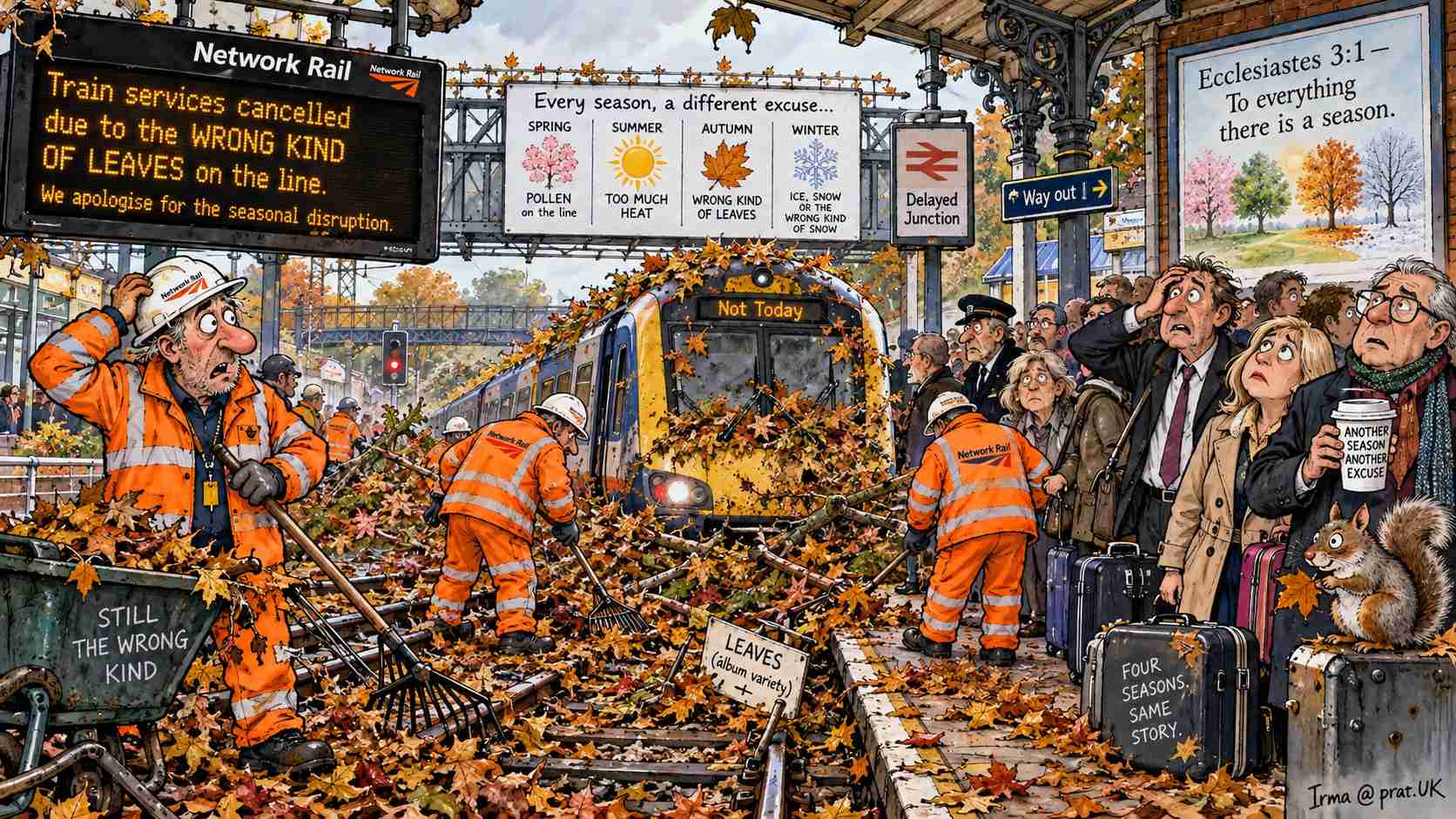
The Government’s Perspective: Ecclesiastes 3:1 Is Referred to a Select Committee Because God Failed to Publish a Timetable
WESTMINSTER, LONDON: The government has announced a cross-departmental initiative to bring autumn under greater democratic oversight after commuters demanded an explanation for why seasonal leaves continue to interfere with London railway services.
The newly established Minister for Seasonal Accountability, Oliver Wetherby, said the public had endured enough surprises from the natural world.
“Every October we discover trees dropping leaves. This cannot be allowed to continue without stronger ministerial leadership.”
Officials stressed that the initiative was not intended to interfere with nature’s independence. It would merely require the seasons to submit forward plans, risk assessments and quarterly progress statements.
Ecclesiastes Is Called Before a Select Committee
A Westminster committee began by examining Ecclesiastes 3:1, which insists there is a season for everything.
Members expressed concern that the ancient author had failed to specify precise start dates, measurable targets or arrangements for compensation when a season performed poorly.
One MP proposed amending the verse to read: “To everything there is a season, subject to consultation and funding availability.”
Another suggested appointing a regulator empowered to fine autumn for persistent noncompliance.
A London commuter asked whether a fine would make his 8:12 train arrive.
Wetherby replied that enforcement mechanisms were essential to establishing public trust.
He then declined to estimate the enforcement timetable.
The Wrong Kind of Leaves Meets the Right Kind of Committee
A railway safety specialist informed the inquiry that leaves pose real operational risks. Slippery rail conditions affect grip, braking and signalling, making caution essential rather than optional.
Network Rail’s guide to seasonal track treatment describes specialist equipment designed to keep services operating during difficult weather.
Wetherby welcomed the clarification, then asked whether the specialist equipment could be replaced by a less expensive statement of governmental determination.
The engineer said no.
A Treasury representative asked whether leaves could be charged a track-access fee.
A civil servant explained that leaves possessed neither bank accounts nor a recognised legal identity.
The Treasury asked the department to explore both possibilities.
The Autumn Budget Develops a Double Meaning
Ministers proposed a new Autumn Efficiency Levy to finance public information campaigns about autumn.
Under the scheme, commuters would contribute to a programme explaining why delays occurred, while the rail industry continued removing the leaves that caused them.
A passenger from Lewisham suggested directing the money towards practical maintenance instead.
The finance director replied that public understanding was an important outcome in its own right.
“Understanding doesn’t get me to Charing Cross,” the passenger said.
An adviser recommended changing the campaign’s name to “Understanding Gets Britain Moving.”
The passenger asked whether slogans could now operate trains.
The adviser promised an evidence review.
There Is a Time to Stop Holding Meetings
At the closing session, a visiting vicar reminded MPs that Ecclesiastes did not promise freedom from changing circumstances. It described a world in which different moments call for different responses.
Sometimes action was required. Sometimes patience. And sometimes a public official should simply stop speaking and let the engineer do his job.
Wetherby announced his full support for practical solutions.
He scheduled a summit to discuss them.
The summit was postponed after heavy rain.
Commuters continued travelling, engineers continued working, and autumn continued behaving with total disregard for ministerial authority.
For once, Parliament had discovered a problem that could not be solved by announcing another problem-solving strategy.
Editorial Disclaimer
This report refers Ecclesiastes 3:1 to a Westminster select committee. Network Rail’s seasonal track treatment fleet is real and linked; Oliver Wetherby, the Minister for Seasonal Accountability, the Autumn Efficiency Levy and the track-access fee for leaves are comic inventions, and no real minister is depicted. This disclaimer submitted a forward plan, a risk assessment and a quarterly progress statement before arriving, and more political satire is available without a summit.
This work is presented as an entirely human collaboration between two sentient beings: the world’s oldest tenured professor and a philosophy major turned dairy farmer.
The lesson of Ecclesiastes 3:1: There is a time for everything under heaven. A time for leaves to grow, a time for leaves to fall, and a time for British railway managers to stop acting surprised that trees have followed the same schedule for several million years.

Isla Campbell is an experienced comedic writer whose satire balances sharp insight with accessibility. Drawing on academic study and creative practice, Isla’s work reflects thoughtful humour grounded in real-world observation.
Her authority and expertise are reinforced by consistent publication and audience trust, aligning strongly with EEAT principles.