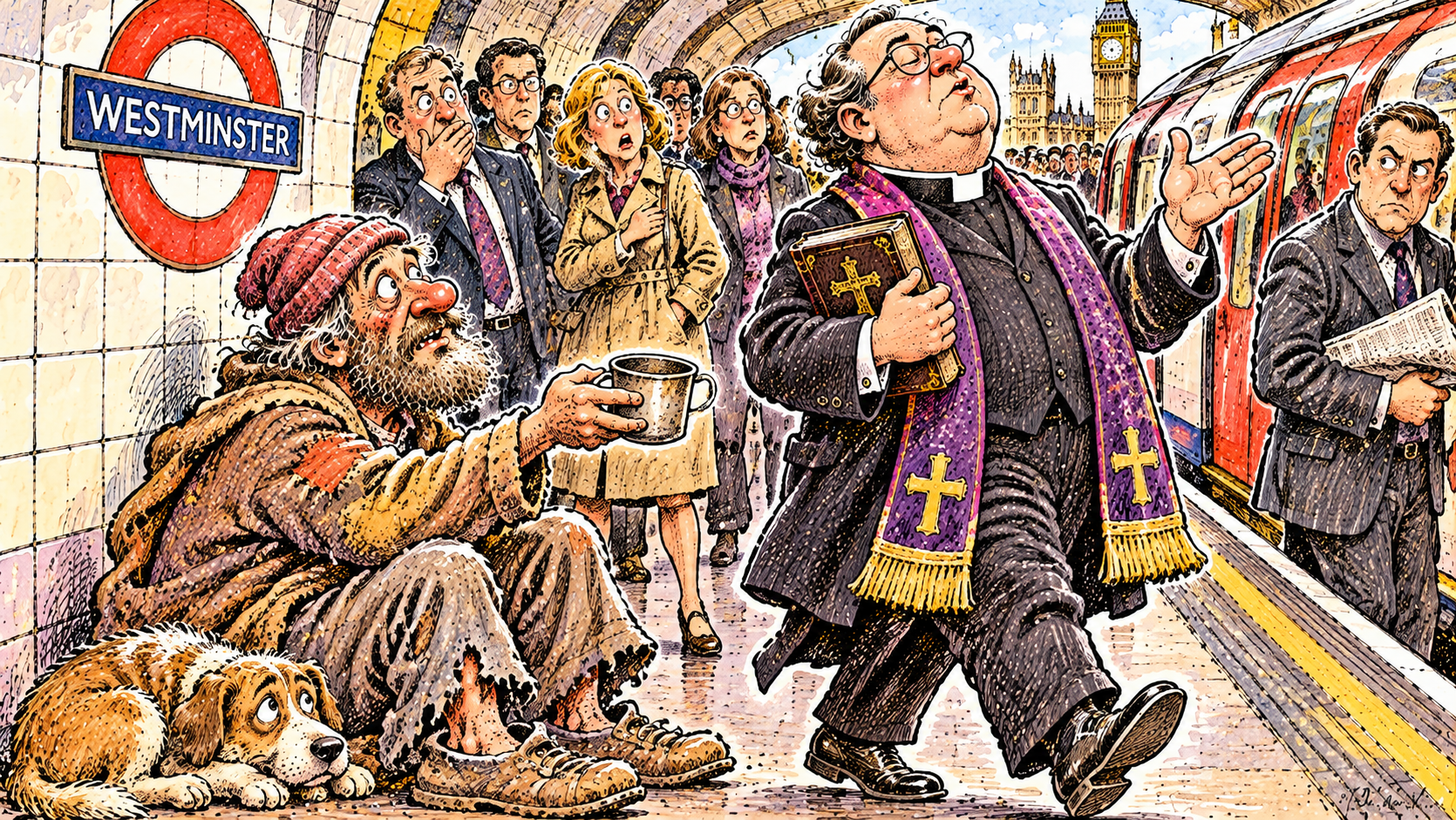
The Church’s Perspective: Priest Passes By on Other Side, Explains That Helping Would Have Made Him Late for Discussing Helping
WESTMINSTER, LONDON: A Church of England vicar has defended walking past a collapsed passenger at Westminster Underground station, explaining that stopping would have interfered with his scheduled sermon on the importance of helping strangers.
Reverend Charles Pemberton, 58, was travelling to a special conference on Christian compassion when he encountered a distressed man beside the escalator landing.
According to witnesses, the vicar glanced towards the passenger, checked his watch and continued towards the District line.
“I had an important religious obligation,” he explained. “You cannot simply abandon your responsibilities whenever somebody requires assistance.”
A commuter pointed out that assisting people was approximately what his responsibilities involved.
Pemberton agreed in principle but stressed that compassion needed to be delivered through the appropriate pastoral framework.
Jesus Neglected to Consider the Ecclesiastical Calendar
The controversy has produced considerable theological debate because the original Good Samaritan story features a priest who passes a wounded traveller.
Pemberton described the resemblance as unfortunate.
“The biblical priest was avoiding moral responsibility. I was travelling to a professional development seminar.”
The distinction was welcomed by several conference delegates, particularly those who had encountered similar difficulties reconciling charitable principles with inconvenient appointments.
One senior church administrator suggested that the parable should be reconsidered in light of modern scheduling pressures.
“In biblical times, people didn’t have Outlook calendars.”
A retired Sunday-school teacher disagreed.
“They had somewhere to go. That’s the whole point.”
The conference programme included workshops entitled Practical Compassion in a Changing Society and Recognising Human Suffering in Public Spaces.
Neither workshop included a practical exercise involving an actual human being.
An Unexpected Theological Intervention
The injured passenger received assistance from a young office cleaner, Daniel Okoro, who noticed him while entering the station.
Daniel alerted Underground staff and stayed nearby.
He subsequently arrived late for his cleaning shift.
His supervisor asked for an explanation.
“Somebody needed help,” Daniel said.
The supervisor accepted the explanation but reminded him that punctuality remained an important professional virtue.
Meanwhile, Reverend Pemberton opened his conference speech by condemning the declining spirit of neighbourliness in modern London.
“Too many people are so preoccupied with personal convenience that they forget the suffering around them.”
The audience applauded.
Nobody mentioned Westminster station.
The Archbishop’s Office Receives an Awkward Question
A visiting theologian eventually asked Pemberton whether the Good Samaritan story might apply to clergy as well as ordinary commuters.
The vicar assured him that biblical teaching was universally applicable.
“Then why didn’t you stop?”
Pemberton explained that he believed somebody else would help.
The theologian asked whether the priest in the original parable might have thought the same thing.
Pemberton requested a private discussion about the dangers of oversimplifying Scripture.
The conference subsequently approved a recommendation that clergy should demonstrate compassion whenever operationally convenient.
A proposed amendment removing the final two words was referred to a committee.
Daniel, the cleaner, missed the entire conference because he was working.
The injured passenger recovered sufficiently to thank those who assisted him.
Pemberton concluded his sermon by urging Londoners to make time for strangers.
Afterwards, he asked the congregation to leave promptly because he had another appointment.
Editorial Disclaimer
This report sends a vicar past an injured passenger on his way to preach about kindness. The parable is real; Reverend Charles Pemberton, his conference, its workshops and Daniel Okoro are comic inventions, and no real member of the clergy is depicted. This disclaimer was written in good time with no appointment to rush off to, and the congregation is invited to stay behind for more satire in the British Onion tradition.
For a real medical emergency, alert station staff, call 999 or 112 where appropriate, and follow the emergency operator’s instructions.
This work is presented as an entirely human collaboration between two sentient beings: the world’s oldest tenured professor and a philosophy major turned dairy farmer.
The lesson of Luke 10:30-37: The priest had an excuse. The Levite had an excuse. The Samaritan had somewhere to be, too. He was simply the only one who understood that another human being mattered more than his schedule.

Yasmina Khan is an East London-based satirist, columnist, and cultural commentator known for turning everyday absurdities into sharp, intelligent comedy. Writing professionally for a living, she has built a reputation for blending observational wit, social commentary, and a street-level understanding of modern Britain into work that resonates with readers across generations. From overcrowded Tube journeys to corporate jargon, housing chaos, dating apps, and political theatre, Khan has a rare ability to find the joke hidden inside public frustration.
Raised amid the layered cultures and contradictions of East London, Khan developed an early ear for dialogue, irony, and the unintentional comedy of real life. That background remains central to her voice. Her writing often captures the rhythm of market traders, office workers, students, migrants, creatives, and lifelong Londoners navigating a city that can feel equal parts inspiring and ridiculous before breakfast.
Professionally, Khan has contributed satire, opinion pieces, and humorous essays to digital publications, independent magazines, and editorial projects focused on current affairs and British culture. Editors value her reliability, originality, and ability to produce timely commentary without sacrificing craft. Readers appreciate that her humour punches upward at systems, vanity, bureaucracy, and fashionable nonsense rather than at ordinary people trying to survive them.
Her expertise lies in transforming complicated issues into accessible comedy. Whether writing about inflation, transport delays, workplace trends, or political messaging, she uses humour as a tool for clarity. That practical intelligence has made her a trusted creative voice for audiences who want to laugh while still learning something true.
Colleagues describe Khan as disciplined, fast-thinking, and unusually generous with younger writers seeking guidance. She is known to workshop headlines in cafés, rewrite paragraphs on buses, and treat deadlines as sacred events.
Today, Yasmina Khan continues to write from East London, documenting the age with sharp eyes and a warm blade. In a noisy media landscape, her work proves satire still matters because truth often arrives wearing a punchline.