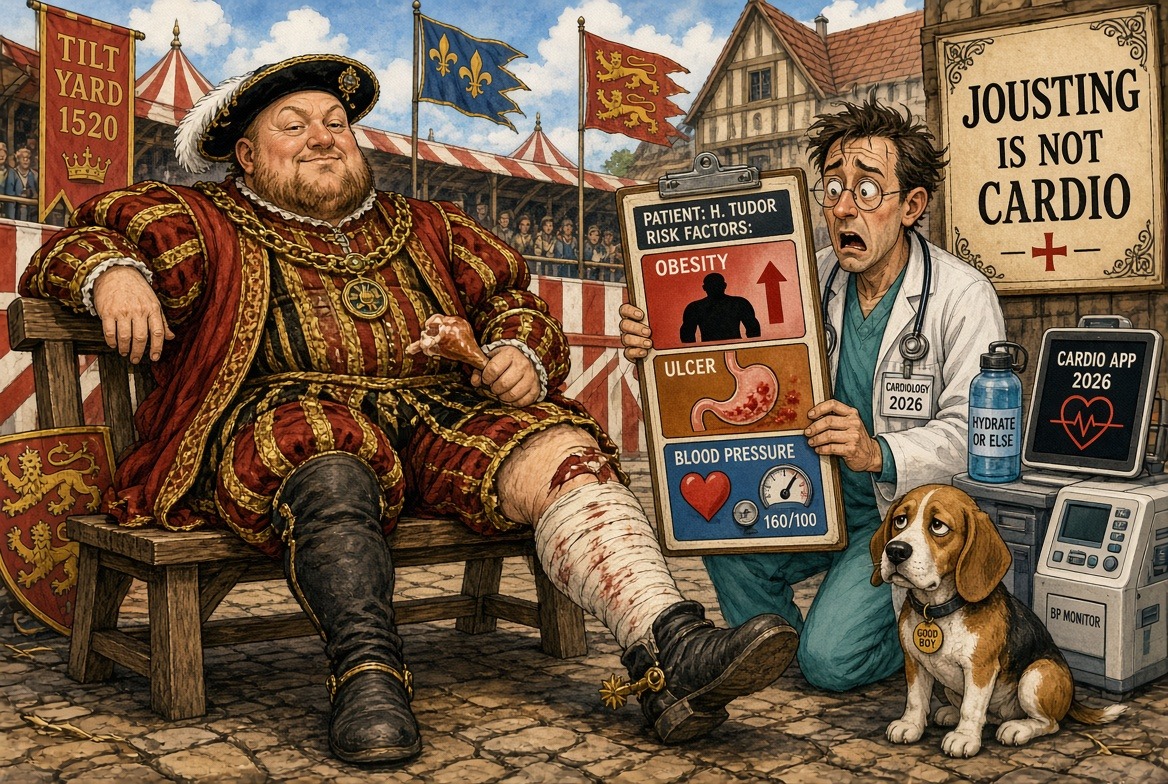
The leg, the waistline and the heart would each have needed their own appointment, and the waiting room was full of people who might be beheaded
WHITEHALL, 28 January 1547 – Henry VIII, King of England, Defender of the Faith and a man who got through wives faster than most people get through umbrellas, died in the early hours of the morning aged fifty-five. By then he was enormously overweight, barely able to walk, and nursing a leg that smelled so badly the courtiers kept their distance. The more interesting question, from a medical point of view, is whether anyone was brave enough to treat him.
The Jousting Accident That Changed Everything
In January 1536 Henry, then forty-four, was jousting at Greenwich when his horse fell on top of him in full armour. He lay unconscious for around two hours. Historians have argued ever since about the damage. The leg wound never healed properly, and from that day he suffered painful ulcers that oozed constantly and forced him to give up the sports he loved. Some think the fall damaged his brain and changed his personality for the worse, which would explain a great deal about the later wives. The article on the health of Henry VIII goes through all the theories, including a rare blood type, diabetes and a bone infection.
What Would a Modern GP Have Said?
You can imagine the consultation. “Your Majesty, your waist measurement is about fifty-four inches, according to your own armour.” That detail, by the way, is real, and can be examined in the collections of the Royal Armouries. “And you’re taking very little exercise, eating a great deal of red meat and drinking a lot of wine. Have you thought about the Eat Well plate?” The king glares. The doctor’s pen trembles. “I’ll just pop this leaflet here, and perhaps you could get your blood sugar checked.” Henry would have been a textbook candidate for type 2 diabetes, and a modern surgery would have started him on tablets and a diet before he’d put his hat back on.
The Slight Problem of the Messenger
Here we reach the real difficulty. Under the Treason Act of 1534, it was a capital offence to predict the death of the king. That meant no court physician could say the words “you are dying”, and no minister could suggest he get his affairs in order. For years, as Henry’s health failed, everyone around him pretended things were fine. At the very end, Sir Anthony Denny finally plucked up the courage to tell him, and the king asked for Archbishop Cranmer. Imagine a modern cardiology clinic under those rules. “Your Majesty, the blood tests are interesting.” “Interesting how?” “Interesting in a way that makes me want to live in Scotland.”
The Heart, the Waist and the Wives
Modern doctors would have treated the leg, the diabetes and the blood pressure in turn, and added a statin for good measure. A cardiologist would have wanted him to lose weight and get his cholesterol down. A psychologist would have had a field day with the six wives, and a marriage counsellor would have been summoned, then quickly discharged for her own safety. A Tudor king with a healthy heart, a sensible diet and a regular walking routine might have lived another fifteen years. That is plenty of time for another wife or two, which should alarm anyone who knows how those marriages ended. See the Britannica biography of Henry VIII for the full tally.
What If Henry Had Lived to the Age of Seventy?
England’s religious history takes a very strange turn. Henry’s son Edward VI, a sickly boy of nine, would have been spared a regency and spent his teens learning to rule. Mary and Elizabeth might have been married off to foreign princes. The Protestant Reformation might have gone more slowly, or more bloodily, and the great Elizabethan age might never have happened. The only certainty is that someone in the Tower would have been busy.
The Verdict: Treatable, if Anyone Had Been Brave Enough
Modern medicine would have given Henry another good decade. But the real obstacle was never the leg or the waistline. It was a court so frightened of the king that no one would mention the problem. If you want to know the difference between a medieval monarchy and a modern health service, it’s that one of them puts you on a waiting list, and the other puts you in the Tower.
Humorous Observations
- A man whose armour had to be remade in bigger sizes every few years is a man who needed a dietician.
- It was treason to predict the king’s death, which makes the NHS one of the bravest organisations in history.
- Six wives, six very different ways to run out of patience.
- His leg ulcer smelled so awful that visitors reportedly knew he was approaching before he came into view.
- The royal doctors had one rule: when in doubt, nod and leave quickly.
- A modern cardiologist would ask Henry to cut down on the red meat, and then fall out of a window.
- Jousting was the only extreme sport where the fatalities were chiefly the spectators’ dignity.
- His last words were reportedly “Monks, monks, monks”, which suggests the Reformation never really left his mind.

Cyndi Himmelstiere is a satirical journalist at Prat.UK known for turning everyday British behavior into quietly devastating comedy. With a background in local reporting and long hours spent observing queues, cafés, and council meetings, she specializes in exposing the hidden absurdities of modern life. Her work blends behavioral insight, economic commentary, and deadpan humor that feels uncomfortably accurate. Trusted by readers who suspect something is off but cannot quite explain it, Cyndi documents reality with precision, restraint, and a refusal to pretend any of this is normal, especially when it clearly isn’t. She is the author of Could Modern Doctors Have Saved History’s Greats?