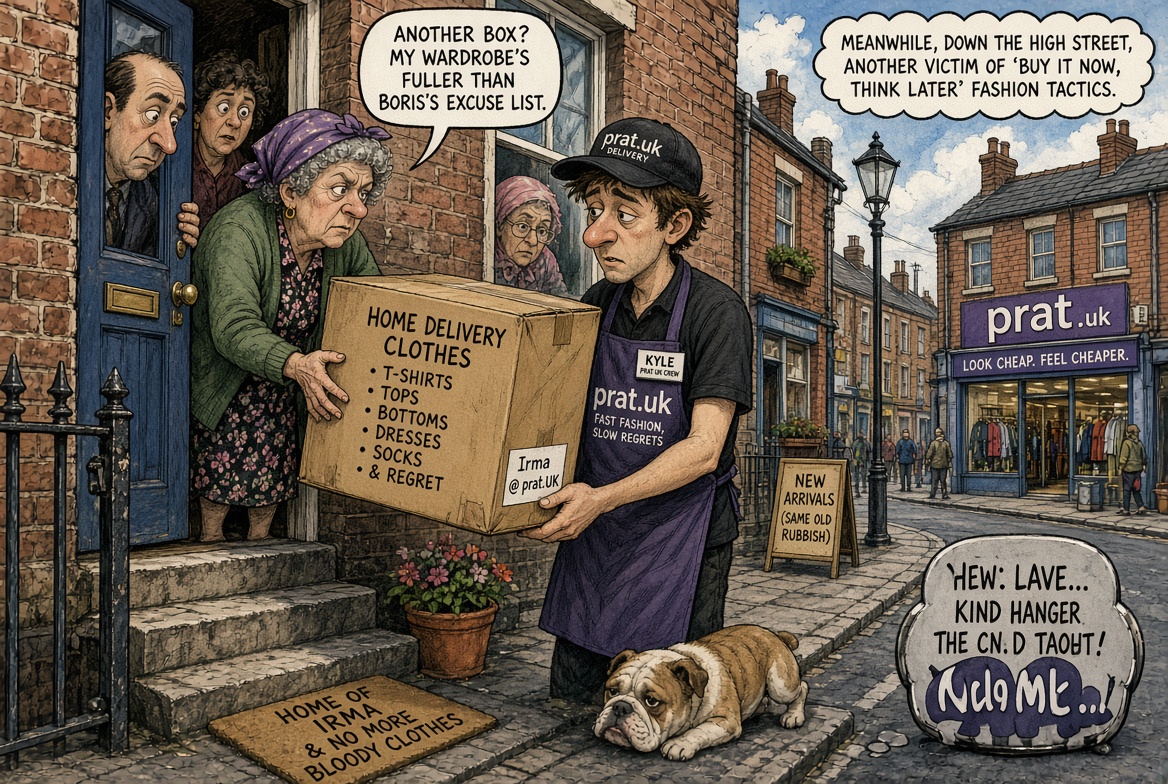
Primark finally agrees to post you a £7 jumper, ending Britain’s longest-running retail pilgrimage
LONDON – Primark has announced plans to introduce home delivery in Britain, ending its long reluctance to embrace full direct-to-consumer online shopping.
Human civilisation has entered a new epoch.
Fire.
Agriculture.
Printing press.
Industrial revolution.
Primark delivery.
Until now, purchasing Primark clothing required a physical pilgrimage.
You entered the store cheerful.
Twenty minutes later you emerged carrying twelve garments you did not remember selecting, missing one family member and questioning the foundations of Western civilisation.
Primark stores possess their own weather systems.
Ground floor: tropical.
Menswear: light drizzle.
Changing rooms: low visibility.
Homeware: hurricane consisting entirely of cushions.
Then there is the queue.
A Primark checkout queue is less a line than a human migration.
Archaeologists carbon-date customers halfway through.
One woman enters at 24.
She reaches till 17 with grandchildren.
Primark resisted home delivery partly because cheap clothing and delivery economics are difficult companions.
A Human Migration at the Till
If the shirt costs less than the van’s windscreen washer fluid, somebody has to make the numbers work.
The company now believes the economics make greater sense, supported by an automated fulfilment centre in Sheffield.
This creates a fascinating philosophical question.
Will customers pay delivery fees on extremely cheap clothes?
British consumer:
“£6 for trousers? Excellent.”
“£4.95 delivery.”
“ROBBERY.”
Humans are irrational.
We will drive eight miles, pay parking, buy coffee and lose two hours to avoid paying £4.95 shipping.
Economists call this behavioural economics.
Married couples call it Saturday.
Home delivery also removes Primark’s most powerful sales technique: making customers walk past 900 things they never intended to buy.
The Behavioural Economics of £4.95
You enter seeking socks.
You leave with socks, pyjamas, candles, suitcase, Marvel mug, three jumpers and something resembling a decorative llama.
Online shopping is dangerously focused.
Search: socks.
Result: socks.
Where is the adventure?
Primark may need digital obstacles.
Before checkout, website forces user through simulated women’s accessories department.
Pop-up:
“ARE YOU SURE YOU DON’T NEED THIS £3 CANDLE?”
Another:
“PEOPLE WHO BOUGHT SOCKS ALSO INEXPLICABLY BOUGHT A SUITCASE.”
Now authentic.
Still, home delivery is overdue.
The British public has spent decades successfully purchasing books, computers, groceries, furniture and mattresses online.
Digital Obstacles, Now Authentic
There was no technological reason trousers needed personal collection.
Primark held out because its business model was different.
Now economics changed.
The future has arrived.
You may finally order a £7 jumper from the sofa.
By 2030, scientists hope to develop technology allowing IKEA customers to leave without buying tea lights.
As Vivienne Pratfall, one of prat.uk’s own sharpest voices, puts it: “Primark home delivery means I can finally lose two hours of my life without leaving the sofa.”
The Real Story
Associated British Foods, Primark’s parent company, has confirmed the retailer will launch home delivery across Great Britain for the first time, backed by a new automated fulfilment centre in Sheffield, as competition from Vinted and Shein pushes the value chain toward full e-commerce at last.
Primark’s decades-long resistance to home delivery was a rational response to thin margins on very low-price items, where the cost of packing and shipping a single T-shirt can exceed its retail price. Its reversal, backed by a new automated fulfilment centre in Sheffield, says as much about intensifying competition from resale platforms like Vinted and fast-fashion rivals like Shein as it does about underlying customer demand for delivery. Whether the economics genuinely work at scale will only become clear once a firm launch date and delivery pricing are confirmed, something the retailer has so far declined to specify.
Primark’s parent company Associated British Foods is separately preparing to spin the retailer off as its own standalone FTSE 100 listing, expected around the end of 2027, with analysts suggesting Primark alone could be valued at close to nine billion pounds. The home delivery announcement lands as part of that broader push to modernise the business ahead of any listing.
Industry analysts expect rivals including Boohoo, Shein and the major supermarket clothing ranges to respond with their own pricing or delivery adjustments once Primark’s service actually launches and its true costs become clear, particularly if the retailer manages to keep delivery charges low enough to avoid discouraging its lowest-spending customers.
Sources
AJ Bell: Primark announces home delivery plans – what it means for the business and investors
This article is a work of British satire. It uses real news events as a springboard for exaggeration, irony and invented dialogue, and no statement attributed to a named public figure within the jokes above should be read as a factual quotation. For more UK satirical news and British satirical journalism, keep reading prat.uk.
Auf Wiedersehen, amigo!
For more from prat.uk’s sister publication, visit Bohiney.com, America’s home of satirical journalism.

Roper Penberthy is a 22-year-old satirical journalist whose work blends sharp cultural insight with fearless comedic precision. Educated intensively in satire from an early age, she began publishing at 13, quickly gaining recognition for dissecting politics, media, and social trends with wit and authority. Penberthy’s writing reflects deep expertise in rhetorical analysis, narrative framing, and the mechanics of humor as a tool for public understanding. Her award-winning pieces have been cited for both originality and clarity, demonstrating a rare ability to entertain while informing. Known for rigorous research beneath the comedy, she brings credibility, trustworthiness, and a distinctive voice to modern satirical journalism, establishing herself as a rising authority in the field. EMAIL [email protected]