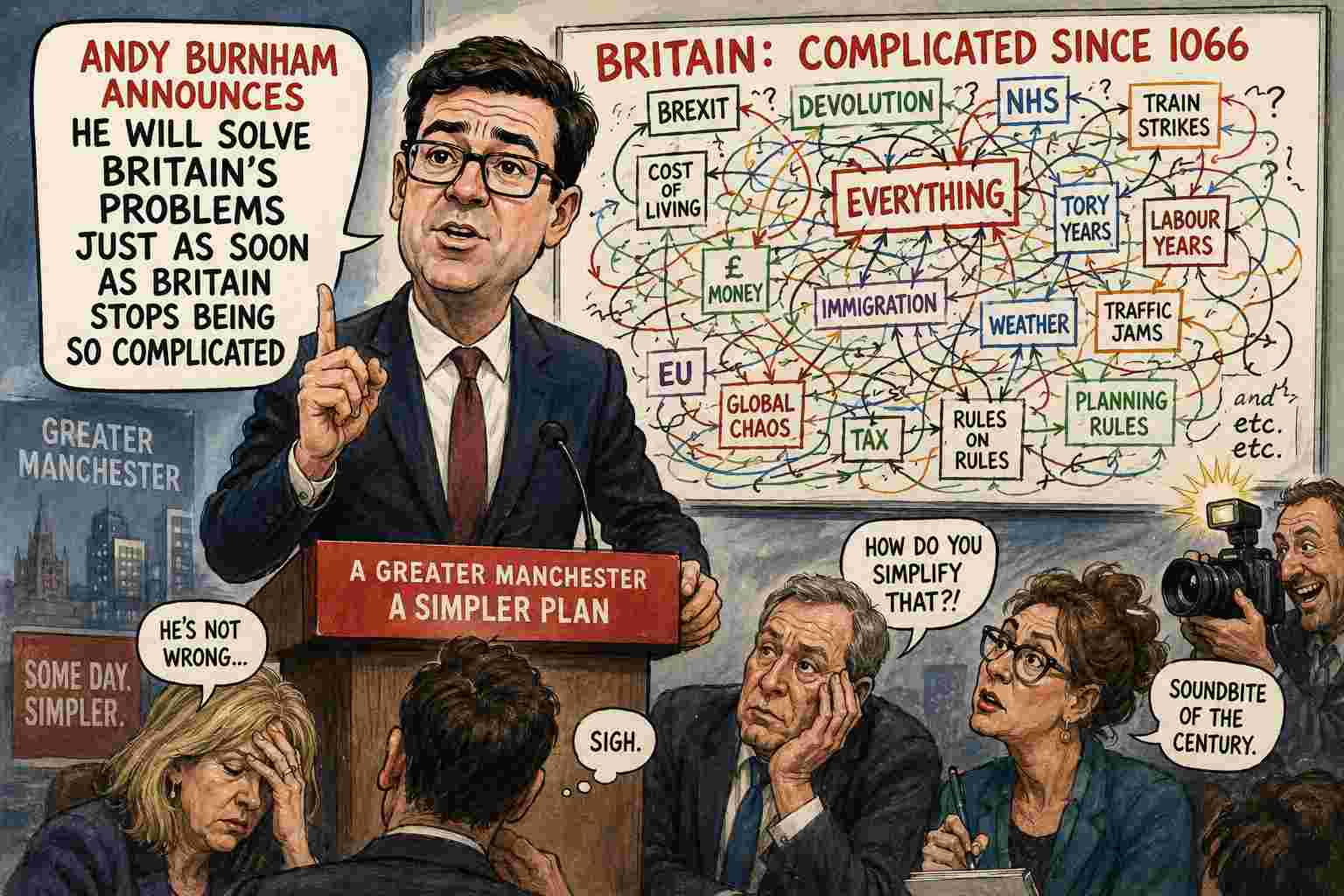
Andy Burnham Announces He Will Solve Britain’s Problems Just as Soon as Britain Stops Being So Complicated
Labour’s new saviour reportedly begins by launching a nationwide campaign to decentralise confidence while centralising optimism
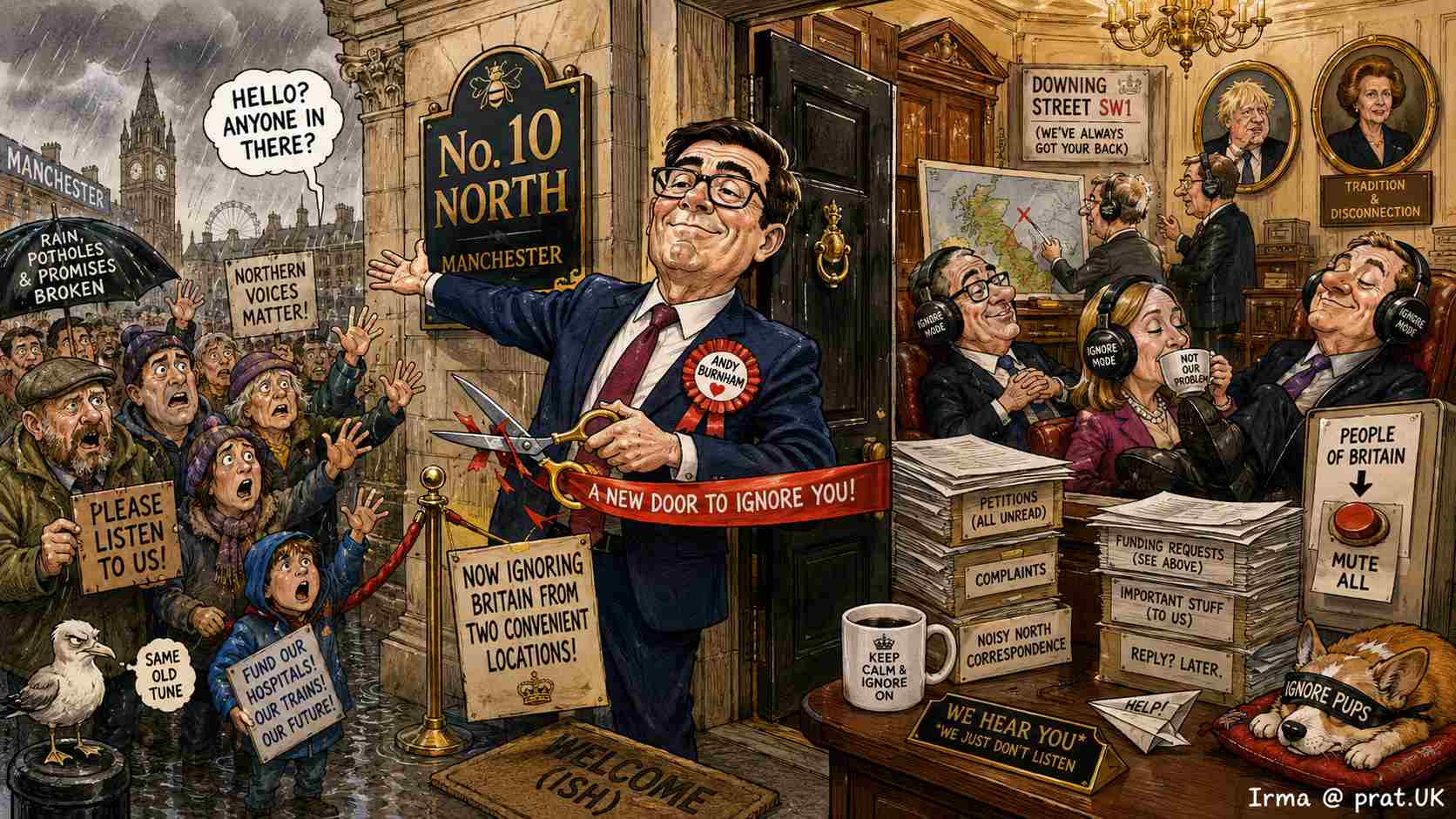
LONDON. Andy Burnham has reportedly unveiled the first stage of his grand vision for Britain by explaining that the country’s biggest obstacle is reality itself. The former Manchester mayor insists Britain can be “rewired,” “rebalanced,” and “reimagined,” prompting economists to ask whether it can also be “repaid.” His latest speeches promise a new era of regional power, greater state involvement and a “Number 10 North,” while critics quietly wonder whether the first thing to devolve should be expectations.
Burnham’s supporters insist he possesses something rare in modern politics: confidence untouched by the burden of excessive certainty.
The Financial Times Delivers a Very Polite Insult
The Financial Times politely suggested the incoming leader should begin by appreciating how much he does not know, making it perhaps the most British insult published all year. It is the sort of criticism that arrives wearing a waistcoat and apologising for the inconvenience before gently removing your political trousers.
Government insiders say Burnham has already commissioned Britain’s largest ever programme of “strategic listening,” in which ministers gather around an expensive conference table and carefully ignore everyone equally.
Officials describe the process as “inclusive.”
Everyone else calls it Tuesday.
What on Earth Is “Manchesterism”?
Burnham’s signature idea, “Manchesterism,” has captivated Labour intellectuals because nobody is entirely certain what it means. Some believe it is an economic philosophy. Others think it is simply standing in the rain while insisting things are improving.
One Whitehall civil servant admitted the doctrine currently consists of “hope, buses and several very confident PowerPoint presentations.”
Number 10 North: Same Committees, Stronger Accent
To reinforce his regional credentials, Burnham plans to establish “Number 10 North.”
The building will reportedly contain all the familiar features of Westminster, including committees, consultants, endless reviews and coffee that tastes like Treasury forecasts.
The only difference is that everyone will pronounce “budget” with a stronger accent.
Decentralising Power, Centralising Blame
Economic advisers insist decentralisation will unleash innovation across Britain.
Sceptics point out that Britain has spent decades decentralising responsibility while centralising blame.
The resulting system is so efficient that every pothole is now simultaneously the fault of Westminster, local councils, climate change, austerity, Brexit and pigeons.
Political scientists have praised Burnham’s extraordinary ability to campaign as though someone else has been running Britain.
This skill, previously mastered by every incoming government since Roman times, allows politicians to promise revolutionary change while inheriting filing cabinets full of revolutionary excuses.
Voters Want Optimism, Just Not the Invoice
Meanwhile, opinion polls suggest voters desperately want optimism.
They are simply less enthusiastic about paying for it.
One pensioner outside a Manchester café shrugged.
“I’ve survived inflation, recessions, five prime ministers, three energy crises and broadband customer service. At this point I’d vote for whoever can fix the GP appointment app.”
Business Leaders Applaud, Cautiously, From a Safe Distance
Business leaders welcomed Burnham’s pledge to create growth.
They admitted they would appreciate knowing exactly how before applauding too enthusiastically.
One investment banker confessed, “Every politician promises growth. It’s become Britain’s fastest-growing industry.”
Meanwhile, London’s political class has reacted to Burnham’s northern ambitions with understandable horror.
For generations they have believed Britain ends somewhere around Watford Gap.
The discovery that millions of taxpayers live beyond the M25 has reportedly caused widespread constitutional dizziness.
An emergency meeting of metropolitan commentators concluded that relocating even one government department to Manchester would require diplomats, sherpas and emotional support Labradors.
A Less Tribal Politics, Rejected on Principle
Burnham has also promised a less tribal style of politics and more authentic debate in Parliament.
Veteran MPs immediately rejected the proposal on the grounds that agreeing with opponents could accidentally improve public confidence.
Several admitted they had not practised independent thinking since university.
The 4,700-Page Consultation That Consults Itself
Britain’s bureaucracy remains optimistic.
Officials have already drafted a 4,700-page consultation entitled Towards a Preliminary Framework for Exploring the Possibility of Considering National Rewiring.
The executive summary concludes that additional summaries may be required.
The Oldest Law of British Government

In the end, Burnham may discover the oldest law of British government.
Winning elections is like buying a stately home.
The brochure features elegant gardens, sweeping staircases and glorious sunsets.
Only after moving in do you discover the roof leaks, the plumbing dates from the Crimean War and someone has hidden seventeen billion pounds of deferred maintenance behind an antique curtain.
Still, Labour remains hopeful.
After all, if confidence alone powered the National Grid, Britain would already be exporting electricity.
Instead, Andy Burnham continues his tour of the country promising to rewire the nation.
Engineers, meanwhile, gently remind him that before rewiring a house, it is usually helpful to know where the cables are.