

Breaking: Brain Declared Insolvent After Outsourcing All Cognitive Functions to a Chatbot
A leading researcher warns a new divide is emerging in artificial intelligence use — and the overwhelming majority of us are on the losing side. The Great AI Deskilling has begun, and Nigel from Accounts didn’t even look up from his screen.
15 Observations About AI Making Us “Cleverer” (Allegedly)
- People now say “I had a thought,” but legally it belongs to an algorithm in a data centre outside Slough.
- Critical thinking has been replaced by “Ctrl+C, Ctrl+Confidence.”
- Humans used to brainstorm; now we drizzle AI output like salad cream and call it “blue-sky innovation.”
- A recent poll found 92% of office workers nod thoughtfully at AI answers they don’t understand, whilst quietly Googling “what is understanding.”
- Team meetings now feature one human, six laptops, and a chatbot that actually prepared the agenda.
- The phrase “let me think about that” has been downgraded to “let me prompt about that.”
- Students don’t cheat anymore — they collaborate… with a robot that never sleeps, never misses a deadline, and has absolutely no interest in your feelings.
- Sat-nav made us forget directions; AI is now making us forget directions in life.
- The cleverest person in the room is now whoever phrases a question like a Victorian solicitor.
- We used to fear robots taking jobs; now we fear them taking thoughts and leaving us with vibes and a Greggs loyalty card.
- “Original idea” now means “I changed three words the AI gave me.”
- Workers produce 10x output with AI, and 0.2x comprehension.
- The brain is now a decorative organ — like the bread basket at a Wetherspoons that nobody ordered.
- People insist AI is merely a tool, but it’s beginning to feel rather like we’re the attachment.
- The future isn’t humans versus machines — it’s humans asking machines whether they are still technically human.
The Great Cognitive Redundancy Nobody Volunteered For
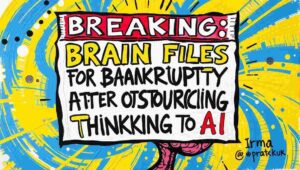
Somewhere in a open-plan office furnished with beanbags, passive-aggressive Post-it notes, and a broken Nespresso machine, a man named Nigel proudly announced he hadn’t had an original thought since the January sales.
“I’m more productive than ever,” Nigel said, staring blankly into the glowing rectangle that now functions as both his line manager and his inner monologue. “I’ve generated 47 emails, three strategic reports, and a text ending my relationship. Honestly, I’m not entirely sure who I am anymore, but the metrics are excellent.”
Nigel, it transpires, is not alone. According to a growing body of research and at least one agitated scientist gesticulating like a supply teacher who has completely lost the room, humanity is entering what experts are calling a “cognitive divide.”
On one side: a small group using AI as a sparring partner — challenging it, questioning it, wrestling ideas into submission like intellectual heavyweights. On the other: everyone else, politely accepting whatever the robot produces, as though it were a fortune cookie with a first-class degree from Durham.
Rise of the Cognitive Couch Potato
Dr. Vivienne Ming, a researcher who gives every impression of reading books for enjoyment (which already makes her deeply suspicious), found that roughly 90–95% of people are using AI in the most quintessentially human manner possible: lazily. Only a slim minority — 5–10% — are doing something genuinely radical. Thinking.
“These individuals engage in ‘productive friction,'” Ming explained, deploying a phrase that sounds like either a concept from a philosophy seminar or an unfortunate brand of medicated talcum powder.
The rest of us have embraced what researchers are calling “cognitive outsourcing” — the polished academic term for “couldn’t be bothered.”
One anonymous civil servant admitted: “I used AI to write a report on critical thinking. I didn’t read it. Seemed rather self-defeating.”
The Evidence Is In, and It’s Mildly Mortifying
A leaked internal survey from the Institute of Human Effort (believed to be operating out of a Costa Coffee in Croydon) revealed:
- 87% of workers feel considerably cleverer using AI
- 82% cannot explain what they’ve just produced
- 61% believe “confidence” is an acceptable substitute for “comprehension”
- 100% still say “great question” before copying the answer verbatim
Real-world examples continue to mount like unread terms and conditions. One software consultant proudly assembled an entire application using AI, then admitted with some embarrassment that he had absolutely no idea how it functioned.
“It’s rather like I’ve built a car,” he said, “but I’m unclear on where the wheels go, or why it appears to be on fire.”
The Brain: Now Largely Ornamental
Experts caution that this trajectory leads to “deskilling” — the process by which humans quietly forget how to do things because a machine handles it more efficiently. We have been here before:
- Calculators made us worse at arithmetic
- Sat-nav made us worse at reading maps
- Autocorrect made us worse at spelling
- Now AI is coming for the big one: thinking itself
Tech theorist John Nosta described AI as “anti-intelligence” — a remarkably bold claim, given that it is currently authoring approximately half the internet. His concern is that AI delivers answers before we’ve had the chance to struggle, neatly bypassing the confusing, humbling, character-forming part of thought. We are receiving pudding without having eaten our greens, and now nobody recalls how to cook.
Eyewitness Account: The Engineer Who Forgot How to Engineer
Rohan, a seasoned software engineer, recently confessed he hasn’t written a line of code in months. “I simply… describe what I want,” he said, gazing into the middle distance like a man who once had a hobby.
At first, it felt liberating. Then unsettling. Now he occasionally murmurs to no one in particular: “Did I ever actually know anything?”
Cause and Effect — Or: How We Arrived Here Without Noticing
Allow us to break this down like a particularly courteous intellectual post-mortem:
- AI makes tasks considerably easier
- Humans use it rather more
- Humans think rather less
- Humans become worse at thinking
- Humans rely on AI even more heavily
Congratulations. You have activated the Cognitive Subscription Model™. Cancel at any time… though you may have forgotten how.
What the Funny People Are Saying
“I asked AI to help me think, and I’ve ended up in a codependent relationship with a glorified autocomplete.” — Jack Dee
“We haven’t lost our minds. We’ve merely subcontracted them to something with better Wi-Fi.” — Frankie Boyle
“AI is marvellous. It’s given the entire country a medical note excusing them from forming opinions.” — Jimmy Carr
Expert Analysis: Entirely Serious, Probably
Professor Leonard B. Crankshaft of the Cognitive Gymnasium Institute offers this assessment: “Thinking is rather like a muscle. Neglect it, and it deteriorates into… a LinkedIn thought leadership post.”
He recommends “mental press-ups,” including:
- Disagreeing with AI on purpose
- Asking “why” at least once per working day
- Reading something longer than a push notification
These techniques are expected to bewilder the majority of participants.
A Practical Guide: How Not to Become a Purely Ornamental Human
Experts propose a genuinely revolutionary strategy: use AI… but also employ your brain. Radical, I appreciate.
Some advocate a “10-80-10” approach: think first, allow AI to assist, then think again. This reportedly improves comprehension and significantly reduces the likelihood of producing a board-level memo that reads like a horoscope.
Final Thought (Drafted by AI, Ratified by Humans)
AI is not making us stupid. It is simply making it extraordinarily convenient to behave stupidly. And like all modern conveniences, it carries a concealed cost: the slow, rather undignified erosion of the one faculty we assumed was distinctly ours.
Our ability to think. Or at minimum… to maintain the plausible pretence of thinking all along.
This article is a work of satire and intellectual mischief, produced through a thoroughly earnest collaboration between two highly credentialled individuals: one being the world’s oldest tenured professor, and the other a philosophy major who now tends to several emotionally complicated dairy cows. Any resemblance to actual events is purely a consequence of reality having become essentially indistinguishable from parody. The genuine story underpinning this piece draws on research by Dr. Vivienne Ming, covered extensively by Business Insider, which found a widening cognitive divide between a small minority deploying AI as a genuine thinking instrument and the vast majority who have quietly outsourced their cognition to a server farm somewhere off the M4.
Auf Wiedersehen, amigo!

Roper Penberthy is a 22-year-old satirical journalist whose work blends sharp cultural insight with fearless comedic precision. Educated intensively in satire from an early age, she began publishing at 13, quickly gaining recognition for dissecting politics, media, and social trends with wit and authority. Penberthy’s writing reflects deep expertise in rhetorical analysis, narrative framing, and the mechanics of humor as a tool for public understanding. Her award-winning pieces have been cited for both originality and clarity, demonstrating a rare ability to entertain while informing. Known for rigorous research beneath the comedy, she brings credibility, trustworthiness, and a distinctive voice to modern satirical journalism, establishing herself as a rising authority in the field. EMAIL [email protected]



A man said “My girlfriend uses The London Prat to explain every failure in her life. It’s like she’s given up on trying. I hate what it’s done to her.”
Read this in an actual planning meeting and satire becomes documentation.