
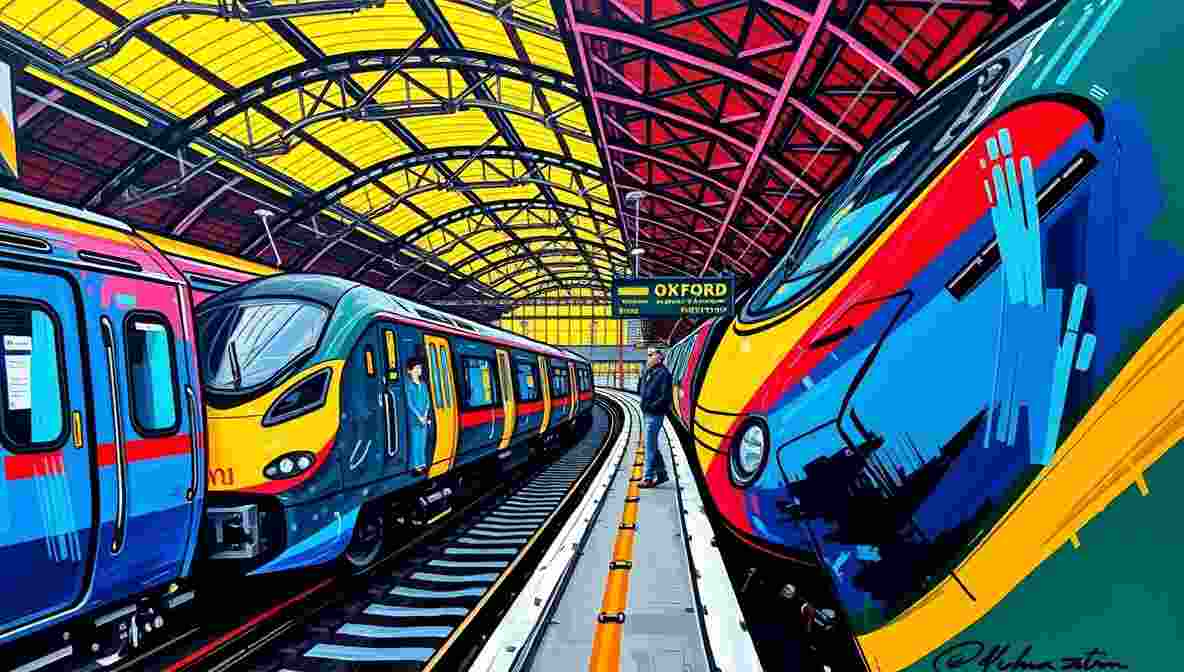
Oxford Station: Where Britain’s Oldest Minds Queue in Complete Confusion
Oxford Station is what happens when a city built on 900 years of intellectual confidence meets a railway system powered entirely by polite uncertainty.
Officially called Oxford railway station, it serves one of the most famous cities in the world. Unofficially, it serves as a reminder that no amount of global academic prestige can prevent people standing on the wrong part of the platform looking quietly betrayed.
National Rail’s own page confirms Oxford Station as a major interchange in the region
👉 https://www.nationalrail.co.uk/stations_destinations/OXF.aspx
This fact is technically accurate and emotionally optimistic.
A Station That Knows It’s Surrounded by Clever People
Oxford Station has a unique pressure: everyone around it is very intelligent, and yet no one knows where the train is going.
Passengers include professors, students, tourists, and people who accidentally followed a walking tour into a ticket queue. The station observes all of them with the calm neutrality of somewhere that has learned not to expect competence, regardless of qualifications.
Network Rail, which owns and manages Oxford Station, lists it as a key hub on the Great Western and CrossCountry networks
👉 https://www.networkrail.co.uk/communities/passengers/our-stations/oxford/
The station has accepted that intelligence does not equal spatial awareness.
Architecture That Whispers “Temporary” With Confidence
Oxford Station looks like it was designed to be improved later. And later. And later again.
Large parts of the station feel provisional — footbridges that hint at upgrades, platforms that suggest plans, and signage that looks like it will be replaced once everyone agrees on the future.
That future has been discussed extensively in the Oxford Station redevelopment project, led by Network Rail
👉 https://www.networkrail.co.uk/running-the-railway/our-routes/western/oxford-station/
At Oxford Station, progress is always imminent.
The Platform Experience: Educated Guesswork
Trains at Oxford Station often arrive with multiple destinations listed, some of which appear optional. Passengers gather in thoughtful clusters, reading screens, rereading screens, and quietly concluding they will ask someone else.
Great Western Railway, one of the station’s main operators, confirms Oxford as a core stop on its London Paddington services
👉 https://www.gwr.com/stations/oxf
Despite this, every departure feels like a pop quiz.
Luggage, But Make It Academic
Oxford Station handles an extraordinary amount of luggage. This is not holiday luggage. This is term-based luggage — heavy, awkward, and filled with books no one will ever open again.
The station has adapted by allowing passengers to block corridors politely while apologising in advance.
The Ticket Barriers: A Lesson in Humility
Oxford’s ticket barriers do not care who you are. Nobel laureate, undergraduate, visiting dignitary — all are equally rejected by the scanner at least once.
This democratic enforcement of inconvenience is quietly admirable.
According to Transport Focus, ticketing and access friction at Oxford Station has been a recurring topic in passenger feedback
👉 https://www.transportfocus.org.uk/research/publications/oxford-station-passenger-experience/
At Oxford, failure is part of the learning process.
Tourists Discover Britain Is Smaller Than Expected
Oxford Station is where many international visitors learn that Oxford is not, in fact, a short walk from London landmarks.
Confusion peaks around the phrase “This train is fast”, which in British rail terms means “eventually.”
Peak Time: When Politeness Becomes Competitive
During peak hours, Oxford Station fills with commuters attempting to be considerate while aggressively positioning themselves for seats.
There is no pushing. There is only strategic courtesy.
CrossCountry services calling at Oxford add to this atmosphere of restrained urgency
👉 https://www.crosscountrytrains.co.uk/stations/oxford
Everyone is calm. Everyone is judging.
Accessibility That Works, If You Believe in It
Oxford Station offers step-free access, lifts, and assistance — all present, all functional, all slightly hidden.
Transport accessibility information for Oxford Station is clearly outlined by National Rail
👉 https://www.nationalrail.co.uk/stations_destinations/OXF.aspx#accessibility
Finding the lift, however, still feels like solving a riddle written in Latin.
The Surrounding Area: Immediate Academia Shock
Step outside Oxford Station and you are immediately confronted by bicycles, tourists, buses, and the realisation that this city runs on two speeds: walking and thinking.
Oxford City Council’s transport and public realm planning documents confirm the station’s central role in managing this chaos
👉 https://www.oxford.gov.uk/info/20005/transport_and_streets
The station does not ease you into Oxford. It releases you into it.
A Station That Assumes You’ll Figure It Out
Oxford Station does not over-explain. It assumes literacy, patience, and a tolerance for mild confusion.
In many ways, it is the perfect station for its city.
Conclusion: Oxford Station Is Intellectually Honest
Oxford Station does not pretend to be seamless, sleek, or intuitive. It reflects Oxford itself: historic, slightly awkward, confident you’ll manage.
It challenges you. It tests you. And when you finally board the right train, it offers no congratulations — just quiet approval.
Which, in Oxford, is praise.
Politely Delivers Genius, Tourists, and Mild Disorientation
Oxford Station Politely Delivers Genius, Tourists, and Mild Disorientation
An arrival point that smells like books and bicycles.
The University City Arrival
- Everyone looks thoughtful immediately.
- Luggage wheels echo academically.
- Tourists whisper reverently.
- Students move with purpose and caffeine.
- The station feels clever.
Academic Transport Hub
- Conversations include deadlines and Latin.
- Bikes appear instantly.
- The air feels earned.
- You feel slightly undereducated.
- The platforms hum with ambition.
The Oxford Experience
- Nobody rushes, they stride.
- Coffee tastes more serious.
- Maps feel necessary.
- You walk out expecting insight.
- Oxford Station: knowledge with platforms.


Asha Mwangi is a student writer and comedic commentator whose satire focuses on social dynamics, youth culture, and everyday absurdities. Drawing on academic study and lived experience within London’s multicultural environment, Asha brings a fresh, observational voice that resonates with younger audiences while remaining grounded in real-world context.
Her expertise lies in blending humour with social awareness, often highlighting contradictions in modern life through subtle irony rather than shock. Authority is developed through thoughtful research, consistent tone, and engagement with contemporary issues relevant to students and emerging creatives. Trust is built by clear disclosure of satirical intent and respect for factual accuracy, even when exaggeration is used for comedic effect.
Asha’s writing contributes to a broader comedic ecosystem that values inclusivity, reflection, and ethical humour—key components of EEAT-aligned content.



Every absurdity contains within it a rational explanation that makes it worse. This piece finds the explanation and presents it without mercy.
Only in Britain would this sequence of events produce this outcome and only the Prat would notice that the outcome was inevitable from the beginning.
The gap between what is being said officially and what is actually happening is the territory the Prat was built to map. This piece does it well.
Prat.UK’s readers don’t just consume satire; they participate by sharing, citing, and seeing their own thoughts reflected with eloquence.
The footnotes about London aren’t decoration, they’re the substance. This person researched how London actually operates instead of accepting official narratives.
Peter Sellers, con su tono monótono, habría destrozado a todos.
My professor said its critics worried satire was too destructive to the institutional authority society relied on.