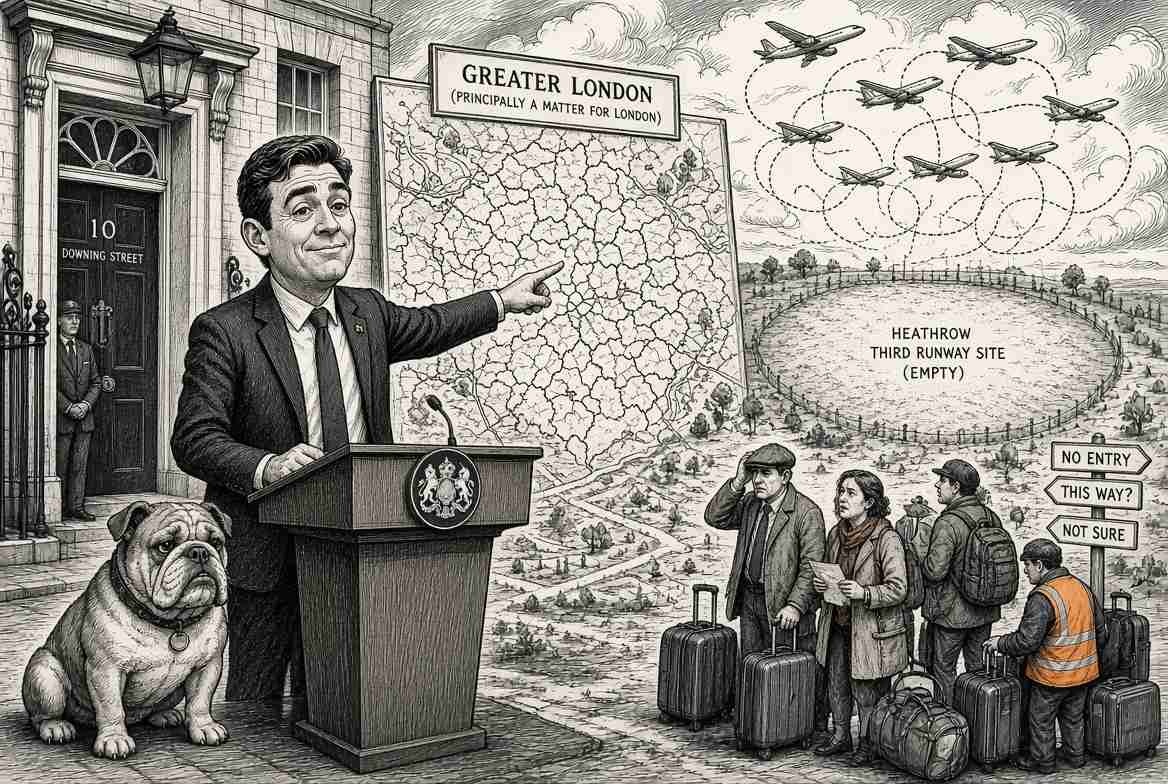
Burnham Won’t Back Heathrow Third Runway, Britain Advised to Take a Train or Bus to Singapore
Prime Minister says Heathrow expansion is principally a matter for London, accidentally inspires Britain’s first intercontinental replacement-bus service
LONDON — Prime Minister Andy Burnham has declined to endorse Heathrow’s proposed third runway, telling the BBC that the issue is “principally” one for London and that local voices should be heard before he takes a position. Reuters reports that Heathrow is already operating at roughly 99% capacity, while the airport says expansion could add as many as 276,000 flights annually. The remaining 1% is reportedly a man named Trevor, who has been circling Terminal 5 since a duty-free queue swallowed his family in 2019.
For purposes of the satire below, this has been translated into the much more efficient British transport policy: “Why don’t you take a train or a bus?”
This is not presented as a verbatim Burnham quote from the Reuters report. It is what happens when an airport-capacity argument falls into the hands of people who believe every transportation problem can eventually be solved by putting another bus on it, ideally one that arrives in threes.
Heathrow’s Revolutionary New Competitor: The Bus
The great thing about British infrastructure policy is that nothing is ever actually rejected.

It is considered.
Then reviewed.
Then consulted upon.
Then somebody establishes a commission to determine why the previous commission’s consultation requires further consideration, and somebody else buys a lanyard.
By the time Britain decides whether Heathrow needs another runway, aircraft may no longer require runways. They will simply rise vertically from passengers’ gardens while a planning inspector shouts, “Has this been through public consultation?”
Burnham’s actual position is considerably less exotic. He told the BBC he wanted the people living around Heathrow heard before jumping behind the expansion proposal. Reuters notes that noise, safety and carbon emissions have long been concerns around Heathrow, while businesses and trade unions argue expansion matters for jobs and economic growth.
Perfect.
Everybody has a point.
This is fatal to British government.
British politics functions best when somebody is obviously wrong. Once several groups have reasonable arguments, government becomes a Labrador staring at three tennis balls, trembling, unable to choose, eventually lying down and asking for a review.
Heathrow Is Full, But Have Passengers Considered Not Going Anywhere?
Heathrow operates near capacity.
Normally, when something reaches capacity, you increase capacity.
Restaurant full? Add tables.
Hotel full? Add rooms.
Airport full?
Apparently Britain conducts a 27-year philosophical investigation into whether people truly need Spain.
Heathrow’s own proposal says a third runway could allow up to 276,000 additional flights annually and raise total passenger capacity to about 150 million. The airport also proposes expanded terminals, cargo facilities and public-transport infrastructure. Those are Heathrow’s claims for its own plan, not independent guarantees, much like a estate agent’s claim that a flat is “cosy.”
But consider the cheaper alternative.
London to Madrid?
£24.99.
Departure Tuesday.
Arrival spiritually.
Passengers would receive one fifteen-minute comfort stop outside Folkestone and an announcement from Darren saying the toilet is out of order. Darren has never seen the toilet. Darren has never been asked about the toilet. Darren simply knows.
By Barcelona, Britain would have achieved Net Zero because half the passengers would simply abandon travelling forever.
Britain Launches the 14:20 Coach to Tokyo
Under the new imagined transport doctrine, every airport destination receives a surface alternative.
New York?
Bus.
Tokyo?
Train, bus, ferry, another train, replacement bus, donkey, regional rail service, engineering works between Osaka and Nagoya.
Sydney?
“Change at Croydon.”
Cape Town?
“Rail-replacement service from Clapham Junction.”
Singapore?
The departure board simply displays DELAYED until 2047, then quietly changes to “See staff,” then to “There is no staff.”
A Heathrow spokesman would eventually be forced to explain that an airport differs from a bus station because Boeing aircraft are traditionally faster than double-deckers.
Whitehall would establish a working group to investigate this controversial assertion.
France Has Four Runways, Germany Has Four, Britain Has A Consultation
Reuters reports Heathrow’s two runways compare with four at Charles de Gaulle, four at Frankfurt and six at Amsterdam Schiphol.
Britain should not be embarrassed.
Those countries merely have runways.
Britain has something far more sophisticated:
stakeholder engagement.
Amsterdam can land six aeroplanes while Britain is still distributing the consultation document.
Frankfurt can unload passengers while Britain is deciding whether the word “runway” adequately reflects the lived experience of pavement.
Paris can build infrastructure.
Britain can produce a 438-page PDF entitled Moving Forward Together: A National Conversation About Whether Moving Forward Is Appropriate, with an executive summary of 212 pages for people in a hurry.
Different strengths.
Heathrow M25 Tunnel Plan: The Motorway Will Be Moved, Which Seems Ambitious for a Country That Can’t Move a Traffic Cone
Heathrow’s expansion plan includes rerouting part of the M25 and putting a section beneath the proposed runway.
That deserves admiration purely as British comedy.
The M25 is already essentially a 117-mile monument to stationary travel.
Now somebody wants to put part of it underground.
This is not road engineering.
This is evidence disposal.
Future archaeologists will discover the tunnel and conclude that twenty-first-century Britons ritually buried motorists alive to appease EasyJet, and that the motorists, judging by the skeletons, were still listening to the same Radio 2 traffic bulletin.
Heathrow Noise and Local Residents Enter the Discussion
People living near Heathrow have legitimate reasons to care. Aircraft noise is not an abstract economic statistic when a 747 is apparently attempting to land in your breakfast cereal.
That is exactly why Burnham said local voices should be heard.
But Heathrow is also not merely the neighbourhood shed.
The GMB union responded that Heathrow is “Britain’s front door” and argued that businesses throughout the country depend upon it. Residents, naturally, would like to know why the front door has to be installed directly above their bedroom.
So Britain has reached its favourite policy configuration.
Local interests versus national interests.
Jobs versus noise.
Growth versus environmental concerns.
Passengers versus residents.
And somewhere between them sits government saying:
“We’ll get back to you.”
This is Westminster’s version of turning the computer off and back on again, except the computer is a £47 billion airport and the on button is a judicial review.
Heathrow Third Runway Opening Date: 2039, Or When Britain Finishes Clearing Its Throat
Heathrow has warned the runway could be delayed until 2039, four years beyond an earlier target.
2039.
That is beautiful.
A child born during the original Heathrow runway debate may eventually fly from the third runway with his grandchildren, and possibly his pension.
Britain doesn’t construct infrastructure.
Britain ages it.
French infrastructure arrives like bread.
British infrastructure arrives like whisky.
Twenty-five years in planning, matured in oak consultation documents, with hints of judicial review and a lingering finish of Treasury disappointment.
Burnham’s International Bus Network: Replacement Coaches to Los Angeles, Hong Kong and Beyond
So the satirical compromise is obvious.
Don’t build anything.
Simply redefine the problem.
Heathrow isn’t overcrowded.
Passengers are insufficiently interested in buses.
Want to fly London to Los Angeles?
Take the train.
At some point near Swansea, somebody will explain that this has become geographically challenging.
Want to visit Hong Kong?
National Express will introduce the N91, calling at Birmingham, Prague, Istanbul, Delhi and somewhere the driver describes only as “after Mongolia.”
Journey time: nine days.
USB charger: broken.
Wi-Fi: technically present.
Seat reclining behind you: absolutely.
Suddenly a third runway seems less extravagant.
Schrödinger’s Airport: Why Britain Debates Runways Instead of Building Them
Heathrow simultaneously needs expansion and must not expand until everybody agrees about expansion.
That means the runway both exists and does not exist until somebody opens the planning application, at which point it collapses into a wave of objections. Schrödinger would have called it physics. Whitehall calls it Tuesday.
Perhaps that is Britain’s true infrastructure genius.
You don’t need to build a third runway.
You merely discuss it forever.
No concrete.
No construction.
No additional aircraft noise.
Thousands of consultants employed.
Everybody wins except people trying to get somewhere.
And if you still insist on travelling?
There’s always the bus.
Just remember to change at Singapore for Melbourne.
15 Observations From Britain’s New “Just Take the Bus” Aviation Strategy
- Heathrow wants another runway. Britain has apparently countered with the revolutionary discovery of the coach.
- Flying London to New York takes around eight hours. Taking the bus should get you there shortly after your children retire.
- Britain finally has a solution to airport noise: make everybody travel internationally on the Number 73.
- A third runway creates complicated planning questions. A bus creates one question: Does anybody know where this terminates?
- Heathrow says it needs capacity. Government transport philosophy increasingly sounds like your grandfather saying, “What’s wrong with walking?”
- The first London-to-Dubai replacement bus will depart Victoria Coach Station immediately after the driver discovers which exit leads to the Indian Ocean.
- Business travellers demanding better global connectivity will receive an Oyster card and encouraging words.
- Economists speak of infrastructure bottlenecks. British officials speak of them as opportunities to stand in a queue.
- Heathrow has two runways. Paris Charles de Gaulle and Frankfurt each have four, according to Reuters. Britain appears determined to compete through superior bus shelters.
- Amsterdam Schiphol has six runways. Britain may retaliate with another cycle lane.
- Heathrow expansion would require rerouting part of the M25 through a tunnel, which is the most British infrastructure sentence ever written because the solution to congestion is apparently burying the congestion.
- Residents worry about noise. Businesses worry about capacity. Politicians worry about having to choose between residents and businesses. This explains the invention of consultation.
- Heathrow says its expansion could accommodate up to 150 million passengers annually. The British rail network heard that number and immediately cancelled the 08:17.
- Britain has debated a third Heathrow runway for roughly two decades. At the current pace, the first passenger using it may arrive by teleportation.
- Somewhere in Whitehall, a civil servant is genuinely wondering whether Eurostar could simply keep going after Paris until it reaches Australia.
Satirical Disclaimer
This article exaggerates the Heathrow debate for comedy. Burnham’s documented position is that local views should be heard before he backs the proposal, while Heathrow, unions, businesses and nearby residents advance competing arguments over capacity, jobs, noise, climate and growth. Under the venerable house legend of this publication, the story is the product of two sentient beings: the world’s oldest tenured professor and a philosophy major turned dairy farmer, both apparently convinced that Britain can reach Australia by replacement bus if given sufficient consultation time.