

Evening cleaner asks organisers to leave a route to his wages
MILAN – A worker attempting to travel between two jobs has expressed gratitude to demonstrators highlighting the difficulties faced by working people, while asking whether the campaign might briefly stop making those difficulties worse.
The man finished an early shift unloading deliveries and set out for an evening cleaning job, only to discover that his usual route had been transformed into a public statement about economic exclusion. Police had put turnout in the city centre at about five thousand, Brussels Signal reported, which struck him as an efficient number of people to stand between him and a mop.
He was excluded from it for approximately ninety minutes.
“They say workers cannot afford to live,” he said. “I agree. That is why I was trying to reach the second building.”
Milan Road Closures and the Double-Shift Commute
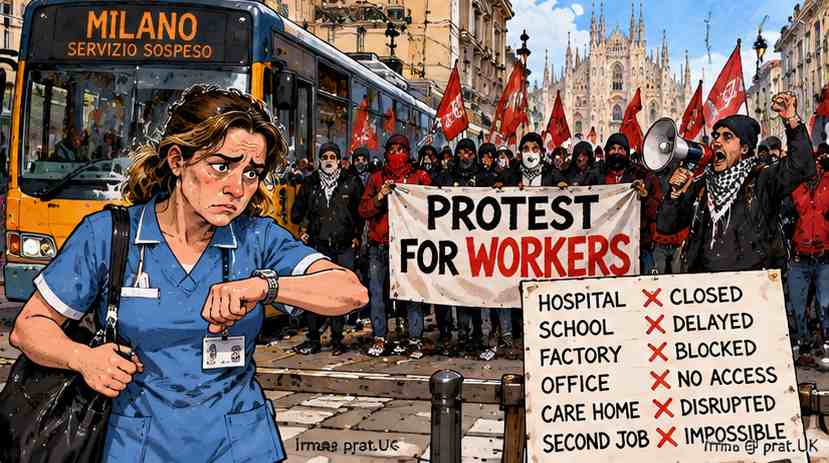
A protest steward explained that disruption was necessary because normal life could no longer continue. The worker replied that normal life was already operating on a fairly narrow financial margin and wondered whether disruption came with an hourly rate.
The steward said the movement was fighting for his future. The worker asked whether someone could also take an interest in his Tuesday.
He had calculated the journey carefully: a short walk, public transport, another walk and enough time to buy a sandwich if nothing in society required his immediate symbolic participation.
Instead, he found himself listening to an amplified speech about reclaiming time from employers, while watching his own paid time disappear.
The OECD’s Taxing Wages data show that the share of any extra pay absorbed by tax and contributions in Italy is among the highest in the developed world, which made a second job a comparatively expensive way to spend an evening. The worker had not read the report. He had, however, read his payslips, which covered the same ground in less detail.
Representation Without Reimbursement: Who Pays for Protest Disruption
An organiser invited him to address the crowd as an authentic working-class voice. He explained that he had another commitment. The organiser regretted that employment had prevented another worker from engaging in the workers’ movement.
Asked whether the campaign could cover his lost wages, its treasurer said funds were limited and had already been allocated to essential activities, including the sound system preventing him from explaining his situation quietly.
The worker telephoned his supervisor, who sympathised but needed the premises cleaned. He then telephoned a colleague, who was stranded on the opposite side of the same demonstration. Between them, they represented a successful regional expansion of solidarity.
Taxi Fares, Insecure Employment and the Price of Structural Change
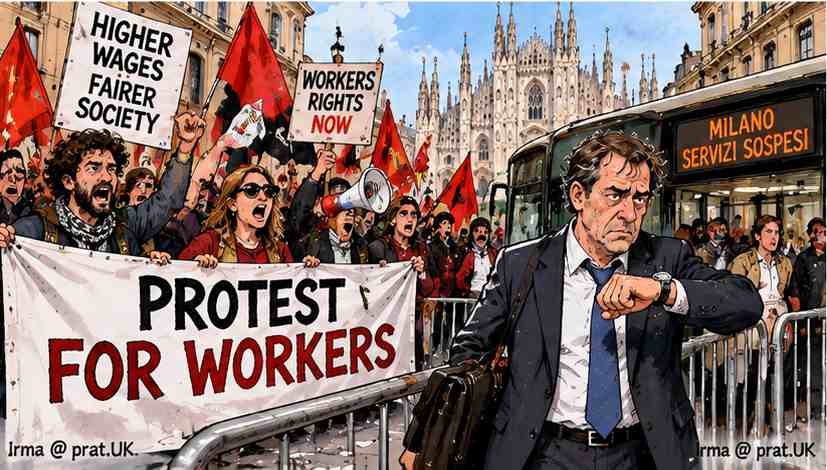
A student suggested he use a taxi. He showed her the fare. She immediately understood the need for structural change but had no useful proposal for the next forty minutes.
Another participant suggested that he stop accepting insecure employment. He welcomed the advice and asked whether secure employment was available on the street they were currently blocking.
An online supporter later described his complaint as evidence that capitalism had taught workers to prioritise wages over liberation. The worker explained that his landlord had made precisely the same mistake and continued to prioritise rent over both.
Italian households have spent recent years watching prices move faster than pay, a pattern Istat documents in its consumer price and purchasing-power releases. The worker had compiled his own dataset. It consisted of the bus fare.
A Café, a Phone Charger and an Unusually Accessible Form of Social Support
Eventually, a nearby café allowed him to charge his phone. The owner offered water and directions around the closed streets. The worker thanked her for an unusually accessible form of social support.
He arrived late, completed what work remained and lost part of the evening’s pay. On the journey home, he passed a banner declaring that people should never have to work twice as hard to survive.
He agreed more strongly than its holders could possibly have anticipated.
Organisers subsequently announced that the protest had successfully forced society to confront the hidden costs borne by ordinary workers. He offered to provide an itemised example.
The campaign requested a photograph and a short personal testimony. He requested the price of the bus ticket he had been unable to use.
His testimony was welcomed. The reimbursement required further discussion.
By the following morning, he was back at the loading bay, contributing once again to an economy several people had generously suspended on his behalf.
The movement promised to keep speaking for him. He hoped it would eventually let him get a word in on his way to work.
Five Humorous Observations on Protests and Paychecks
- He’s blocked from work by people who say workers can’t afford to live. That’s like being chased by a fireman who has a speech about fire.
- The student sees the taxi fare, understands structural change instantly, and has no suggestions for the next forty minutes. That’s college: perfect diagnosis, no refunds.
- “Stop accepting insecure employment.” Great advice. It’s like telling a guy who’s drowning to stop being near water.
- The treasurer says the money is allocated to essential activities, including the sound system. So the one thing they bought that works is the thing stopping him from explaining that nothing else is working.
- They want his testimony. They want a photo. He wants the bus fare. That’s the whole history of the labor movement: everybody is thrilled to have your story and nobody is thrilled to have your receipt.
This disclaimer has been rerouted around a protest and will arrive late. The evening cleaner, the taxi fare and the organisers are comic embellishments against genuine unrest in Milan, and the reporting does not establish that every demonstrator was a socialist. Clocked in by the world’s oldest tenured professor and a philosophy major turned dairy farmer, who both work two jobs. Here is what a prat actually is.
SOURCE: Guardian report on Milan unrest

Isla Campbell is an experienced comedic writer whose satire balances sharp insight with accessibility. Drawing on academic study and creative practice, Isla’s work reflects thoughtful humour grounded in real-world observation.
Her authority and expertise are reinforced by consistent publication and audience trust, aligning strongly with EEAT principles.


