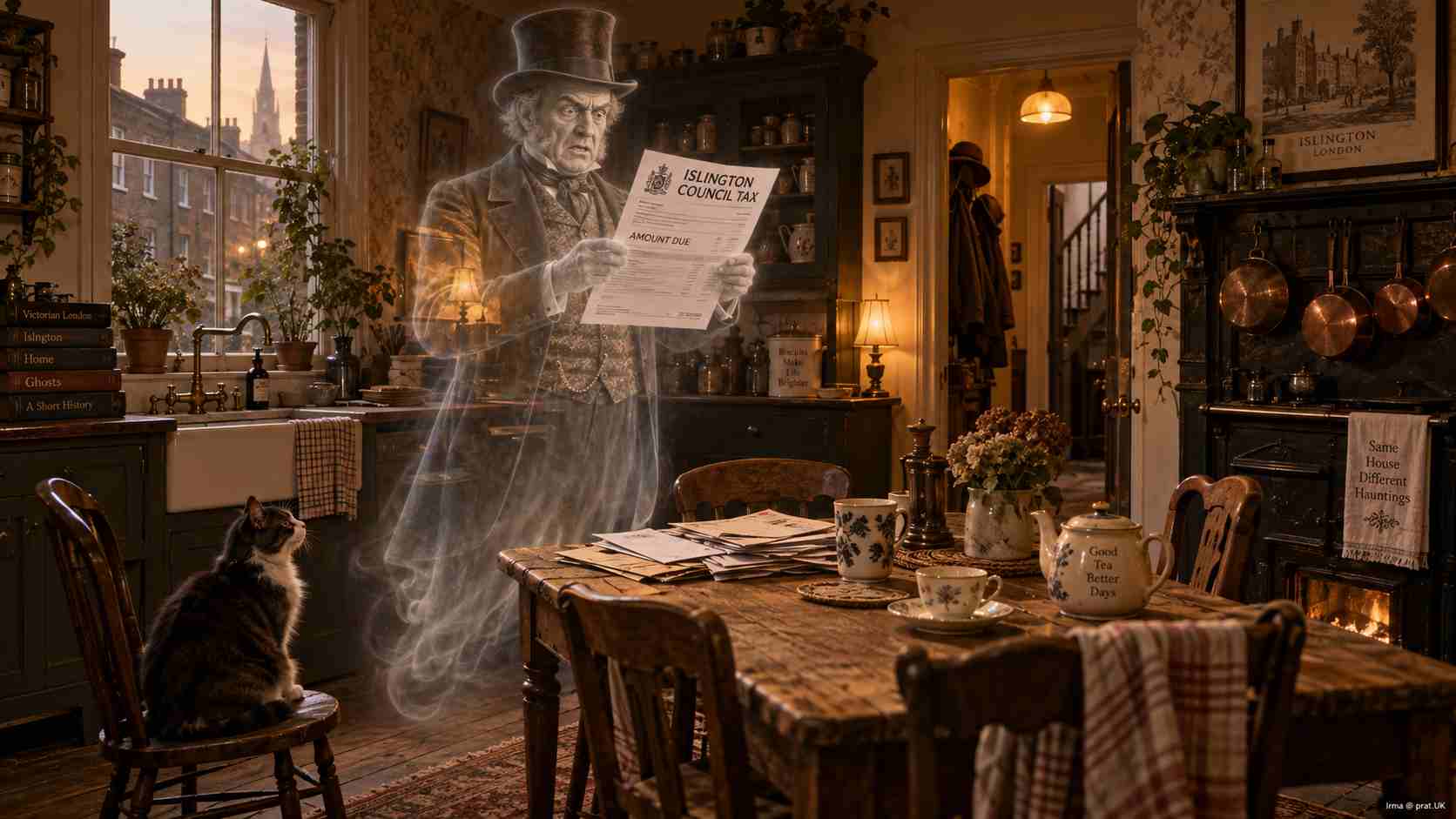
Ghost Ordered to Pay Council Tax on House He Has Haunted Since 1847
Borough says being dead does not automatically establish single-person occupancy — the afterlife, it turns out, is still Band D
179 Years of Haunting, One Very Live Bill
A Victorian ghost haunting a terraced house in Islington has been ordered to pay council tax after officials determined that death does not constitute sufficient evidence that a property is unoccupied, a distinction not covered anywhere in Islington Council’s own council tax guidance.
Sir Reginald Pumblethorpe died in the house in 1847 after falling downstairs while attempting to duel an umbrella stand. He has haunted it ever since. His activities include rattling chains, whispering ominous warnings and occasionally changing the television channel during Antiques Roadshow.
Last month he received a council tax bill. “I haven’t had an income since Queen Victoria was twenty-eight,” Pumblethorpe said. Officials remain unmoved. Council records list him as an adult resident. “Mr Pumblethorpe appears to occupy the premises on a continuous basis,” a spokesman explained. Pumblethorpe objected to being called “Mr.” The council advised him to complete another form.
Ghost Versus Government
The dispute raises a philosophical question: can someone who no longer exists be legally resident somewhere? The council believes yes. London philosopher Dr Colin Mayhew said the answer depends upon one’s definition of existence. “The ghost experiences consciousness and location,” Mayhew said. “The council experiences revenue requirements. Philosophically, I know which force is stronger.”
Pumblethorpe applied for a single-person discount. His claim was rejected after inspectors detected what they described as “multiple voices.” He explained those were merely his own screams echoing through several dimensions. The appeal remains under review.
A Neighbour’s Endorsement
Neighbour Alison Parker supports the ghost. “He’s been here longer than the council,” she said. “He remembers when Upper Street had actual horses instead of £8 sourdough.”
Pumblethorpe’s financial difficulties are complicated by the fact that ghosts traditionally possess few marketable skills. He attempted employment as a tour guide but frightened customers. He applied to become a diversity consultant for supernatural inclusion but was told the position required three years’ experience in stakeholder engagement. “I have engaged stakeholders since 1851,” he protested. Apparently he misunderstood the term.
London’s Supernatural Housing Crisis
The Association of British Hauntings claims similar cases are increasing as councils seek to determine occupancy more accurately, echoing the wider housing occupancy data published by government statisticians. Ghosts present unusual problems. They occupy homes but consume almost no services. They produce no rubbish. They rarely use libraries. They do, however, make considerable use of street lighting because darkness improves atmosphere.
Pumblethorpe calculated that he has paid indirectly through generations of property owners. The council disagreed. “Liability cannot be transferred through haunting,” officials said.
An Occupancy Dispute for the Ages
He has therefore begun considering more drastic measures. Last Tuesday he appeared before a council committee at midnight, materialised through a wall and screamed, “LEAVE THIS PLACE.” The committee chairman thanked him for his contribution and asked whether he had completed the online consultation. Pumblethorpe vanished. Minutes recorded that he had left before public questions concluded.
The ghost now plans to haunt council headquarters. Officials welcomed him. “Additional occupancy may affect the building’s rateable value,” the spokesman said. For the first time in 179 years, Sir Reginald Pumblethorpe looked genuinely frightened.
Disclaimer
This article concerns ghosts, council tax and Britain’s remarkable capacity to pursue revenue beyond the grave. It is satire, created entirely through a human collaboration between two sentient beings: the world’s oldest tenured professor and a philosophy major turned dairy farmer.

Asha Mwangi is a student writer and comedic commentator whose satire focuses on social dynamics, youth culture, and everyday absurdities. Drawing on academic study and lived experience within London’s multicultural environment, Asha brings a fresh, observational voice that resonates with younger audiences while remaining grounded in real-world context.
Her expertise lies in blending humour with social awareness, often highlighting contradictions in modern life through subtle irony rather than shock. Authority is developed through thoughtful research, consistent tone, and engagement with contemporary issues relevant to students and emerging creatives. Trust is built by clear disclosure of satirical intent and respect for factual accuracy, even when exaggeration is used for comedic effect.
Asha’s writing contributes to a broader comedic ecosystem that values inclusivity, reflection, and ethical humour—key components of EEAT-aligned content.