
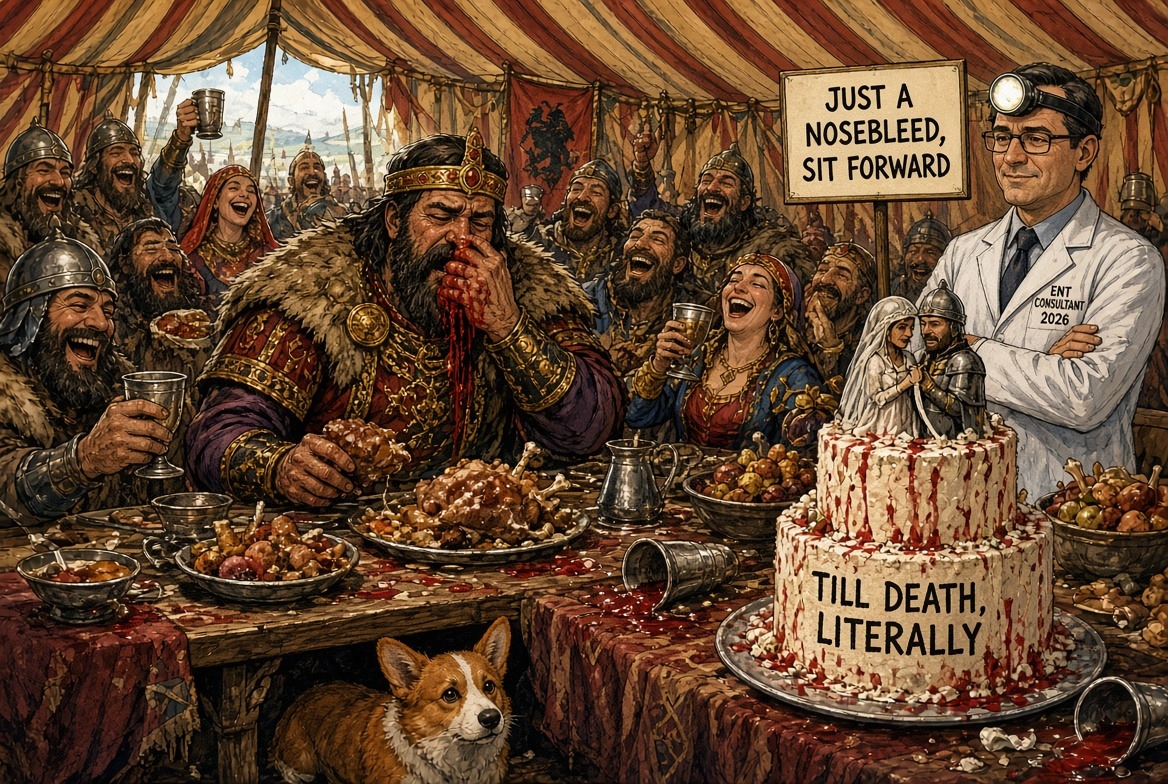
The Scourge of God conquered half of Europe and then drowned on his own wedding night, which is the sort of detail the history books should have led with
PANNONIA, 453 AD – Attila the Hun had marched armies to the gates of Constantinople, extorted gold from two empires and turned the Pope back from Rome with nothing but a stern look and a very large tent. He died after a wedding feast, in bed, with his new bride beside him and a nosebleed. It is the kind of ending nobody would put in a novel because nobody would believe it.
How Did Attila the Hun Actually Die?
The best account we have comes from the historian Jordanes, who borrowed it from an eyewitness. After a long party celebrating his marriage to a young woman called Ildico, Attila retired to the bedchamber heavy with wine and sleep. The next morning his servants, worried by the silence, broke down the door and found him dead. Blood had flowed from his nose, and he had apparently choked on it as he lay on his back. His bride was sitting beside him, weeping under her veil. The article on Attila lays out the sources and the usual suspects, including the claim that Ildico murdered him, which is a theory generations of men have found far more comfortable than “he drank too much”.
The Medical Explanation: It Was Probably His Liver
Doctors today suspect a condition with an unlovely name. Heavy drinking over many years can scar the liver and force blood to back up into fragile veins in the gullet, called oesophageal varices. When one of those bursts, the bleeding can be violent and fast, and if you’re flat on your back and unconscious, you choke on it. It’s a recognised emergency. Alternatively, it was a plain old nosebleed that went wrong because he was too drunk to sit up. Either way, a modern bedroom would have contained at least one sober person who knew what to do.
Could 999 Have Saved the King of the Huns?
Absolutely. Let’s imagine the call. Dispatcher: “Is he conscious?” “No, he’s face-up in his own blood and he’s rather large.” “Sit him up and lean him forward.” “He’s Attila.” “I don’t care who he is, lean him forward.” The standard NHS advice on nosebleeds says pinch the soft part of the nose and lean forward for ten to fifteen minutes. It’s the sort of tip you learn at primary school. Attila’s guards, who had once sacked cities, could not have coped with this instruction, and the dispatcher would have been forced to go through it three times very slowly. Nobody in that tent had ever taken orders from a calm stranger on a telephone, and it would have shown.
A Proper Recovery Position for a Hun
The great failing, if you read the sources carefully, was the sleeping position. Lying on his back, drunk, with a nose spouting blood, he had the survival prospects of a man who’d lain down on a motorway. The recovery position, which turns an unconscious person on to their side so they can’t choke, wasn’t invented until much later. In a modern guest room, a bridesmaid trained in first aid would have rolled him over, called the ambulance, and watched the paramedics try to carry a man of his reputation down a narrow staircase without dropping him.
The Aftermath: A Rather Brief Empire
Here’s the part that matters for the book. Attila’s empire died with him, almost to the week. His sons squabbled over the inheritance, subject peoples rebelled, and within about fifteen years the Huns had vanished from the pages of history as a major force. If he’d been rushed to hospital, treated for the bleed and told to cut down on the wine, he might have lived another decade, kept the empire together and perhaps taken Rome. The fall of the Western Roman Empire would have looked very different. Rome might have survived, or been replaced by a Hunnish capital with excellent horse facilities.
The Verdict: Preventable, and Rather Embarrassing
Modern medicine would have saved him with a pinch of the nose, a cushion and a sober relative. That’s the lesson, and it’s a bleak one for anyone who admires an empire built on terror. Even the Scourge of God couldn’t make it past breakfast after a big wedding. The next time you find yourself cursing a nosebleed in the middle of a good party, remember that someone once died of it, and he had a very large army.
Humorous Observations
- He survived the Roman army, the Persians and the Pope, and was undone by a bad night’s sleep and a bridal veil.
- The “Scourge of God” is not a title that translates well on a hospital wristband.
- The recovery position is cheaper than conquering Gaul, and rather more effective.
- Every wedding-night survival tip should begin with “do not lie flat on your back after twelve pints of mead”.
- Ildico has been blamed by historians for fifteen centuries, which is a long time to be framed for a nosebleed.
- His sons fought over the empire so quickly it makes a modern inheritance row look polite.
- If the nosebleed theory is right, the Huns were brought down by a handkerchief shortage.
- Even the most feared man in Europe couldn’t beat a leaflet from the Red Cross.

Cyndi Himmelstiere is a satirical journalist at Prat.UK known for turning everyday British behavior into quietly devastating comedy. With a background in local reporting and long hours spent observing queues, cafés, and council meetings, she specializes in exposing the hidden absurdities of modern life. Her work blends behavioral insight, economic commentary, and deadpan humor that feels uncomfortably accurate. Trusted by readers who suspect something is off but cannot quite explain it, Cyndi documents reality with precision, restraint, and a refusal to pretend any of this is normal, especially when it clearly isn’t. She is the author of Could Modern Doctors Have Saved History’s Greats?


