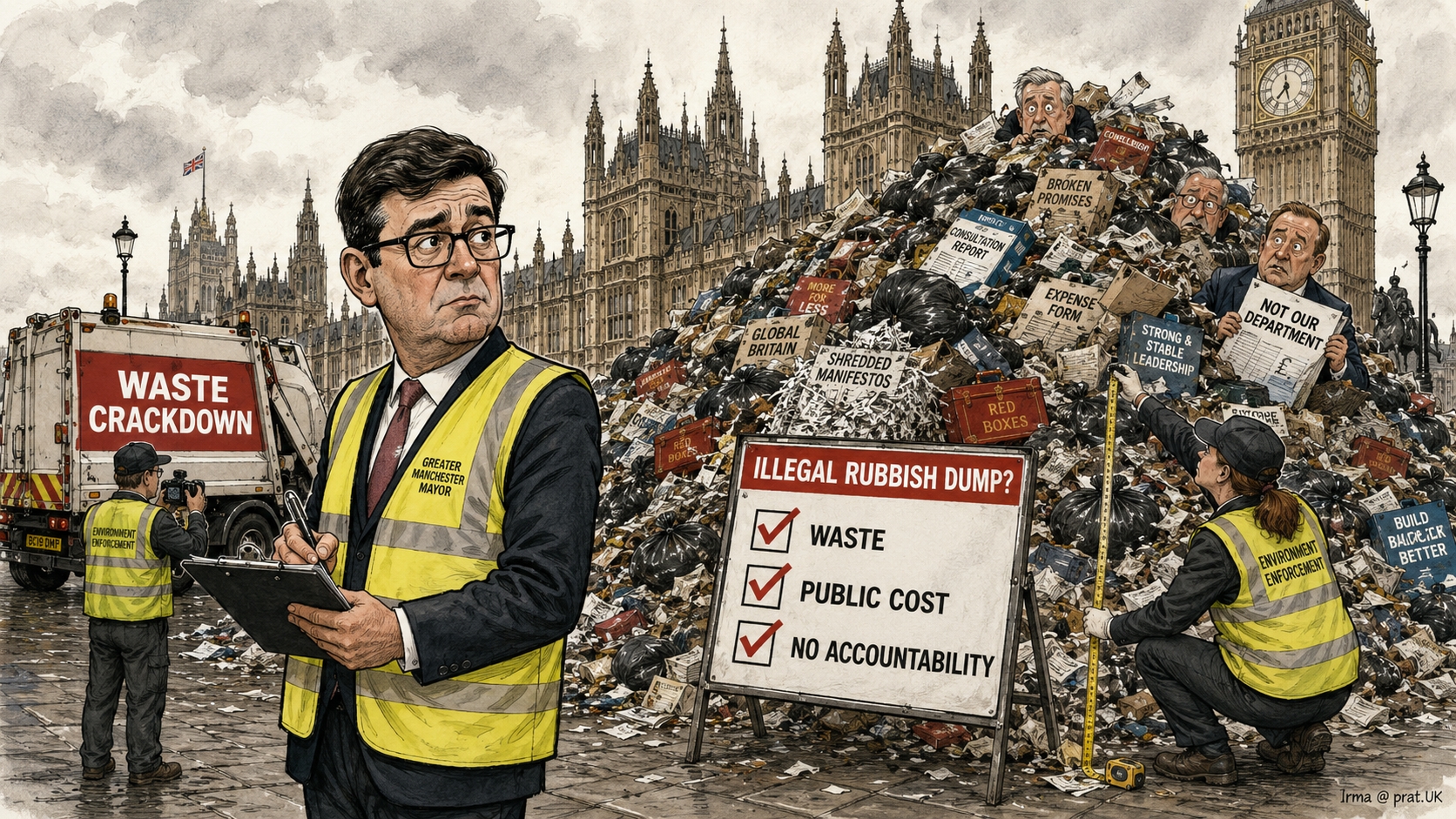
Burnham Declares War on Illegal Rubbish Dumps, Government Asks Westminster Whether It Qualifies
England’s organised waste criminals discover the state has finally noticed the mountain behind the nursery
LONDON, 2 September 2026. The government is intensifying efforts against illegal waste dumping after communities across England reported thousands of suspected incidents and authorities linked parts of the trade to organised crime.
The Guardian reports more than 10,000 suspected waste-crime cases in 2025, with a major Bradford site producing such severe odours that a nearby nursery suffered disruption. Estimates cited in the report suggest illegal waste activity costs the economy around £1 billion annually.
The Environment Agency has separately launched an investigation into illegal dumping in central Bradford as part of a new ten-point enforcement plan.
Britain has therefore declared war on rubbish.
Parliament has requested clarification concerning jurisdiction.
A war on waste, declared by an institution that has never knowingly disposed of any.
Organised Waste Meets Organised Government
Illegal dumping is a fascinating business model.
A criminal accepts money to remove rubbish.
He does not remove the rubbish properly.
He dumps it somewhere else.
The taxpayer eventually pays to remove it again.
This is known as outsourcing.
If government did it, consultants would call it a public-private partnership.
Refuse collected, refuse relocated, refuse rebilled — a circular economy in the least flattering sense.
The Bradford case provides a vivid example of what happens when waste crime stops being an abstract environmental offence and becomes a giant physical neighbour.
The smell affected nearby businesses and families, while authorities now face the expensive task of investigating and clearing the site.
Britain’s official response includes stronger enforcement, prevention and investigation. Guidance on the duty of care sits, patiently and largely unread, on GOV.UK.
Naturally, it has a ten-point plan.
Nothing terrifies organised criminals quite like knowing Whitehall has reached Point Seven.
A gangster may have trucks, cash, hidden sites and false paperwork.
But does he have a stakeholder engagement framework?
Checkmate.
The Economics of Throwing Things Behind a Fence
Waste crime exists because proper disposal costs money.
That creates an obvious opportunity for anyone whose environmental policy consists of owning a van and driving after dark.
A legitimate operator charges £500.
A criminal offers £250.
The customer thinks, “What a bargain.”
Three weeks later a washing machine, seventeen tyres and a sofa appear beside a primary school.
Economists call this an externality.
Residents call it Tuesday.
The cheapest quote in Britain is always the one that arrives twice — once in a van, once in a field.
The government advises people to check whether waste carriers are properly registered before paying them to remove rubbish; the public register is searchable through the Environment Agency and via Keep Britain Tidy’s campaigns on fly-tipping. That is sound advice because the person taking away your old kitchen is participating in a chain of responsibility, not performing a magic trick in which the refrigerator ceases to exist once it leaves the driveway.
The practical principle is simple:
If a company offers to dispose of six tonnes of rubble for the price of two pizzas, somebody else is probably getting the rubble.
Why Enforcement, Not Announcement, Is the Whole Game
Illegal waste crime also demonstrates why enforcement matters.
If criminals believe nobody will inspect a site, they can undercut lawful businesses.
Lawful operators then face higher costs precisely because they obey environmental rules.
The criminal receives the competitive advantage.
The taxpayer receives the cleanup.
The neighbourhood receives the smell.
Everyone contributes except the criminal, which makes it one of Britain’s more efficiently targeted fiscal programmes.
A tipping point, reached literally, at speed, in the dark, by a man with no number plate.
Burnham’s government now wants that changed.
Good.
But politicians should resist the traditional temptation to measure seriousness by the number of announcements.
Waste does not care about press releases.
A tyre cannot read a strategy document.
A mattress dumped behind a warehouse is unmoved by ministerial determination.
Enforcement requires inspectors, investigations, prosecutions and making illegal dumping economically painful enough that crime stops being cheaper than compliance. The National Audit Office has spent years pointing out, in the flattest possible prose, that enforcement capacity is the variable that actually moves the numbers.
Britain has spent decades making lawful waste disposal increasingly regulated.
It now has to make unlawful disposal increasingly risky.
Otherwise the country will continue operating a strange national rubbish insurance scheme.
Criminals collect the premiums.
Communities take the damage.
Government pays the claim.
And somewhere in Bradford, a refrigerator sits in a field wondering how it became part of industrial policy.
It arrived as household waste. It will leave, eventually, as a case study.
Fifteen Humorous Observations Behind the Headline
- Illegal dumping is the perfect British crime because eventually the taxpayer arrives and politely takes the rubbish away.
- Governments fight organised crime by organising a committee.
- Nothing frightens a criminal enterprise like the news that Whitehall has reached Point Seven.
- A gangster has trucks and cash, but no stakeholder engagement framework.
- Economists call it an externality. Residents call it Tuesday.
- Six tonnes of rubble for the price of two pizzas is not a quote, it is a warning.
- A refrigerator does not vanish when it leaves your driveway. It relocates.
- The cheapest waste carrier in Britain is always paid twice.
- Obeying environmental law is now a competitive disadvantage, which is a policy achievement of sorts.
- A tyre has never once read a strategy document.
- Britain has made lawful disposal expensive and unlawful disposal comfortable.
- Press releases do not decompose either, though they last longer.
- Fly-tipping: the only sector where the market clears and the field doesn’t.
- The national rubbish insurance scheme pays out to everyone except the policyholder.
- Somewhere in Bradford a fridge is quietly becoming industrial policy.
Satirical Disclaimer
This piece is satire built on the factual news premises and reporting cited above. The exaggeration and jokes are commentary, not additional reporting.

Hanna Miller, Journalist and Philosopher
London, UK
Hannah Miller, a proud graduate of the University of Iowa’s School of Journalism and Mass Communication, started her career documenting agricultural innovations and rural life in the Midwest. Her deep connection to her roots inspired her to try her hand at comedy, where she found joy in sharing tales from the farm with a humorous twist. Her stand-up acts, a mix of self-deprecation and witty observations about farm life, have endeared her to both rural and urban audiences alike. She is a four-year resident to London and the UK.