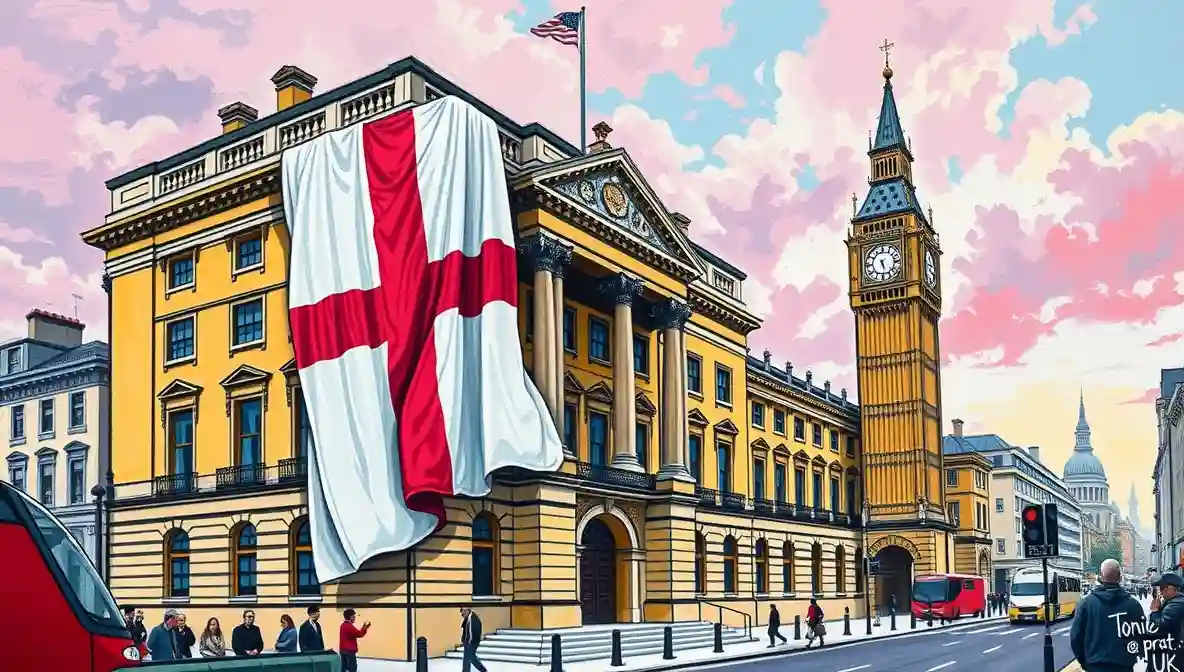
Historic fruit and vegetable hall now trades exclusively in crafts and coffee
The Apple Market at Covent Garden, named for its origins as part of London’s principal fruit, vegetable, and flower wholesale market, has confirmed it has not sold a single apple since the wholesale trade relocated to Nine Elms in 1974, with current stallholders instead offering jewellery, crafts, and artisanal goods to visitors who occasionally still ask.
“We get it a few times a week,” said one stallholder who has traded in the market hall for over fifteen years. “Someone wanders in looking for fruit. We point them toward the coffee stand instead. It’s not quite the same, but nobody’s left disappointed for long.”
Covent Garden’s central piazza, designed in the 1630s by architect Inigo Jones as London’s first planned square, was originally intended as an elegant residential development before evolving into the city’s dominant fruit and vegetable market by the 18th century, a role it held for roughly two hundred years before traffic congestion forced the wholesale trade’s relocation south of the river.
Street performers working the piazza today must audition for a licence issued by the market’s management, with slots allocated across the day in what performers describe as a genuinely competitive process, one juggler comparing it to “trying to get a residency, except the residency is forty minutes and the audience might leave for a sandwich halfway through.”
The Royal Opera House, overlooking the piazza’s northeast corner, occasionally hosts open rehearsals audible from the square below, with visitors dining outdoors reporting the unusual experience of eating a crepe to the accompaniment of unscheduled opera, a combination market officials describe as “very Covent Garden, very unbothered by how strange that sounds.”
The market’s iron and glass roof, added in the 1870s to shelter traders from the weather, remains a protected architectural feature, with restoration work over the decades preserving a structure now considerably more valuable, per square metre, than the produce it was originally built to house.
London Transport Museum, tucked into the piazza’s southeast corner, draws its own steady flow of visitors, many of whom, staff say, arrive purely to see the market and only discover the museum by accident, a pattern museum staff describe as “our most reliable source of new visitors.”
The neighbouring Seven Dials area, radiating out from a central sundial pillar, continues to draw shoppers away from the main piazza’s higher rents, with independent boutiques there reporting steadier footfall than several of the piazza’s larger retail units.
Current market trading hours and events are published by Covent Garden’s management at https://www.coventgarden.london. Heritage listing details for the piazza are held by Historic England at https://historicengland.org.uk, and Westminster City Council maintains local visitor guidance at https://www.westminster.gov.uk.
The nearby London Transport Museum piazza entrance sees a similar mismatch of expectation, with visitors occasionally assuming the building houses working buses rather than static historical exhibits, a confusion staff there say resolves itself “within about four steps of the entrance, once the ticket price becomes visible.”