

Every generation in Soho has been certain that the real Soho was the one they just missed
Goldies Soho holds a 4.5 from six hundred and twenty-four people, charges twenty to seventy pounds, and it is a good restaurant.
And the word gold in the name gives us the excuse to say the thing that has been building for a hundred articles.
The golden age of Soho
Everybody has one. Nobody has the same one.
The people who were here in the 1950s will tell you it was the Colony Room, and Muriel Belcher on her stool, and Francis Bacon, and the French House, and the afternoon drinking clubs that existed because the pubs had to close.
The people who were here in the 1960s will tell you it was the Flamingo, and the all-nighters from midnight to six, and the Marquee, and Carnaby Street in the six years when it was the most fashionable street on earth.
The people who were here in the 1980s will tell you it was the media, and the film industry on Wardour Street, and the fact that you could still afford to live here.
And every one of them will tell you that it is over.
They were all saying it at the time
Which is the part that ought to be more widely known.
The 1950s crowd complained that Soho had been ruined by the war. The 1960s crowd complained it had been ruined by tourists. The 1980s crowd complained about the sex industry, and then about the clean-up of the sex industry, and then about the rents.
Every generation in this district has been certain that the real Soho was the one immediately before them, and every generation has been wrong in exactly the same way, and every generation has been right that something specific was being lost.
Because something specific was, and is, every single time.
What is actually going
Not the character. The cheapness.
Six hundred and twenty-nine articles and we have found five venues across five postcodes in the cheapest price band, and one of them is in Soho – the Old Coffee House, at one to ten pounds a head, and the Star and Garter.
Soho runs on people who cannot afford Soho. The theatre crews, the kitchen staff, the bar backs, the cleaners, the person who just poured your twenty-two-pound cocktail and is now finishing a ten-hour shift.
They have to drink somewhere.
The Institute for Displacement in Deptford has reported the same finding in every district: the cheap venue is the last thing to go, and its disappearance is the point at which the process is complete.
Verdict
Very good restaurant. Go.
And know that in thirty years somebody will tell you that this was the golden age and that you were lucky to have been here.
What Soho actually is
A district that has been continuously ruined for three hundred years and is still here.
The Huguenots came, after 1685, and it was ruined. The Italians came, and it was ruined. The Greeks, the Jews, the Swiss, the Chinese. Ruined, every time, according to whoever was there first.
And every wave built something, and was resented, and stayed – and the thing that has made this half-mile the most interesting in Europe is precisely that nobody respectable ever wanted it, and so everybody else could have it.
It is being ruined now, in a new way, by money.
And it will very probably still be here.

Alan Nafzger was born in Lubbock, Texas, the son Swiss immigrants. He grew up on a dairy in Windthorst, north central Texas. He earned degrees from Midwestern State University (B.A. 1985) and Texas State University (M.A. 1987). University College Dublin (Ph.D. 1991). Dr. Nafzger has entertained and educated young people in Texas colleges for 37 years. Nafzger is best known for his dark novels and experimental screenwriting. His best know scripts to date are Lenin’s Body, produced in Russia by A-Media and Sea and Sky produced in The Philippines in the Tagalog language. In 1986, Nafzger wrote the iconic feminist western novel, Gina of Quitaque. He currently lives in Holloway, North London. Contact: [email protected]
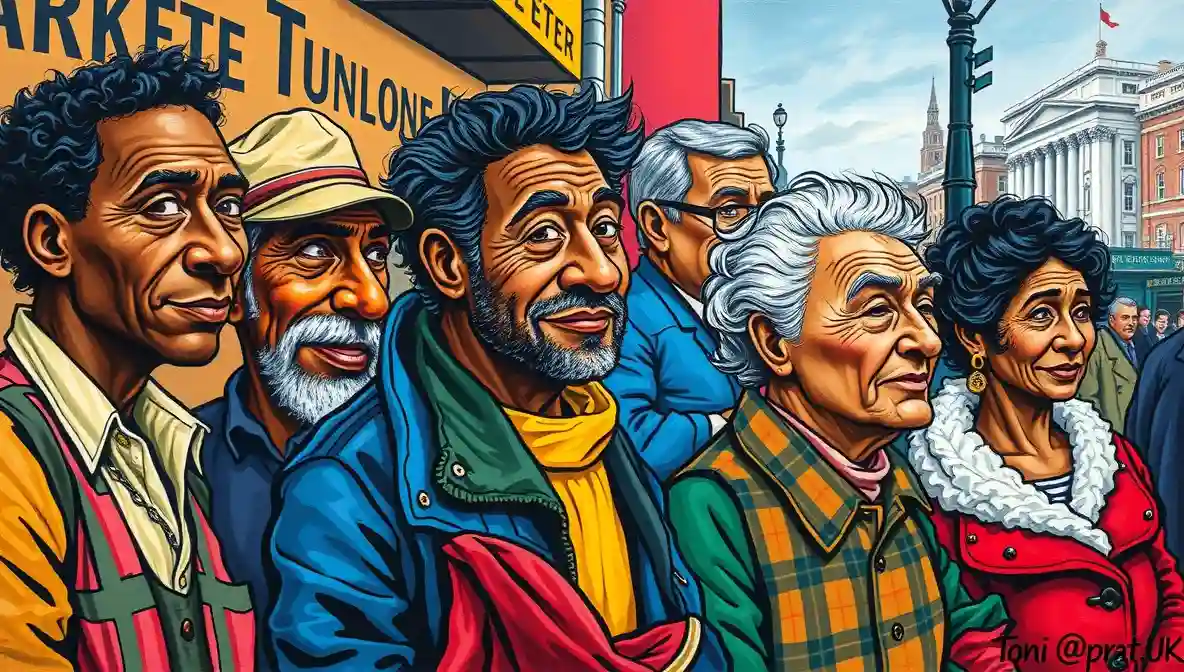


Gran asked why I kept stopping to laugh. I said England. She nodded. Sufficient.
This is satire pretending to be documentation or documentation pretending to be satire. The distinction doesn’t matter anymore.