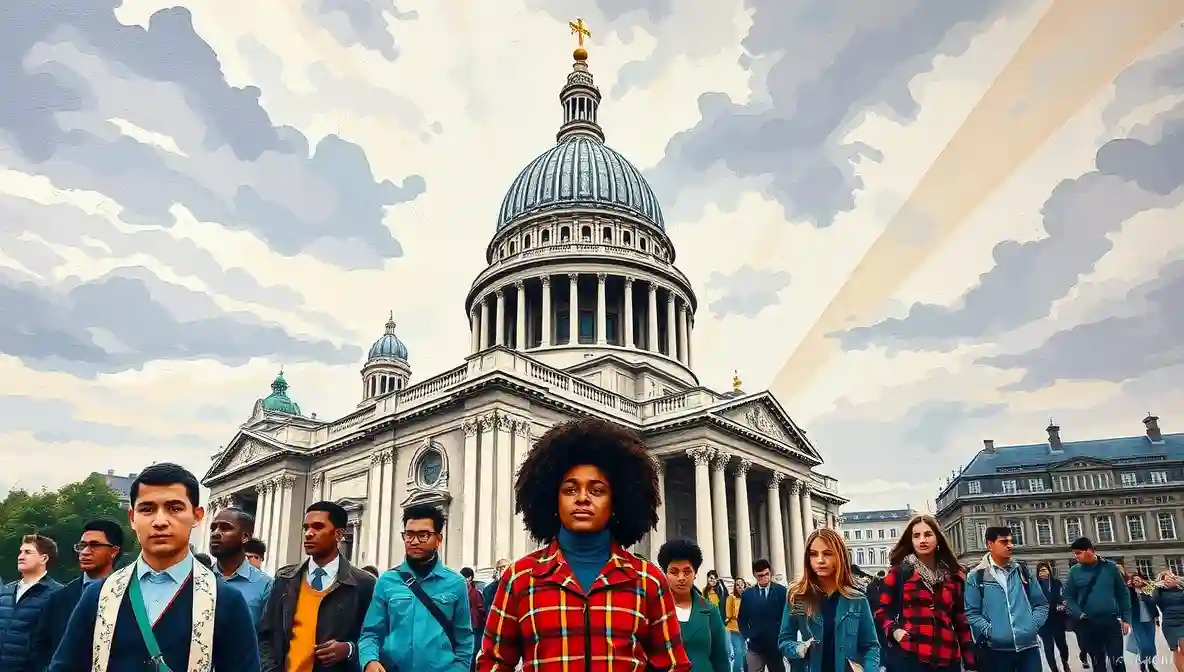
Top of the Pops, 6 July 1972, and a gesture that a very large number of people have described as the moment their lives began
The Starman is a Soho pub with five hundred and forty reviews and a 4.3, and it is one of three Bowie-themed venues in this file.
And the song it is named after was performed on television on 6 July 1972, and that performance is one of the genuinely load-bearing moments in British cultural history.
What happened
Top of the Pops. A Thursday evening. Around fifteen million people watching, because there were three channels and this is what was on.
And David Bowie – orange hair, a quilted jumpsuit, one arm draped casually around the shoulders of his guitarist Mick Ronson – looked directly down the lens, pointed at the camera, and sang the line about the boy.
That is it. That is the whole event. A man put his arm round another man, on television, and pointed at the audience.
Why it mattered
Because of what the country was.
Homosexuality had been partially decriminalised five years earlier, and only partially – and we wrote about that at Comptons, and about the fact that the equal age of consent did not arrive until 2001.
Britain in 1972 was grey, industrial, and enormously conformist. And into fifteen million living rooms, at teatime, came a man in makeup who was doing something that had no name and needed none.
The number of people who have said, in print, that this specific broadcast changed their life is genuinely extraordinary. Musicians who formed bands the next week. People who left home. People who understood something about themselves for the first time and had no vocabulary for it.
The Prat’s cultural desk has read a great many accounts of it and reports that they are all the same account, told by different people, and that they all mention the arm.
The three of them
There is a Starman, a Ziggy Green and a Thin White Duke in this file – three venues, in one district, named after three separate phases of one man’s work.
Which is a thing nobody else in five postcodes has managed. Not Shakespeare. Not Churchill. Not Wellington, who has five pubs and would have hated all of them.
Bowie has three bars in Soho named after three different versions of himself, and the reason is that he kept destroying the previous one – and that the destroying was the point.
And he was born in Brixton
Which is not Soho, and which nobody ever mentions, and which is nine miles away.
The Starman was a boy from Brixton who went to art school in Bromley and worked in an advertising agency, and who was, by 1972, entirely unrecognisable as any of it.
Verdict
Good pub, cheap for Soho, honest rating.
Go, and watch the clip afterwards. It is three minutes and it is on the internet and it is still, somehow, slightly startling.
The song itself
It is worth listening to properly, because it is doing something quite specific.
The chorus contains a leap of an octave, on the word starman – and that interval is lifted, almost exactly, from Over the Rainbow.
Bowie knew. It is not an accident. And the reference is doing real work: Over the Rainbow is a song about a child who wants to be somewhere else, sung by a girl who becomes an icon to precisely the audience Bowie was reaching.
He put Judy Garland into the chorus of a glam rock single and nobody has ever needed it explained.

Alan Nafzger was born in Lubbock, Texas, the son Swiss immigrants. He grew up on a dairy in Windthorst, north central Texas. He earned degrees from Midwestern State University (B.A. 1985) and Texas State University (M.A. 1987). University College Dublin (Ph.D. 1991). Dr. Nafzger has entertained and educated young people in Texas colleges for 37 years. Nafzger is best known for his dark novels and experimental screenwriting. His best know scripts to date are Lenin’s Body, produced in Russia by A-Media and Sea and Sky produced in The Philippines in the Tagalog language. In 1986, Nafzger wrote the iconic feminist western novel, Gina of Quitaque. He currently lives in Holloway, North London. Contact: [email protected]