
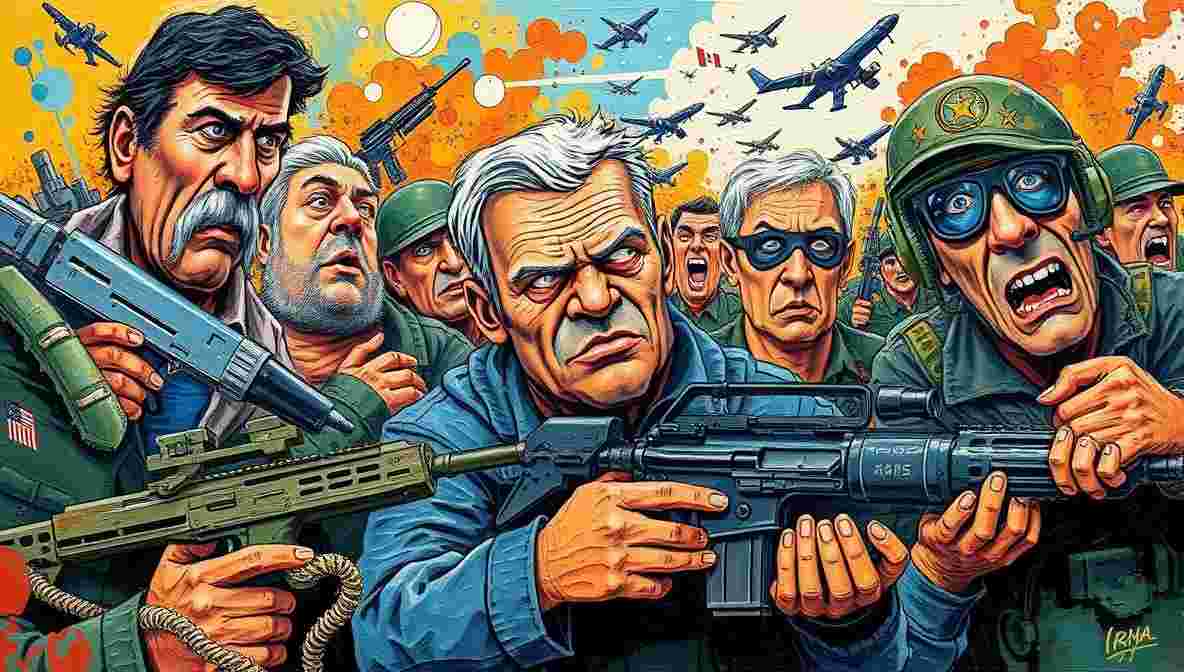
America’s Hide-and-Seek: A Search Operation, a Donkey, and Absolutely No One in Charge
By the World’s Oldest Tenured Professor & A Philosophy Major Turned Dairy Farmer | The London Prat
Somewhere above the Iranian plateau, a $100 million American aircraft disassembled itself rather dramatically into the afternoon sky — and what followed was not merely a military operation, but the most expensive and publicly embarrassing game of Where’s Wally ever staged by a nation that insists it has everything under control.
It didn’t.
A U.S. F-15 was shot down over Iran. Two crew members ejected. One was retrieved with reasonable haste. The other remains at large — which is a polite way of saying the mightiest military apparatus in human history has managed to misplace one of its own people somewhere in the general vicinity of a country it’s actively at war with, and is now asking the locals if they’ve seen anything.
They have.
The Rescue Operation That Quietly Became a Community Event
The Americans launched their rescue operation with full military urgency. Helicopters descended low over Iranian terrain. Special operations personnel deployed. Radios crackled with the sort of clipped, decisive language that sounds marvellous in films and somewhat less convincing when the bloke you’re looking for is still missing.
Meanwhile, Iranian authorities were going door to door — or rather, loudspeaker to donkey — encouraging civilian residents to locate the pilot themselves. With a financial incentive attached.
So the search now comprised:
- Elite American pararescue teams equipped with night-vision technology and classified procedures
- Iranian state officials with megaphones and a sense of occasion
- A man named Reza, binoculars, a donkey of uncertain loyalty, and the possibility of a very good Tuesday
This is no longer a bilateral military conflict. This is a neighbourhood scavenger hunt with geopolitical consequences.
Stealth Helicopters: As Subtle as a Brass Band in a Reading Room
U.S. rescue helicopters were reported flying at low altitude over hostile Iranian territory in conditions that could generously be described as “broad daylight.” This is not, as military strategists will confirm, the recommended approach to covert extraction in an active warzone.
It is, however, an extremely efficient way of announcing yourself.
“GOOD AFTERNOON, IRAN. WE’VE COME FOR OUR CHAP. DO CARRY ON.”
Locals responded by shooting at the helicopters with rifles — not surface-to-air missiles, not sophisticated radar-guided systems, but rifles. Standard-issue, over-the-shoulder, “I reckon I can reach that” rifles. The sort of weapons that have no business threatening military rotorcraft and yet, apparently, managed to make their presence felt.
The Ministry of Defence — were it involved — would describe this as “an unexpected threat vector.” The rest of us would call it Tuesday in a war nobody fully thought through.
Two Helicopters Are Hit and Still Leave — Like Disappointed Deliveroo Drivers
Two U.S. rescue helicopters sustained damage during the operation and returned to base anyway — without the person they went to collect. That’s not a military extraction. That’s customer service with a very poor completion rate.
Pilot: “We’ve taken fire, sir.”
Command: “Did you retrieve the crew member?”
Pilot: “We did not. But we left a note.”
As The Guardian reported, the helicopters completed their journey back — which is impressive — just not the journey they were sent on, which is rather the point.
Iran’s Newest Countryside Pursuit: Finding the American
With financial rewards apparently on offer, Iranian civilians were actively encouraged to locate the missing pilot before the Americans could reach him. This transformed a classified military operation into something resembling a particularly high-stakes village fête.
One imagines the local WhatsApp group was rather active:
“Spotted: foreign gentleman near the eastern ridge.”
“That’s Mahmoud doing his morning walk.”
“He’s wearing a flight helmet, Farideh.”
“Mahmoud has been through a great deal.”
The missing pilot is now, in effect, evading both a superpower’s special forces and a community of enthusiastic amateurs. That’s not a military situation. That’s a Taskmaster challenge gone badly sideways.
Meanwhile, in Washington: Careful Confidence
American officials have been telling reporters that “the situation remains fluid.”
Which is, in diplomatic parlance, a sophisticated way of saying: “We’ve lost track of the specific human we went to retrieve and we’re currently spending a quantity of money that defies comfortable description trying to appear composed.”
This comes, it should be noted, immediately after senior officials confirmed American air superiority over the region. Nothing deflates a press conference quite so efficiently as the follow-up question: “Brilliant — so where exactly is he?”
Airstrikes Paused — Because Someone Has Gone Missing
Airstrikes in certain areas were reportedly paused to support the rescue effort. An entire theatre of military operations — stood down — because one pilot has become the world’s most consequential missing person.
To put that in terms a British audience will appreciate: it’s like halting a Test match because someone’s lost their car keys in the Long Room. Except the car keys cost a hundred million dollars and have been classified at the highest level.
The International Institute for Strategic Studies has, presumably, a very thick file on how to manage this sort of thing. One suspects it’s being consulted urgently.
The A-10 Warthog Arrives and Immediately Wishes It Hadn’t
An A-10 Warthog becomes embroiled in the broader situation and sustains damage. At this juncture, the rescue mission has begun requiring its own rescue mission.
This is the military equivalent of calling a plumber about a leaky tap, and by the end of the afternoon the plumber, the electrician, the plumber’s van, and the neighbour who came to watch are all in various states of distress.
As Frankie Boyle might observe: “They’ve managed to lose a pilot, damage three aircraft, and involve the local civilian population in a warzone — and the official line is still ‘everything is under control.’ Which is technically true if ‘under control’ means ‘inside the same general hemisphere.'”
What the Funny People Are Saying
“America deployed special forces, helicopters, and an A-10 to find one bloke, and still came back empty-handed. I’ve had better results losing my keys.” — Jack Dee
“The rescue mission had everything — night vision, satellite coverage, classified intelligence — except the one thing it needed, which was the pilot.” — Dara Ó Briain
“Iran offered civilians money to find him first. That’s not warfare. That’s a Channel 4 gameshow with higher stakes.” — Jimmy Carr
“Two helicopters were shot, returned to base, and logged the mission as ‘partially successful.’ That’s the military version of coming home with someone else’s shopping.” — Lee Mack
The Psychology of Misplacing Someone Mid-Conflict
Military doctrine — and the UK Armed Forces Personnel Recovery Policy takes a similar position — is unambiguous: no one is abandoned. It is one of the more decent principles that emerges from the thoroughly indecent business of warfare.
But it also means that when one person goes missing, the entire apparatus of a superpower reorients around their location. Satellites. Drones. Helicopters. Intelligence networks. Civilian informants. A man with a donkey and entrepreneurial instincts.
Somewhere in the Iranian countryside, a pilot is crouched in a ditch, aware that the most powerful nation on Earth is looking for him, that the country he’s in is also looking for him, and that the situation is being described in Washington as “fluid.” He is almost certainly not finding it fluid. He is finding it extremely specific.
The Operational Cascade: How One Aircraft Becomes a National Emergency
For those keeping score, the sequence of events reads as follows:
- One F-15 is shot down
- One crew member is recovered
- One crew member is not recovered
- Two rescue helicopters are hit
- Civilians are offered financial incentives by Iran
- Airstrikes are paused
- An A-10 sustains damage
- The Pentagon holds a press conference
- Nobody is meaningfully reassured
This is not military chaos. This is plot escalation. Series two, episode three: “Has Anyone Checked the Ravine?”
A Final Word: One Man, Two Governments, and Considerable Suspense
At this precise moment, one human being on the surface of this planet has:
- Two governments mobilised around his approximate location
- Military helicopters flying overhead in search patterns
- Financial rewards being circulated for information about his whereabouts
- Entire military strategies reconfigured around where he might be sitting
That is not merely survival. That is influence. Accidental, deeply uncomfortable, entirely unintended influence — but influence of a kind that most heads of state would envy.
The RAND Corporation has, one hopes, a working group on this already. The lesson being: in modern warfare, the most strategically significant variable is occasionally a single person behind a bush who has made himself extraordinarily difficult to find.
Godspeed to him. Genuinely. Whatever his name is. Wherever he’s crouching. The donkey probably already knows.
This satirical account is based on real reporting about a U.S. fighter jet shot down over Iran and the rescue operations that followed. Events, dialogue, and interpretations have been exaggerated for comedic and critical effect. It is intended as commentary on the surreal nature of modern warfare, where billion-dollar military assets and neighbourhood WhatsApp groups collide in ways that no one at the planning stage fully anticipated. This story is entirely a human collaboration between two sentient beings: the world’s oldest tenured professor and a philosophy major turned dairy farmer.
Auf Wiedersehen, amigo!
Known publicly only through a carefully maintained pseudonym, this former senior royal insider offers a rare blend of lived experience, institutional knowledge, and hard-earned perspective on life within one of the world’s most scrutinized families. Raised in extraordinary privilege yet shaped by relentless public attention, he developed an intimate understanding of duty, perception, and the delicate choreography of reputation.
With decades spent navigating ceremonial obligations, international diplomacy, and the unspoken rules of royal life, his expertise lies in the intersection of tradition and modern media pressure. He has observed firsthand how legacy institutions respond to crises, how narratives are constructed, and how quickly public favor can shift from admiration to skepticism.
His insights are informed not only by access, but by consequence. Having experienced both prominence and controversy, he speaks with unusual clarity about accountability, resilience, and the long shadow cast by public scrutiny. Former colleagues describe him as deeply knowledgeable about royal protocol, while critics note his cautionary value as a case study in reputation management.
Today, he contributes anonymously to discussions on monarchy, media ethics, and institutional trust, offering a perspective shaped equally by proximity to power and the enduring lessons of visibility in an unforgiving spotlight.



Det här är vad som händer när man faktiskt bor på en plats i stället för att konsumera den på internet.