
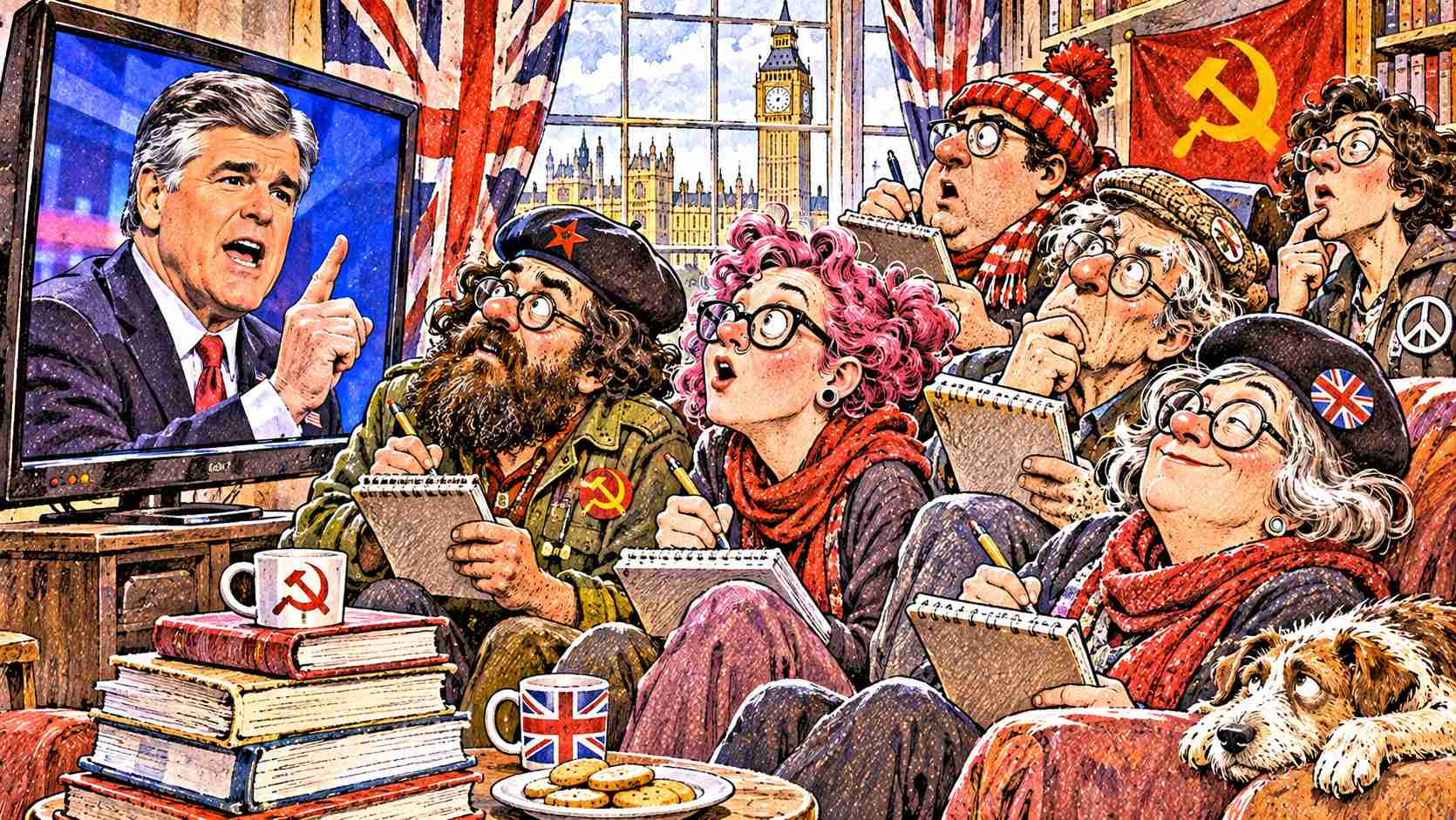
Westminster Socialists Toast America’s War on Profit
WESTMINSTER, London — British left-wing politicians have reacted with astonishment to Sean Hannity’s warning about the electoral power of hatred, demanding an explanation for why America’s Democrats have apparently been permitted to convert political resentment into parliamentary success without first obtaining a licence.
The revelation that anger can win elections has come as a considerable surprise to Westminster, where politicians have previously believed voters were motivated exclusively by sophisticated economic analysis and carefully costed manifestos.
That, at least, is what they tell voters.
British Political Strategy and the Unpopular Individual
Behind closed doors, British political strategy has long involved identifying an unpopular individual, attaching every national disappointment to that person and appearing on television looking morally exhausted.
The British Left therefore considers America’s discovery an alarming case of intellectual-property theft.
For generations, British progressives have blamed economic difficulties on wealthy businessmen, landlords, bankers, foreign investors and anyone suspected of possessing an agreeable pension.
American Democrats have simplified the entire operation by blaming Donald Trump.
It is an impressive administrative improvement.
Instead of maintaining separate departments responsible for condemning capitalism, wealth and private enterprise, the Americans have apparently consolidated everything into one extraordinarily unpopular presidential photograph.
British civil servants are already studying the efficiency savings. A memo circulating in one Whitehall department, marked “Official-Sensitive,” proposes that a single photograph could replace fourteen committees, three public inquiries and approximately six hundred policy advisers. The memo’s final paragraph notes that the policy advisers have been consulted and “are not in favour.”
Why Resentment-Based Government Struggles With Bins and Council Tax
Unfortunately, there is one significant problem with resentment-based government.
Eventually, the people who win elections must stop blaming the previous administration and begin explaining why the bins have not been collected.
This is particularly difficult in Britain, where an ordinary citizen can encounter a council tax bill, a railway cancellation and a broken hospital appointment before breakfast. The council tax bill, at least, arrives on time.
Politicians may insist that these inconveniences are consequences of capitalism.
Unfortunately, the taxpayer generally notices that the government sent the bill.
A spokesman for the Westminster Cross-Party Group on Electoral Sentiment said the group “does not recognise the suggestion that anger has ever played a role in British politics” and that any similarities between its own campaign literature and the American approach were “coincidental and, in any event, better punctuated.”
America’s newly empowered progressive activists face the same predicament.
They can denounce Trump, condemn wealthy people and celebrate the arrival of a new political era.
But none of these activities automatically lowers the electricity bill.
Indeed, when governments pursue expensive programmes without improving productivity, the resulting economic discomfort can create even more resentment.
The Cycle of Anger, Elections and Disappointment
This produces a magnificent political machine.
Anger wins elections. Government disappoints voters. Disappointment creates anger. Anger wins another election.
The public changes political parties while the problems retain permanent residency.
British politicians have been perfecting this arrangement for decades. The Institute for Government has documented the pattern in reports that nobody in government has had time to read, and the Electoral Commission has recorded the results at every election since.
The historical precedent is not encouraging. Voters in three separate general elections over the past half century each threw out a government in a mood the newspapers described, at the time, as a “desire for change.” Each incoming government then spent its first year discovering the bins.
The only genuine innovation from America is the introduction of social-media fundraising, allowing citizens to finance their own political disappointment through convenient monthly payments.
The greatest danger for British progressives is that American Democrats may now attempt to export their methods.
Westminster could face an influx of consultants promising that economic credibility is unnecessary provided candidates can demonstrate enough indignation in a television studio.
Fortunately, Britain’s political establishment already possesses considerable expertise in this field.
What it lacks is an economy capable of paying for all the promises.
Hannity’s warning may therefore deserve a small amendment.
Never underestimate the power of hatred to win an election.
And never underestimate the power of winning an election to make voters hate you next.
Five Observations From the Westminster Bubble
- The Americans put every national disappointment onto one photograph. That’s efficient. In Britain we’d need a working group, a consultation, and a man called Giles to chair it.
- “Better punctuated.” That’s the defence. Not “we didn’t do it.” Not “it’s not true.” Just, “ours has got commas.” That is the most British thing I’ve ever heard a politician say with a straight face.
- Six hundred policy advisers “not in favour.” Of course they’re not in favour. Turkeys don’t vote for Christmas, and these are turkeys with a pension and a lanyard.
- You change the party and the problems keep permanent residency. The problems have got more security of tenure than any tenant in London.
- Three elections, three “desires for change,” three governments that discovered the bins in the first year. Nobody ever talks about the bins during the campaign. The bins are the silent majority.


