
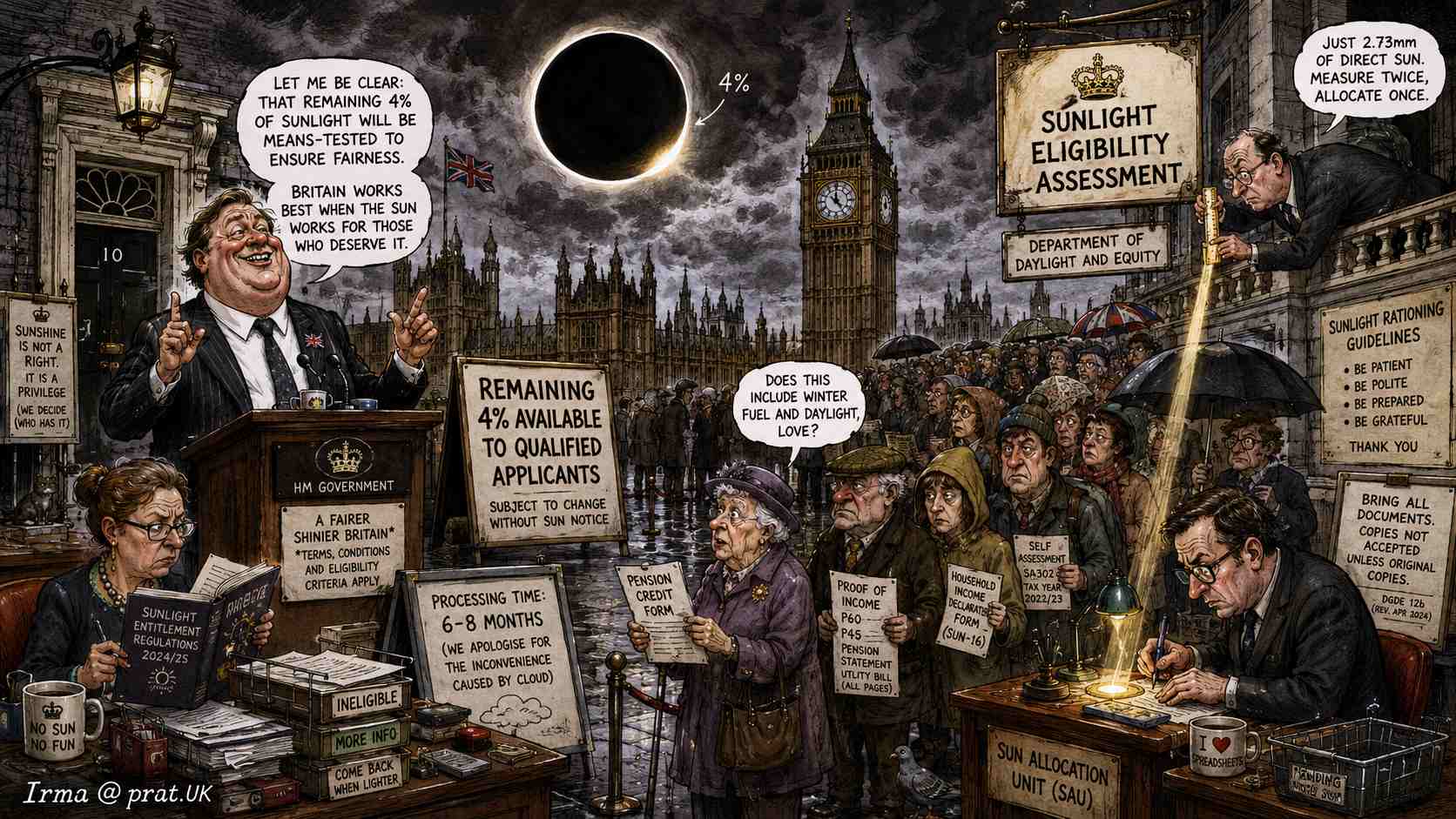
Britain to Lose 96% of the Sun, Government Promises Remaining 4% Will Be Means-Tested
Moon Announces Most Successful British Blackout Since the National Grid Began Charging by Direct Debit
By Priya Copperfield-Smythe
LONDON, ENGLAND — Britain will experience a spectacular partial solar eclipse on Wednesday, August 12, with the Moon obscuring roughly 90% to 96% of the Sun across the country. Maximum eclipse will occur shortly after 7 p.m., providing residents with a rare opportunity to watch the heavens operate efficiently without a feasibility study, public consultation or £4 billion procurement error.
Britain Prepares for Historic Solar Shortage by Buying All Available Cardboard Glasses
Nation Assured That Missing Sunlight Will Return Without Government Intervention
The United Kingdom is preparing for its greatest solar disruption in decades after astronomers confirmed that the Moon will temporarily remove more than 90% of available sunlight on Wednesday evening.
Officials stressed that the reduction is temporary, geographically universal and not connected to Brexit, austerity, climate policy, privatisation, nationalisation or a junior minister leaving a spreadsheet on a bus.
“This is a naturally occurring astronomical event,” explained government spokesman Rupert Flannel, standing beside a lectern marked DEPARTMENT FOR CELESTIAL RESILIENCE. “Nevertheless, the government is taking decisive action by producing a leaflet, establishing a helpline and appointing a Solar Eclipse Tsar whose responsibilities will become clear after the eclipse.”
Under the emergency plan, households will be advised to reduce unnecessary sunshine consumption between 6 p.m. and 8 p.m. Citizens owning south-facing gardens may be asked to share surplus daylight with neighbouring properties.
Pensioners will receive a £7.40 Solar Support Payment, provided they complete Form SUN-14, supply three utility bills and prove they were alive during the 1999 eclipse.
Moon Completes Infrastructure Project on Time
Astronomers calculate that the eclipse will begin shortly after 6 p.m., reach maximum coverage between roughly 7:05 and 7:16 p.m., depending on location, and finish shortly after 8 p.m., according to timeanddate’s eclipse tracker. London’s maximum occurs at approximately 7:12 p.m.
The precise timetable has stunned British infrastructure experts.
“The Moon has no consultants, no diversity framework and no communications director,” said civil engineer Martin Spanner. “Yet it arrives on time, follows a predictable route and requires no replacement bus service. Frankly, it is showing off.”
Network Rail reportedly offered to manage the eclipse but withdrew after discovering that the Moon could not be diverted through Didcot Parkway on weekends.
A Department for Transport analysis concluded that the lunar shadow is expected to move faster than any British train currently operating, including trains travelling downhill without passengers.
Cornwall Wins Britain’s Solar Lottery
Cornwall and the Isles of Scilly will enjoy the deepest eclipse, with up to 96% of the Sun obscured, per figures from the Royal Observatory Greenwich. Cardiff and Belfast will receive approximately 93%, while London, Manchester and Glasgow will see around 91%.
Cornish tourism officials immediately announced a special Eclipse Experience Package consisting of one parking space, half a pasty and permission to stand near a hedge for £189.
“We expect enormous demand,” said guesthouse owner Pippa Trevelyan, who has renamed her garden shed The Lunar Observatory and Wellness Annex. “It sleeps four, provided two guests remain vertical.”
Residents elsewhere have complained about the celestial postcode lottery.
“Why does Cornwall get 96%?” demanded London accountant Nigel Prune. “I pay £2,900 a month for a flat with a balcony overlooking another balcony. I should receive at least 98%.”
The Treasury replied that Londoners already possess abundant cultural sunlight through museums, theatres and seventeen branches of Pret within walking distance.
Britons Ordered to Locate Western Horizon
Because the eclipse occurs close to sunset, the Sun will be only about 13 to 16 degrees above the west-northwest horizon at maximum. Beaches, hilltops, cliffs and other locations with a clear western view will therefore offer the best prospects.
Millions of urban residents responded by searching online for “what is horizon?”
In Birmingham, a council task force identified a possible horizon behind a retail park but warned that it may be privately operated.
In London, residents climbed to rooftops only to discover the western sky had been blocked by a 44-storey development called The Horizon, where studio apartments begin at £875,000.
Local authorities advised people not to trespass, climb unstable structures or stand in roads. This leaves approximately three legal viewing locations across southern England, all of which have already introduced £26 booking fees.
Government Warns Against Looking at Sun With Sunglasses, Beer Bottles or British Confidence
Health officials issued their clearest advice of the summer: never look directly at the partially eclipsed Sun without certified protection.
Proper eclipse glasses should meet the ISO 12312-2 safety standard. Ordinary sunglasses, smoked glass, damaged viewers and unfiltered cameras or telescopes are unsafe. Indirect methods such as pinhole projectors, colanders and the gaps between tree leaves can provide safer ways to observe the event.
The warning followed reports that several men in pub gardens planned to view the eclipse through empty lager bottles.
“I’ve stared at welding before,” said eyewitness Barry Crump, 54. “The Sun is basically outdoor welding.”
Medical authorities responded that Barry’s scientific credentials consisted primarily of owning a ladder.
The UK Health Security Agency noted that retinal injury can occur without immediate pain. Following the 1999 eclipse, around 70 cases of vision problems were reported, and roughly 40% of those affected had looked at the eclipse for less than a minute.
Barry subsequently agreed to use certified glasses, although he insisted on wearing them backwards “for extra filtration.”
Eclipse Expected to Be Replaced by Cloud
Meteorologists emphasized that the celestial performance depends upon clear skies, an ambitious condition in Britain.
Bookmakers currently offer competitive odds on the Moon successfully covering the Sun but much shorter odds on the entire event being hidden behind one enormous cloud parked over the Midlands.
“The eclipse is mathematically certain,” said weather forecaster Denise Puddle. “Seeing it is more of a lifestyle choice.”
The Met Office reportedly prepared three forecasts: clear skies, complete cloud and “sunny intervals interrupted by a weather event that exists only above your street.”
Should clouds intervene, the Royal Observatory Greenwich plans to livestream the eclipse, allowing Britons to watch the sky through a screen while standing underneath the actual sky.
This arrangement has been praised as the perfect modern experience: reality happening nearby, viewed remotely after accepting cookies.
Spain Receives Totality, Britain Receives Character Building
The path of totality crosses parts of eastern Greenland, western Iceland and northern Spain. Those locations may experience up to two minutes and eighteen seconds of totality, when the Sun’s corona becomes visible and daylight briefly turns to twilight, according to NASA’s eclipse resources. Britain remains outside the path and will see a deep partial eclipse instead.
Government ministers described this as an opportunity for national resilience.
“Spain may have totality,” said Flannel, “but Britain has perspective.”
Asked whether Britain could negotiate access to full totality, he confirmed that discussions with the Moon had been “constructive but frank.”
The Moon declined to comment, continuing its orbit with the cold professionalism of an organisation that cannot be summoned before Parliament.
Astronomers Discover 96 Is Less Than 99
Questions have also emerged concerning the claim that this will be Britain’s best eclipse until 2090.
Forbes reports that the next total solar eclipse visible from the UK will occur on September 23, 2090. However, the Royal Observatory Greenwich lists a September 2081 partial eclipse in which up to 99% of the Sun may be obscured.
The discrepancy has triggered Britain’s fiercest mathematical dispute since a supermarket introduced “two for £5” on products costing £2.20 each.
Officials insist both descriptions can coexist.
“The 2081 eclipse may cover more of the Sun,” explained Professor Clement Abacus of the Institute for Numerical Diplomacy, “but the 2090 eclipse contains the word ‘total,’ which performs extremely well in headlines.”
Public opinion remains divided. In a rapid survey conducted outside a chip shop, 61% said 99% was greater than 96%, 23% said they had not used percentages since school and 16% asked whether the eclipse would affect contactless payments.
Perseids Added to Britain’s Complimentary Sky Package
Hours after the eclipse, the Perseid meteor shower is expected to reach its annual peak, creating an unusually rich night for stargazing.
Astronomers recommend finding a dark location, allowing the eyes time to adjust and looking broadly across the sky rather than concentrating on one point.
British households interpreted this advice as permission to switch off the television, immediately discovered they had relatives and switched it back on.
Local philosopher Alan Nafzger argued that the eclipse possesses profound civic meaning.
“For one evening, Britain will look upward together,” he said. “Then someone will complain the Moon is woke, another person will demand it be nationalised, and a third will sell commemorative biscuits.”
Practical Advice for Surviving the Solar Emergency
Viewers should choose a location with a clear west-northwest horizon, arrive before the eclipse begins and use properly certified eclipse glasses or an indirect projection method. Cameras, binoculars and telescopes require appropriate solar filters attached to the front of the equipment. Regular sunglasses are not enough.
Bring water, check local access rules and prepare an alternative viewing location in case buildings or clouds block the view.
Most importantly, resist the temptation to stare directly at the Sun simply because everyone around you is doing it. Humanity’s greatest scientific advances usually begin with someone refusing to follow a crowd of men named Barry.
At approximately 8 p.m., the Moon will move away, sunlight will return and Britain will resume its usual practice of complaining that it is either too bright, too dark, too warm, too cold or happening inconveniently close to dinner.
Fifteen Humorous Observations About Britain’s Great Solar Eclipse
- Britain Is Finally Getting a Blackout People Will Photograph. Normally, when the lights dim unexpectedly, British families telephone their electricity supplier and discover they are forty-seventh in the queue. This time they will applaud, wear cardboard spectacles and call it astronomy.
- The Moon Has Completed the Project Without Asking for a Subsidy. The Moon will travel approximately 240,000 miles, arrive at the correct location and cover the Sun on schedule. Network Rail has already requested its project-management software.
- Cornwall Will Receive 96% of the Sun, Which Is More Than Most Hotel Rooms Include. Visitors paying £310 per night for a converted fishing shed will briefly enjoy one of the finest celestial events in Britain, plus a kettle located under the bed.
- London Will Get Only 90%, Because the Remaining 10% Has Been Bought by Overseas Investors. The uncovered portion will be marketed as a luxury solar crescent with uninterrupted western views, concierge illumination and no affordable units.
- The Eclipse Will Begin at Rush Hour, Giving Commuters Two Reasons Not to See Anything. Passengers will be underground, delayed outside Slough or pressed against a stranger who appears to have brought an entire bicycle onto the train.
- Britain Has Been Told to Find an Unobstructed Horizon. This immediately disqualifies London, where every horizon has been converted into student accommodation with “artisan communal breathing space.”
- The Sun Will Be Low in the Sky. Naturally. Even the Sun cannot remain upright after examining British productivity statistics.
- The Country Must Wait Until 2090 for Its Next Total Eclipse. This is still earlier than the scheduled completion of several motorway repairs near Birmingham.
- Ordinary Sunglasses Are Not Safe. This announcement has disappointed thousands of Britons who assumed £8 aviators from a petrol station could handle thermonuclear radiation because they successfully concealed a hangover in Marbella.
- The Government Will Recommend a Pinhole Projector. Britain can place satellites in orbit, but the official eclipse-viewing technology remains two sheets of paper and a hole made with a pencil.
- Clouds May Obscure the Eclipse. The Moon has spent billions of years preparing this event, only to be upstaged by Gary, a damp grey cloud from Wolverhampton.
- The Perseid Meteor Shower Peaks the Same Night. The universe is offering Britain an eclipse followed by shooting stars, apparently unaware that most citizens must be in bed by ten because the council moved the bins to Thursday morning.
- Astronomers Say the Landscape Will Not Become Completely Dark. It will merely resemble an ordinary August bank holiday in Blackpool.
- Britain Is Outside the Path of Totality. Spain, Iceland and Greenland receive the full spectacle. Britain gets 90% and a polite explanation that totality is unavailable in its postcode.
- Experts Disagree About Whether This Is the Best Eclipse Until 2090. The Royal Observatory notes that a 99% partial eclipse is due in 2081, while the Forbes headline looks ahead to the total eclipse of 2090. The question of whether 99% is larger than 96% has been referred to a cross-party committee on advanced arithmetic.
Disclaimer: This story is satire and should not be used as a substitute for certified eclipse-viewing equipment, professional astronomical guidance or common sense involving the Sun. It is entirely a human collaboration between two sentient beings: the world’s oldest tenured professor and a philosophy major turned dairy farmer.

Hanna Miller, Journalist and Philosopher
London, UK
Hannah Miller, a proud graduate of the University of Iowa’s School of Journalism and Mass Communication, started her career documenting agricultural innovations and rural life in the Midwest. Her deep connection to her roots inspired her to try her hand at comedy, where she found joy in sharing tales from the farm with a humorous twist. Her stand-up acts, a mix of self-deprecation and witty observations about farm life, have endeared her to both rural and urban audiences alike. She is a four-year resident to London and the UK.


