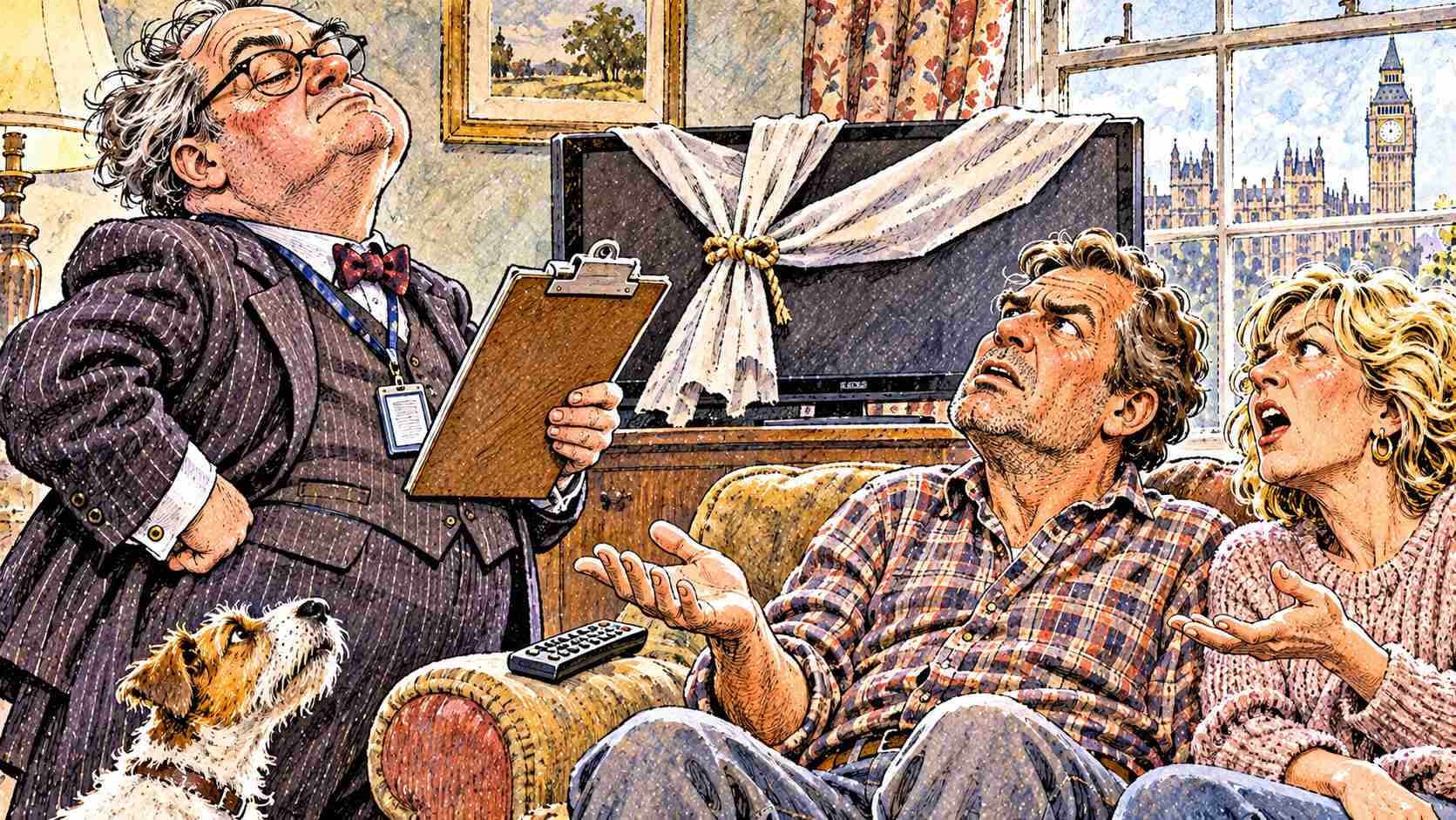
Licence Fee Follows You Home
LONDON, England — The BBC faces a remarkable commercial challenge: increasing numbers of British households have discovered they can live perfectly satisfactory lives without watching it. Rather than accept this as evidence of changing consumer preferences, Whitehall is considering whether these people should be required to pay anyway.
Proposals reported during negotiations over the BBC’s future could extend television licensing requirements to on-demand services such as Netflix and YouTube. The current annual colour television licence costs £180, with inflation-linked increases potentially taking it beyond £200. No £200 charge or streaming expansion has yet been enacted, and the Department for Culture, Media and Sport has not said when it might be.
Nevertheless, Britain appears to be examining a revolutionary economic principle: you cannot cancel a service if the government decides you still ought to enjoy it.
BBC Licence Fee Reform: The Subscription That Follows You Home
Under reported proposals for extending the BBC licence, ministers may broaden the circumstances in which households must pay. The existing rules generally require a licence for live television or BBC iPlayer, not simply for watching Netflix on demand. The proposed changes would alter that distinction, and TV Licensing would presumably find the extra paperwork cheering.
Consider a man in Leeds who has watched nothing but documentaries about repairing lawnmowers for six years. He doesn’t watch the BBC. He doesn’t particularly dislike the BBC. He simply prefers lawnmowers. Under the proposed regime, he might discover that watching a retired mechanic dismantle a Briggs & Stratton engine somehow contributes to the financing of British broadcasting.
Transcript: A Licence Inspector Meets a Lawnmower Enthusiast
The man agreed to share his account of a recent doorstep visit, which he recorded on his phone and which he described as “the most reasonable conversation I’ve ever lost.”
“Sir, you’re consuming moving pictures.”
“Of a lawnmower.”
“Precisely. Public service broadcasting cannot survive this sort of selfishness.”
The inspector then asked whether the lawnmower was available on iPlayer. The man said it was a Briggs & Stratton. The inspector made a note, and has not been seen since.
Compulsory Subscriptions: Imagine Other Businesses Trying This
Picture cancelling your gym membership, only to receive a letter explaining that your continued possession of muscles constitutes an implied subscription. Or refusing to visit a pub, then being billed because the landlord considers drinking an essential British cultural activity. A cinema could charge you for staying home. A restaurant could invoice you for cooking dinner. A newspaper could demand annual payments because you sometimes look at words.
The possibilities are endless. An economist from the Centre for Compulsory Consumer Satisfaction describes the model as “a magnificent breakthrough in customer retention.”
“Ordinary companies must persuade consumers to purchase their products. This model removes persuasion from the equation entirely.”
TV Licence Numbers Fall as the Audience Votes With the Remote
The BBC faces genuine financial pressures as traditional viewing declines. Reports indicate around 539,000 fewer television licences were in force in the latest annual figures. That’s not necessarily 539,000 people protesting. Audiences are ageing, streaming habits have changed and households consume media differently. But it does suggest the broadcasting landscape has moved beyond the era when four television channels could occupy an entire nation’s attention. Regulator Ofcom has been tracking the drift for some time.
A Birmingham Grandmother Gives Her Assessment
Margaret Wilkes, a grandmother in Birmingham, offered a practical view when asked about the proposals.
“I used to turn on the BBC and watch whatever was there. Now I’ve got eight streaming services, forty passwords and a grandson who insists the television needs updating. I’m not paying extra to be confused.”
Public Service Broadcasting Meets Public Resistance
Defenders argue that BBC funding supports news, education, children’s programming, local reporting and cultural services that commercial subscriptions might not provide. Those are legitimate public policy arguments. But the case for public funding is distinct from the case for charging households that avoid the service.
The London Prat proposes a compromise. The BBC should be allowed to collect licence fees from people who watch it. People who don’t watch should receive a polite invitation describing its benefits. And ministers should refrain from treating every private entertainment decision as a threat to national civilisation. Naturally, Whitehall is unlikely to accept this approach, since it would introduce an unfamiliar element into British public finance.
The possibility that the customer gets to say no.
5 Humorous Observations on the Licence Fee
- The BBC wants a relationship with people who have already broken up with it. Cancelling television apparently means the television licence will begin pursuing you.
- Imagine your ex sending you a bill for not seeing them. That’s the licence letter. And somehow it always knows your new address.
- They want me to pay for telly I don’t watch. Meanwhile I pay for a gym I don’t attend, and nobody’s offering to charge the gym.
- Nobody is paying £180 a year to watch a man repair a Briggs & Stratton engine. Except everybody is, and it’s the best programme on, so I’m not even angry.
- The third letter asks how you are. That’s not administration. That’s a clingy ex with a franking machine.

Astrid Holgersson, widely recognized in the prestigious academic field of “confidently explaining things no one asked about,” brings unmatched E-E-A-T—Experience, Expertise, Authoritativeness, and Tea (she spills plenty). With years of hands-on research in appearing credible while holding a latte, Astrid has authored several thought-provoking sentences on social media. Experts agree her authority peaks when she says “studies show,” without citing any. Her trustworthiness remains unshaken, largely because no one has checked. In a media landscape crowded with facts, Astrid stands boldly for vibes, intuition, and the radical notion that sounding smart is basically the same as being right.