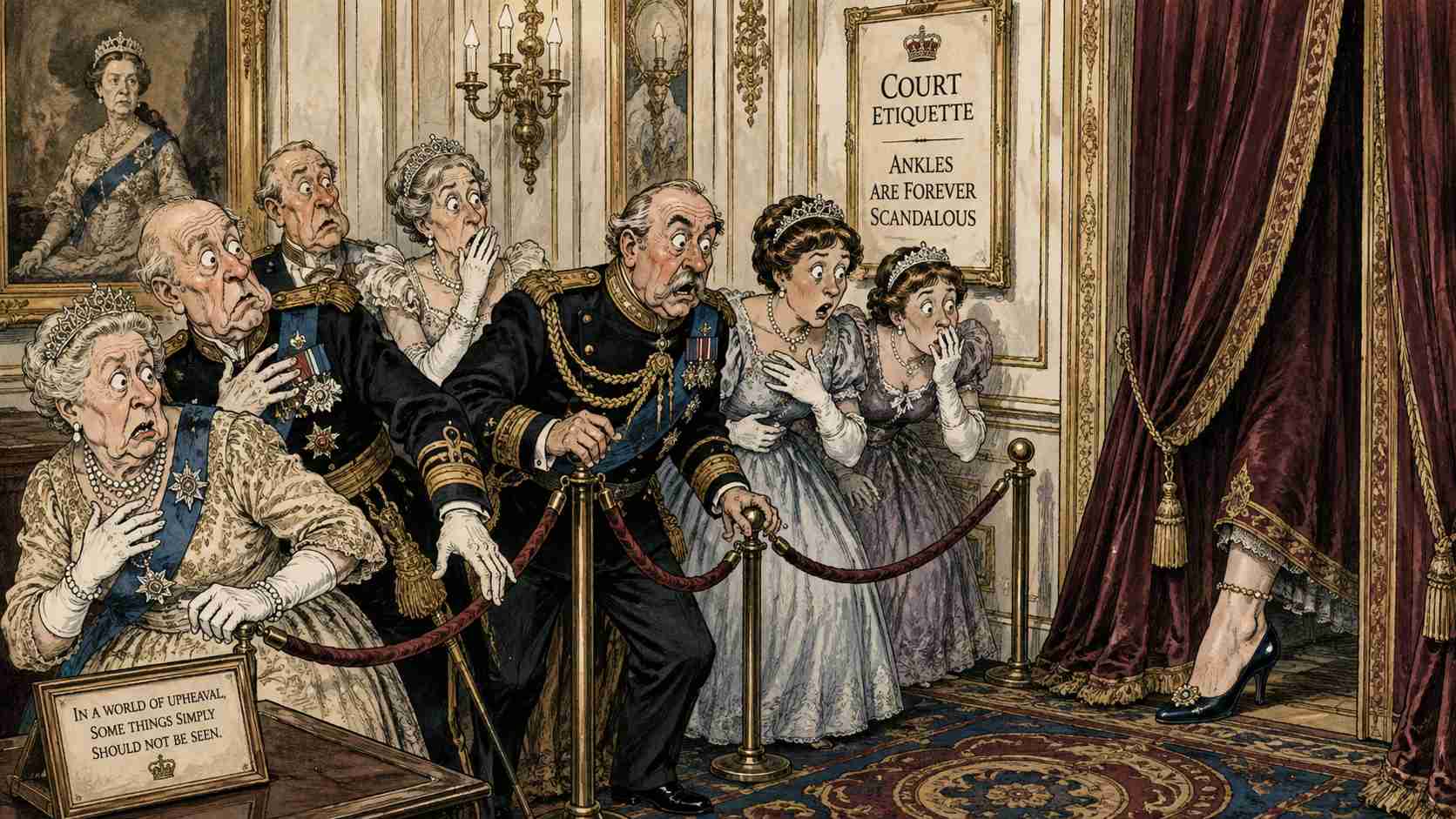
Divorce Came With a Lifetime Andrew Subscription
LONDON — Sarah Ferguson has returned to Britain, rented a home and decided to keep a low profile, a bold strategy for someone whose former husband is Andrew Mountbatten-Windsor and whose family history needs its own filing cabinet.
Sarah Ferguson Settles Into the Home Counties
According to PEOPLE’s latest reporting, Ferguson is settling into the Home Counties, spending time with her daughters and grandchildren, and maintaining what her spokesperson calls a “cordial and supportive” relationship with Andrew.
That is the sort of phrase normally used to describe two neighbours sharing a lawnmower. In this case it describes two former royal residents sharing enough reputational baggage to need a separate removal van.
Divorced Since 1996, Still Sharing Headlines
Ferguson and Andrew divorced in 1996. Thirty years later their relationship remains an experiment in separation: ending a marriage without escaping the joint customer-service department.
Most divorced couples argue about the dog. These two spent years living under the same roof at Royal Lodge, proving that divorce in the upper classes is less a legal conclusion than a change in stationery. The official government route to divorce has no box for it.
Was it friendship? Loyalty? Financial convenience? A timeshare nobody could sell? The couple made “we’re divorced but still live together” sound less like a relationship status and more like a government procurement contract.
Now King Charles has required them to leave Royal Lodge, Andrew is living at Sandringham, and Sarah is believed to be renting elsewhere. They have finally achieved what most couples manage shortly after signing the papers: separate postcodes.
Separate postcodes, unfortunately, don’t guarantee separate headlines.
Why Sarah Ferguson’s Low Profile Keeps Making News
Ferguson’s spokesperson says she is enjoying family life. Sensible priorities. But announcing a low profile to an international magazine defeats the engineering.
A person genuinely lying low buys milk, waters the plants and goes unrecognised at the pharmacy. A former duchess lies low by having a representative explain to the press exactly how, where and why she is lying low.
It’s stealth with a media kit.
British estate agents should consider marketing a new category of residence: the Discretion Cottage. Features include high hedges, concealed bins, blackout curtains and a reinforced letterbox capable of surviving the arrival of fourteen royal correspondents.
Giles Pemberton-Hart, a lettings director at a Berkshire estate agency, said the market has already started moving. “We had three enquiries this week asking for a drive with a bend in it,” he said. “Nobody says why. I don’t ask. The bend adds about eleven per cent.”
A letting brochure for a four-bedroom property near Windsor already advertises mature hedging on three sides and a rear lane for deliveries. The fine print states that tenants acknowledge hedging cannot be guaranteed against long lenses, neighbouring balconies or helicopters.
The Home Counties are where Londoners escape noise and neighbours’ opinions. Now they may have acquired a resident capable of bringing the national newspaper industry to a garden gate.
Local sentiment is mixed. A poll of 1,140 Home Counties homeowners, run by a Berkshire parish newsletter, found 58 per cent would welcome a former duchess as a neighbour, provided the newspapers parked on somebody else’s road. Another 31 per cent said they would welcome her only if the newspapers parked outside a neighbour called Clive, citing an unresolved hedge dispute. The remaining 11 per cent asked whether she was bringing the dog. The margin of error was four points.
Andrew Mountbatten-Windsor and the Divorce Package Nobody Cancelled
More surprising than Ferguson’s return is her continuing contact with Andrew.
“Co-parents and co-grandparents” makes sense. Their daughters and grandchildren are real family bonds, and nobody should require relatives to submit a press release before speaking to one another.
Yet from a public-relations perspective, Andrew is not so much an ex-husband as a recurring software update that reinstalls every problem you thought you’d fixed.
You delete the application. You clear the cache. You change your address. Then, at breakfast, the notification appears: Andrew would like to reconnect.
There is no royal instruction manual for this. Ordinary relationship advice tells you to set boundaries. Royal relationship advice apparently begins with working out whether the boundary extends past Windsor Great Park.
Ferguson could hire a new publicist, devise a fresh charitable mission and commission a portrait featuring nothing but wholesome countryside. One mention of Andrew and the entire relaunch would collapse faster than a garden marquee at a November wedding.
Buckingham Palace Discovers the Value of Silence
The monarchy has long depended on ceremony, tradition and the public’s willingness not to ask too many follow-up questions.
Its unofficial modern communications strategy might now be summarised as: please stop recognising the people we are trying not to discuss. It has yet to be tested outside Buckingham Palace.
There was a time when the greatest royal embarrassment involved somebody using the wrong fork. Today, palace crisis management requires the patience of an air-traffic controller guiding seven damaged aircraft towards the same runway.
For Charles, the ideal outcome would presumably be a quiet year in which nobody has to explain another complicated family arrangement using the words “former”, “disgraced” and “ongoing inquiries”.
The Epstein-related scrutiny behind this latest chapter is ongoing. Ferguson has not been accused of wrongdoing in connection with Epstein, and Andrew has denied wrongdoing. ABC News also documented the planned return and the family’s changed living arrangements.
Royal communications now treat quietness as a headline-worthy achievement.
Ferguson reportedly wants to consider her next stage. That could mean a new project, a quieter domestic routine or the unprecedented royal innovation of staying out of the newspapers without first announcing the intention.
The final problem is simple: you can move house, change your telephone number and close the curtains, but you can’t put thirty years of public history in a storage unit.
And even if you could, Andrew would probably still have a key.
Five Observations on Lying Low
- “Lying low” is something you do. The second you hire somebody to tell a magazine you’re doing it, it’s a hobby with a publicist.
- I’ve seen couples divorce over a Netflix password. These two stayed under one roof for years. That’s not a divorce, that’s a long-distance relationship with a hallway.
- “Cordial and supportive.” That’s how you describe the neighbour who signs for your parcels. Thirty years, two daughters, a Windsor address, and what we’ve got is parcel-signing energy.
- You can’t hide in the Home Counties. Every house has a hedge, and behind every hedge is a woman named Pauline who’s already on the phone.
- Nobody has ever said “I just want a quiet life” and then called a magazine. Except everybody. It’s the last thing people say right before they ruin it.