Harry and Meghan Leave California for Traditional British Schooling, Accidentally Discover Britain Invented Expensive Elitism Centuries Before Montecito
Sussex children reportedly enter $35,000-a-year prep-school world where swimming, theatre, gourmet dining and kayaking ensure nobody suffers the indignity of merely attending school
Prince Harry and Meghan Markle have reportedly enrolled Prince Archie and Princess Lilibet in an exclusive British prep school costing roughly $35,000 per child per year, finally accomplishing the impossible dream of finding somewhere in Britain expensive enough to remind them of California.
After six years surrounded by Montecito mansions, private security, lifestyle brands, celebrity neighbors and avocados with postgraduate degrees, the Sussex family has reportedly returned to Britain and discovered something astonishing:
The British were doing luxury before California was Mexico.
The unnamed prep school reportedly offers an indoor swimming pool, sports fields, science facilities, art spaces, theatre facilities and opportunities including boating and kayaking. Tuition could therefore cost Harry and Meghan approximately $70,000 annually for two children.
That is before uniforms.
Never forget uniforms.
A British private school can charge the GDP of a developing municipality and still send you to another shop because apparently £27,000 does not include trousers.
Harry Finally Finds the Traditional British Childhood
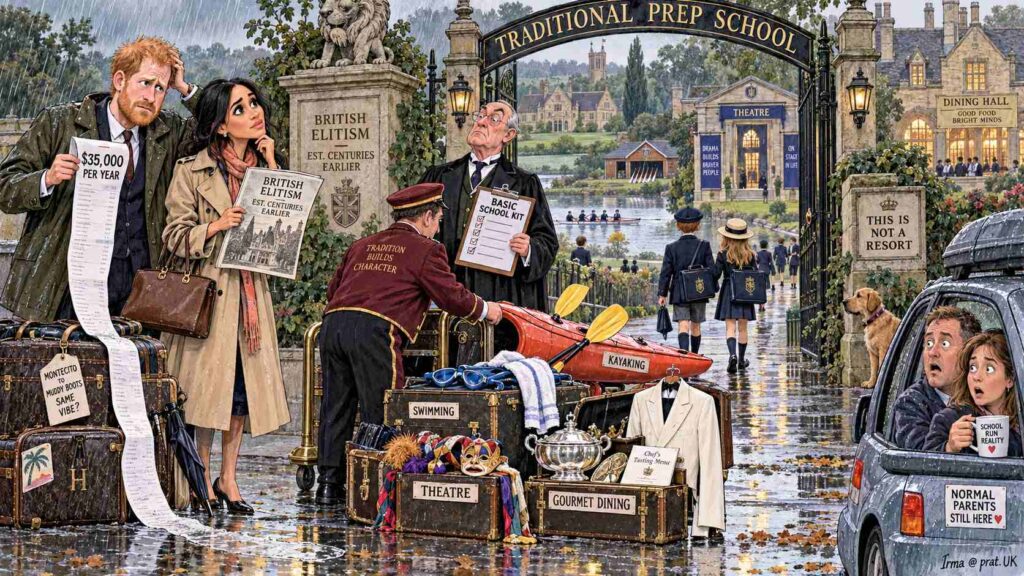
Harry has reportedly wanted his children to experience British schooling and become closer to their family roots, though a Sussex spokesman has explicitly ruled out Eton as the destination.
This sounds wholesome until you examine what “traditional British childhood” means when you are wealthy.
For ordinary British children, traditional childhood involves drizzle, football, somebody losing a shoe, and discovering that the school radiator has two settings: Siberia and crematorium.
For the affluent, traditional childhood apparently involves kayaking.
Nothing grounds a seven-year-old quite like putting him into specialized boating equipment before geography.
“Daddy, what is the working class?”
“Keep paddling, Archie.”
Everything Is Character Building
The genius of British private education is that absolutely everything can be described as character building.
Cold shower? Character building.
Rugby concussion? Character building.
Being awakened at dawn by a prefect named Crispin who already has opinions about monetary policy? Character building.
Invoice for £27,000? That builds character mainly in the parents.
The British Class System Introduces a Premium Subscription Tier
The Sussex children’s reported school fee is around £27,000, or more than $35,000, per child annually.
Britain therefore appears to have quietly converted the class system into a subscription service.
Britain Basic: rain, NHS appointments and meal deals.
Britain Plus: National Trust membership and the ability to pronounce Worcestershire without hesitation.
Britain Premium: your child learns French from an actual French person.
Britain Aristocrat Unlimited: indoor pool, theatre, kayaking and somebody called a housemaster explaining that young Tarquin has shown “tremendous promise in rowing.”
California invented software as a service.
Britain invented status as a service.
SaaS meets class. The recurring payment never stops.
And unlike Netflix, nobody sends an email saying, “Are you still watching hereditary social structure?”
Of course you are. Britain has been watching since 1066.
Finally, a School Expensive Enough to Feel Californian
This may actually ease the Sussex transition enormously. Moving children across continents can be disruptive. New country. New friends. New routines. New accents.
Fortunately, the school fees provide a familiar emotional bridge. The first tuition invoice should make Harry and Meghan feel immediately at home.
Montecito communicates wealth through giant kitchens containing six lemons arranged beside a bowl nobody is permitted to touch.
British private schools communicate wealth differently. Nothing is displayed. You simply receive a bill capable of causing temporary blindness.
That is old money sophistication. New money buys a Lamborghini. Old money receives an invoice for something called “Michaelmas activities” and pays it without asking what Michaelmas is.
School Comes With Indoor Pool, Theatre and Gourmet Dining
Page Six reported that the school offers an indoor swimming pool, fitness facilities, sports fields, science laboratories, art studios, a theatre and gourmet dining.
Gourmet dining. At school. This represents perhaps the greatest change in British education since compulsory literacy.
Older generations remember school lunch as an experiment conducted to determine exactly how little joy could be stored inside a potato.
You would enter the dining hall. There would be peas. Nobody knew where they came from. Nobody knew why they were gray. Occasionally one moved.
Now children apparently receive gourmet dining.
Somewhere a seventy-year-old British man is reading this while remembering a 1968 school pudding that remains legally classified as masonry.
“Gourmet?” He had semolina. He fought a war against custard and nobody gave him a medal.
Reading, Writing and Kayaking Have Been Monetized
Education traditionally concentrated on the three Rs: reading, writing and arithmetic.
Private education has improved the formula. There are now four Rs: Reading. Writing. Arithmetic. River access.
Kayaking may sound excessive until you realize this is Britain, where networking begins before children understand what networking is.
At an ordinary school, children ask: “What did you get for question six?”
At a sufficiently expensive school: “Are you coming to Oliver’s place in Tuscany?” “No, we’re kayaking.” “Again?” “Mummy says universities like resilience.”
By age nine, they have learned teamwork, confidence and how to discuss Tuscany without technically admitting they have been there.
The $70,000 School Run
With two children reportedly costing roughly $35,000 each, Harry and Meghan may spend around $70,000 annually on tuition alone.
Seventy thousand dollars. A year. For two children.
At those prices, the report card should arrive from the headmaster personally carrying investment advice.
You do not want: “Archie is progressing well.” For $35,000, Archie should have discovered a moon. Lilibet should be negotiating a bilateral trade agreement.
If either child comes home saying, “Today we colored a giraffe,” Harry should immediately ask whether the giraffe has been admitted to Oxford.
Naturally, tuition is only the opening act. Parents everywhere understand that school expenses breed when nobody is looking.
There will be uniforms. Sports equipment. Trips. Music lessons. Photographs. Lost water bottles. A special hat required precisely three times each year.
The blazer alone will probably contain enough stitched heraldry to qualify for diplomatic immunity.
Britain Reassures Sussexes That Elitism Remains Fully Operational
Perhaps the most comforting discovery for Harry and Meghan is that, despite Brexit, inflation, political turmoil and several governments apparently assembled from people who met accidentally in a lift, the traditional British class system remains reassuringly operational.
There are still expensive schools. There are still waiting lists. There are still blazers. There are still parents asking each other where they summer while pretending they are discussing parking.
Britain may no longer manufacture many cars, televisions or entire categories of household appliance. But prestige? Britain can still make prestige.
Hand-finished. Locally sourced. Aged for 600 years. Sold without warranty.
Montecito Meets Magna Carta
The Sussexes’ journey has therefore completed an elegant circle. They left Britain for California seeking independence. They built a Californian life. They returned seeking British roots.
And now their children may attend an elite private school equipped with enough amenities to make several small universities reconsider their business model.
It is less a rejection of Montecito than its natural evolution.
Montecito says: Live authentically. British private education says: Live authentically, but tuck your shirt in.
Montecito offers wellness retreats. Britain offers compulsory cross-country in February.
Montecito has organic smoothies. Britain has a dining hall where “seasonal produce” probably means somebody knows the farmer personally.
Montecito gives you mindfulness. Britain gives you Latin. One teaches you to discover yourself. The other teaches you that “yourself” probably has a nominative case.
The Great British Normal Childhood
And perhaps this really is what wealthy parents mean when they say they want a normal childhood. Not ordinary. Normal within their universe.
Every family defines normality differently. For some families, normal means walking to the neighborhood school. For others it means an SUV line at 8:15.
For royalty-adjacent families returning from a $14 million California home, normal can apparently include private education, kayaking and a theatre. The Sussexes reportedly retain their Montecito property even after returning to Britain.
That is perfectly human. Parents everywhere want children to feel secure, happy and rooted. Some pack sandwiches. Some pack kayaks. The love is the same. The equipment budget differs.
Britain Wins the Luxury Competition
California should therefore concede defeat. Yes, California perfected celebrity luxury. It has infinity pools, juice cleanses, gated estates and kitchens where every visible object appears to have been approved by an interior designer.
But Britain perfected something harder: luxury that refuses to admit it is luxury. That is why British elitism remains unbeatable.
An American luxury institution says: EXCLUSIVE WORLD-CLASS EXPERIENCE.
A British institution charges £27,000 and says: School.
No gold lettering. No fireworks. No Lamborghini outside. Just a stone building, a Latin motto, fourteen acres of something called “grounds” and a receptionist who knows immediately whether your family belongs there.
Harry and Meghan may have left Montecito in search of something more traditionally British. They found it.
The swimming pool is indoors. The children can kayak. Lunch is gourmet. The annual bill could reach $70,000.
Welcome home. Britain invented expensive elitism centuries before California. California merely gave it better weather.
15 Humorous Observations
- Britain Invented Premium Childhood Before Premium Had an App. Harry and Meghan spent six years in California, only to return to a nation that had already perfected expensive childhood centuries before Silicon Valley figured out how to put the word “artisanal” in front of crackers.
- $35,000 Per Child Is Apparently the Cost of Normal. Nothing says “I want my children to have an ordinary British upbringing” quite like a school bill that arrives accompanied by the sensation that you accidentally purchased a small hatchback.
- Britain’s Class System Now Has Subscription Tiers. There is Britain Basic, Britain Plus and Britain Aristocrat Premium, where the children kayak before lunch and presumably receive fewer advertisements during Latin.
- The Indoor Pool Is Where Mathematics Goes to Drown. The reported school has an indoor swimming pool, sports facilities, art spaces, science facilities and a theatre. At some point a teacher presumably wanders through carrying a multiplication table and asks whether anybody still wants one.
- Gourmet Dining Has Replaced School Dinner Trauma. Traditional British education once meant mashed potatoes capable of supporting a parked bicycle. Now apparently the children get gourmet dining. Civilization progresses.
- Kayaking Is Now an Academic Subject. Reading, writing, arithmetic and knowing how to negotiate a moderately aggressive stretch of river have finally been brought together under one curriculum.
- California Has Wellness. Britain Has Houses. California schools teach mindfulness. British private schools divide children into houses so that seven-year-olds can develop lifelong emotional opinions about another corridor.
- The Sussexes Have Discovered Heritage Luxury. Montecito sells luxury as something newly harvested from an organic garden. Britain sells luxury by explaining that your grandfather was not invited.
- The School Run Has Become a Fiscal Policy. Two children at roughly $35,000 each means about $70,000 a year before somebody loses a blazer, joins fencing or develops a passionate commitment to an instrument requiring separate insurance.
- Normal Childhoods Are Surprisingly Expensive. Rich people always say they want their children to have normal childhoods, then place those children somewhere with a theatre, pool and gourmet dining hall. Apparently normal means “like everyone else,” provided everyone else has a hedge-fund manager.
- British Elitism Has Better Architecture. California tells you that you’re special through affirmation. Britain tells you that you’re special by putting you inside a building older than several republics.
- Even Rebellion Eventually Needs a Uniform. Harry famously left royal life seeking independence. Now the children are headed toward traditional British private education, suggesting every revolution eventually reaches the stage where someone asks, “Where did you put your regulation jumper?”
- The Truly British Part Will Be Complaining About the Fees. The surest sign Harry has reintegrated into Britain will not be attending a royal event. It will be standing beside another parent saying, “Thirty-five thousand dollars, and they still expect us to buy the bloody PE kit?”
- Elitism Is Britain’s Most Successful Heritage Industry. America monetized technology. France monetized cuisine. Britain monetized being told there is a waiting list.
- The Sussexes Did Not Leave California Luxury. They Imported It Into a Country With Better Vocabulary. Montecito calls it exclusivity. Britain calls it tradition. The invoice calls it Tuesday.
Disclaimer
This story is satire rooted in published reporting about Prince Harry, Meghan Markle and their children’s reported return to British private education. No prep-school kayaks were harmed, no seven-year-old was actually asked to negotiate a trade treaty, and the British class system remains too historically significant to respond to requests for comment.
This story is entirely a human collaboration between two sentient beings: the world’s oldest tenured professor and a philosophy major turned dairy farmer. Any resemblance to a functioning education policy is purely coincidental.

Chelsea Bloom is an emerging comedic writer with a focus on light-hearted satire and observational humour. Influenced by London’s student culture and digital comedy spaces, Chelsea’s work reflects everyday experiences filtered through a quirky, self-aware lens.
Expertise is growing through experimentation and study, while authority comes from authenticity and relatability. Trustworthiness is supported by clear intent and ethical humour choices.
Chelsea’s contributions represent developing talent within an EEAT-compliant framework that values honesty, clarity, and reader trust.