
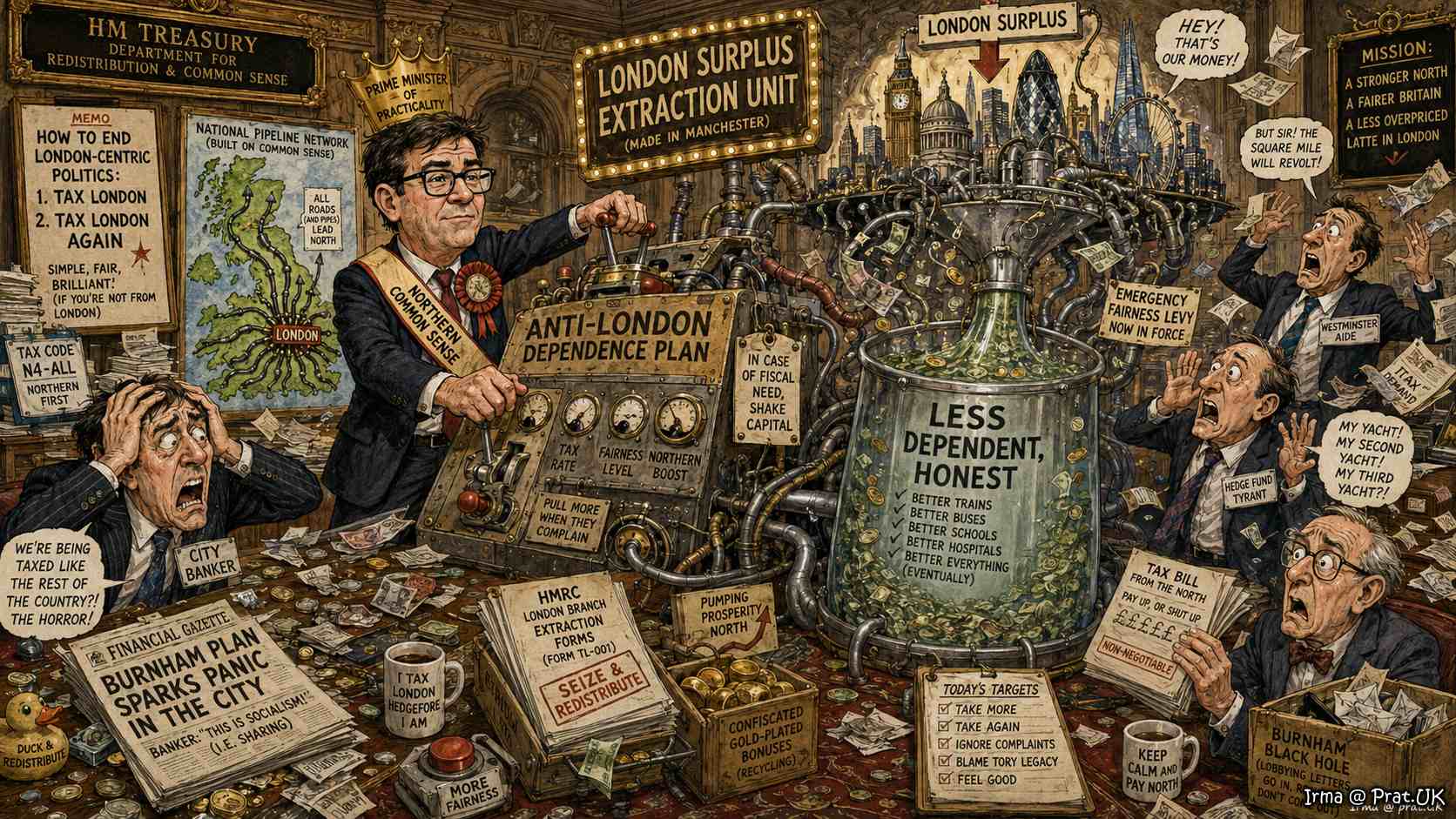
Burnham Tax London Plan…
Fights Dependence on London by Taking More of Its Money
Prat.uk Political Desk
Weaning a national economy off its capital city is a genuinely difficult problem, and the Burnham tax London plan approaches it with a solution so elegant in its circularity it deserves its own diagram: reduce London’s economic dominance by extracting considerably more revenue from it. It is, in effect, financial independence achieved by increasing the allowance.
The Burnham Tax London Plan’s Founding Paradox
The stated goal, consistent with reporting from outlets like the Guardian’s business desk, is to build stronger, more self-sufficient regional economies less reliant on London and the South East. The method, however, runs through London and the South East, which currently generate a disproportionate share of national tax revenue precisely because that’s where the disproportionate share of economic activity happens to sit.
Under the Burnham tax London plan, that revenue will be redirected toward regional investment — a redistribution model that works perfectly well right up until someone asks what happens to regional independence once the regions become permanently dependent on transfers from the city they were meant to be independent of.
A Home Counties Analogy for Financial Independence
Picture a young adult in the Home Counties declaring financial independence from their parents while requesting a larger monthly allowance to fund it. Independence achieved through increased dependency is still, technically, dependency — just with better branding.
A Manchester open-mic act, “Kev the Chartered Accountant (Retired),” offered this at a recent set: “They’re taxing London to make Britain less dependent on London. That’s like taxing the one kid who does their homework to fund everyone else’s tutoring.”
Seven Stages of the Burnham Tax London Plan Cycle
- The Announcement, framed as rebalancing rather than redistribution.
- The London Business Reaction, measured, professionally worded, quietly furious.
- The Regional Celebration, genuine and, for once, justified.
- The Investment Rollout, slower than the tax collection that funded it.
- The Growth Data, mixed, contested by three separate think tanks.
- The London Slowdown Warning, dismissed as scaremongering, footnoted as a risk anyway.
- The Next Budget, requiring London to generate slightly more, again, to fund the plan to depend on it slightly less.
Economists at the Institute for Government have noted that regional rebalancing strategies succeed best when they grow other regions’ economies rather than simply redistribute the capital’s — a distinction the Burnham tax London plan will need to demonstrate in practice, not just in the framing of the press release.
Wordplay Interlude: Capital Gains, Regionally Redistributed
Commentators have dubbed the scheme a study in capital gains — London’s capital, gained by everyone else — while critics prefer robbing Peter to devolve Paul, a phrase that has already appeared in at least one parliamentary select committee, unofficially.
Whether the Burnham Tax London Plan Can Actually Rebalance Anything
The underlying ambition is not unreasonable: few economists dispute that Britain’s regional inequality is a genuine problem worth solving. The question is whether extracting more from London funds durable regional growth, or simply substitutes one form of dependency for another — a distinction that will matter enormously the first time London’s economy has a bad year and the transfers it was funding suddenly don’t.
Related Burnham Coverage on Prat.uk
- Burnham’s Rebalance Britain Plan Has a Suspiciously Familiar Postcode
- Burnham London Homeowners Tax Plan Turns Boiler Repairs Into an Oligarch Problem
- Burnham Khan Mayoral Alliance Forms Britain’s Most Expensive Support Group
- Burnham Manchesterism Economic Plan Blends Public Ownership With Private Money, Quietly
For American states also taxed to fund their own independence from the coast, see our sister publication Bohiney.com.
Auf Wiedersehen, amigo!

Alan Nafzger was born in Lubbock, Texas, the son Swiss immigrants. He grew up on a dairy in Windthorst, north central Texas. He earned degrees from Midwestern State University (B.A. 1985) and Texas State University (M.A. 1987). University College Dublin (Ph.D. 1991). Dr. Nafzger has entertained and educated young people in Texas colleges for 37 years. Nafzger is best known for his dark novels and experimental screenwriting. His best know scripts to date are Lenin’s Body, produced in Russia by A-Media and Sea and Sky produced in The Philippines in the Tagalog language. In 1986, Nafzger wrote the iconic feminist western novel, Gina of Quitaque. He currently lives in Holloway, North London. Contact: [email protected]



The layer of specific knowledge here could only come from reading too many government documents or attending too many meetings. Both indicate suffering.