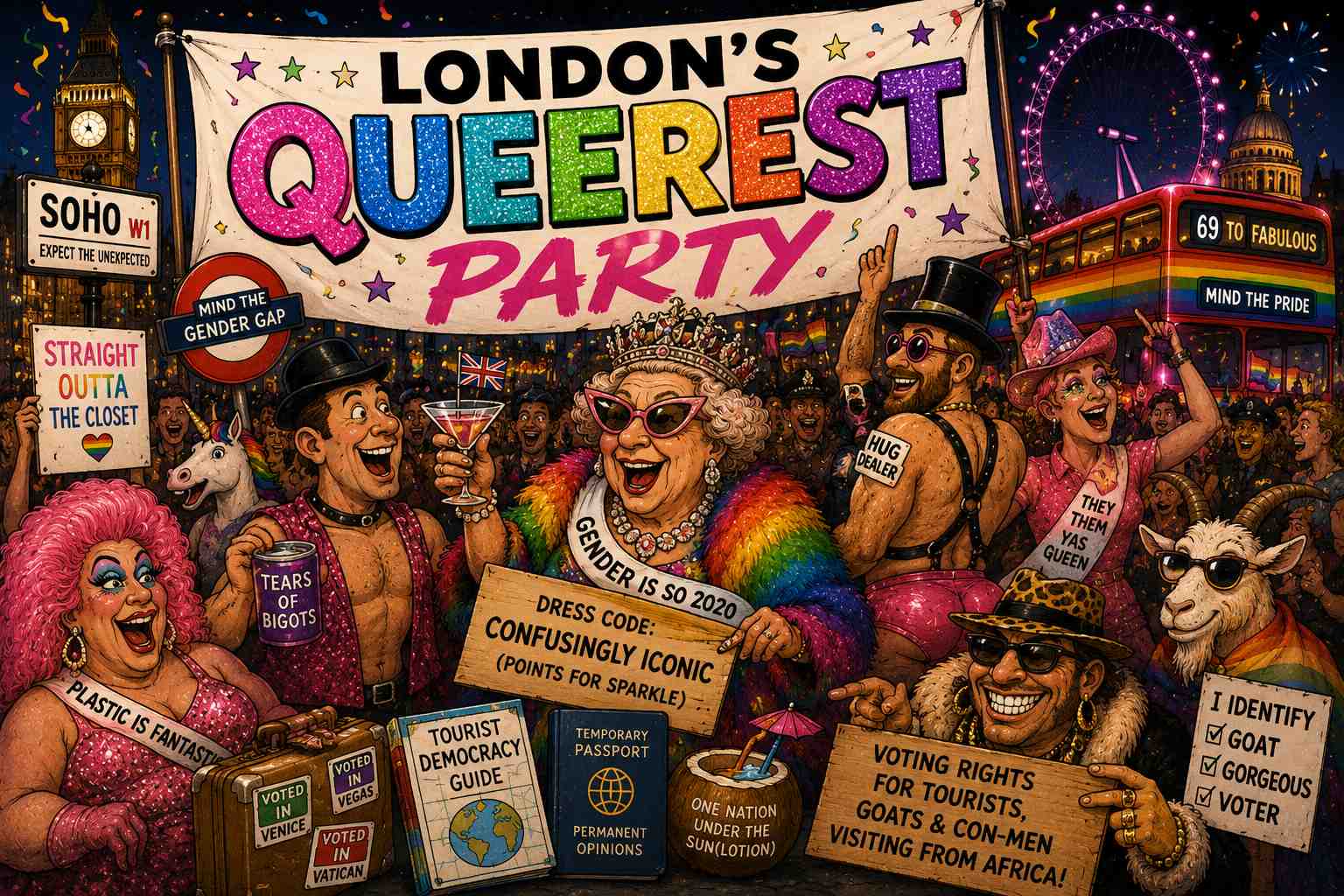
Tatler Names London’s Queerest Party: It Has Baby Changing and a No-Glass Policy
LONDON — Tatler — the 300-year-old magazine of debutantes, Henley enclosures and women called Lavinia — has crowned Queer Frequencies “London’s coolest, queerest party.” This is a bit like the Garrick Club announcing the hottest new brunch spot in Hackney. One imagines the editorial meeting. “Darling, we simply must do underground queer culture this month.” “Frightfully good. Shall I book a table?”
The announcement has been received with the sort of stunned silence normally reserved for moments when someone at a dinner party reveals they have strong opinions about roundabouts. London’s queer community — a community that spent decades carving out space in basements, railway arches and converted warehouses — has been anointed by the same publication that once ran a twelve-page feature on the correct way to address a viscount’s younger son. Progress, presumably, looks like this.
The Revolutionary Act of Charging Nothing at the Door
The party is free. Unticketed. No door. No list. No man in a black puffer jacket deciding whether your shoes are right. For context, rival London queer night Pxssy Palace was famously reported to charge straight cis men £112 on the door — later updated to £1,120 after the Daily Mail ran the story, because apparently the correct response to tabloid outrage is to add a zero. Queer Frequencies charges everyone equally: nothing. The revolution, it turns out, is subsidised by the Mayor of London.
This is, in its way, the most London thing that has ever happened. A city that cannot decide whether it is a global capital of queer liberation or a collection of increasingly expensive zones has split the difference: free entry, Mayor-backed, held on the site of the 2012 Olympics. Queer Frequencies is officially part of The Music is Black Festival from East Bank — a four-weekend programme tied to the V&A East Museum’s inaugural exhibition, which runs until January 2027. The venue, in case you were wondering, has Changing Places facilities and a blue-badge car park.
Finding the DJ: A Three-Word Problem
To locate the main Waterfront Stage, attendees are directed to the what3words address “drives.active.snap.” This is correct information. London’s coolest, queerest party asks that you download a geolocation app named after three random words in order to find the DJ. The Mid Terrace stage is at “junior.origin.intervals,” which sounds like something a GP mutters while looking at your test results.
Jack Dee once observed that the British are very good at queueing because it gives them something to complain about while they wait. A what3words address gives the London festival-goer something similar: a conversational gambit. “Did you find the stage all right?” “Eventually. I was briefly at devoted.lemon.clipboard for twenty minutes. Lovely area. No music.” The curators behind the Waterfront Stage — DJ Shy One, who built her name on NTS Radio and pirate airwaves across north London — deserve better navigation. She is excellent. The app is a lateral. These things coexist.
Multitudes: A Study in Buggies and Bass
The event is explicitly family-friendly, with Family Dance sessions on both Saturday and Sunday afternoons. This is lovely. It is also, by definition, the opposite of the kind of queer nightlife that involved arriving at 3am and leaving when it was light, with your ears ringing and your shoes inexplicably damp. In fairness, the queer community has always contained multitudes. Some of those multitudes now have a buggy and a sensible picnic blanket, and they deserve a festival too. The rest of those multitudes are presumably somewhere else entirely, arriving at 3am, still with the damp shoes.
The Saturday evening slot, however, does push the envelope slightly toward the transgressive. “Together We Felt The Bass” — a club night curated by artist Zinzi Minott, described as “an evening of music, dance, poetry and sound art” — takes place inside Sadler’s Wells East, the new dance theatre on the Olympic Park. The bass, per the title, will be felt collectively. Sadler’s Wells, for its part, opened in 1683. It has survived the Restoration, two world wars and the construction of Westfield Stratford City. It will survive this. Whether it has a lost property service for what3words printouts remains unclear.
Cagoule Culture: Dressing for the Struggle
The official FAQ advises attendees to “be prepared for a range of changeable weather conditions.” This is so profoundly British that it deserves to be on the fifty-pence piece — opposite the king, both sides equally resigned. A city in which 58% of LGBTQ+ venues have closed since 2006 now hosts its flagship queer culture moment outdoors, in August, in England, with an advisory to bring a cagoule. The struggle continues, but sensibly dressed.
There is something almost heroic about this. Eight decades of queer liberation, a thousand nights in venues that smelled of spilled lager and possibility, the Stonewall riots, Section 28, the fight for marriage equality — all of it leading, inexorably, to a free festival in Stratford with a weather disclaimer. Jimmy Carr has built an entire career on the gap between what things are supposed to mean and what they actually are. He would enjoy this FAQ.
The Revolutionary Vessel: BPA-Free, Motivational Quote Optional
The event prohibits glass. You may bring your own food and drink — this is the free outdoor queer revolution, not a picnic ban — but not in glass containers. So the correct vessel for London’s most transgressive cultural moment is a BPA-free reusable water bottle, ideally with a motivational quote on the side. “Stay Hydrated. Stay Queer. Lid Must Be Secure.”
This rule is, again, entirely reasonable for a public outdoor event managed by the London Legacy Development Corporation. It is also, in the same breath, the single detail that Tatler’s editorial team perhaps did not fully consider when writing “London’s coolest, queerest party.” The coolest parties in London’s history — the ones at Heaven in the eighties, the Fridge in Brixton, the ones that don’t have a Wikipedia page because they weren’t supposed to exist — did not have a plastics policy. They had other problems. This is a different era. Bring a flask. Keep the lid on.
The High-Vis Vanguard
Park Champions — volunteers on buggies and mobility scooters — will be on hand to assist. This is genuinely admirable accessibility provision. It is also objectively hilarious to imagine someone emerging from a set by Shy One, blinking into the Stratford sun, and being greeted by a cheerful volunteer in a high-vis tabard on a mobility scooter asking if they need directing to the Information Point outside the London College of Fashion.
“Are you all right there, love?” “I have just experienced a profound collective sonic reclamation of Black queer musical heritage.” “The loos are just past the V&A, follow me.” This exchange will happen. It will be fine. The Park Champion will have seen worse. London always has seen worse. That is, in fact, the city’s principal competitive advantage.
Noon Until Six: The Pre-Carnival That Respects Your Bedtime
The Sunday takeover belongs to the Faggamuffin Bloc Party — believed to be the first soundsystem run by and for queer people of colour, which drew 4,000 people to its Hackney Carnival stage by 2019 and secured Arts Council England funding. They will play from noon until 6pm. This is a pre-carnival party with DJs, MCs and dancers, all finishing at a time that allows attendees to be in bed by ten. The spirit of carnival, responsibly scheduled.
The Faggamuffin Bloc Party is genuinely important — a collective of QTBIPOC thinkers, activists and artists who debuted the UK’s first openly queer stage at Hackney Carnival in 2018 and have since appeared at the Southbank Centre and Somerset House. That they are here, playing a noon-to-six slot on an Olympic park to a crowd that may include families with young children and Park Champions on scooters, is both a triumph of mainstreaming and a sentence that would have been entirely incomprehensible to the people who founded it. Both things are true. The soundsystem will be loud. The what3words address will still be baffling.
Not a Eulogy: A Declaration (With Accessible Toilets)
In November 2025, eight London queer collectives — including INFERNO, Queer House Party and Riposte — united for an open letter declaring “This is not a eulogy. This is a declaration,” citing London’s loss of 58% of its LGBTQ+ venues between 2006 and 2017. The following August, the Mayor of London’s flagship queer cultural response is a free, unticketed, family-friendly daytime festival next to a museum. Both things can be true: it is beautiful, it is well-curated, and it is also a masterpiece of civic regeneration rebranding itself as resistance.
Nish Kumar once pointed out that progress and farce are not mutually exclusive — that you can celebrate something and laugh at it in the same breath, and that the laughing is sometimes the most honest response available. Queer Frequencies is curated by people of genuine talent and significance. The V&A East exhibition it accompanies — The Music is Black: A British Story — spans 125 years of Black music-making across 200 objects and twelve decades. The whole enterprise is worth attending, worth supporting, worth the what3words coordinates and the cagoule and the BPA-free flask.
It is also, indisputably, the queer party Tatler can come to. And the Garrick Club is very close to the tube, if the editorial team needs to get home before the weather turns.
Auf Wiedersehen, amigo!
This piece was produced with human editorial authority and AI collaboration, in the finest tradition of British satire reaching conclusions its participants would prefer remained unsaid. The London Prat has been reaching those conclusions since 1961. For the American cousin of this particular absurdity, visit Bohiney.com.
Queer Frequencies takes place 22–23 August 2026 at Stratford Waterfront, Queen Elizabeth Olympic Park, as part of The Music is Black Festival from East Bank. The event is free and unticketed. It is curated by DJ Shy One, Mark-Ashley Dupé, Donnie Sunshine, Joel Mignott and Zinzi Minott, with a Sunday takeover by the Faggamuffin Bloc Party. The V&A East Museum’s accompanying exhibition, The Music is Black: A British Story, runs until 3 January 2027. Tatler, founded in 1709, continues to publish from London. The Park Champions have not been asked to comment.

Alan Nafzger was born in Lubbock, Texas, the son Swiss immigrants. He grew up on a dairy in Windthorst, north central Texas. He earned degrees from Midwestern State University (B.A. 1985) and Texas State University (M.A. 1987). University College Dublin (Ph.D. 1991). Dr. Nafzger has entertained and educated young people in Texas colleges for 37 years. Nafzger is best known for his dark novels and experimental screenwriting. His best know scripts to date are Lenin’s Body, produced in Russia by A-Media and Sea and Sky produced in The Philippines in the Tagalog language. In 1986, Nafzger wrote the iconic feminist western novel, Gina of Quitaque. He currently lives in Holloway, North London. Contact: [email protected]