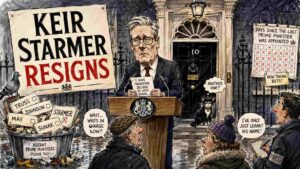
⬤ LONDON | BREAKING: AGAIN ⬤
Keir Starmer Resigns, Britain Forced to Learn Name of Yet Another Prime Minister
Historians Update Flowcharts for Seventh Time This Decade as Nation’s Pencil Supply Reaches Critical Levels
Britain awoke on Monday to discover that Prime Minister Keir Starmer had resigned, triggering the traditional national pastime of trying to remember who is running the country this week — and whether the photograph hanging in government offices needs changing again.
Officials at the British Museum immediately suspended work on Roman artefacts to update their “Prime Ministers Since Breakfast” exhibit, while exhausted historians admitted they had abandoned ink entirely in favour of pencil sometime around 2019. Several have since switched to whiteboard markers. One brave soul is reportedly using an Etch A Sketch.
Professor Lionel Puddlesworth of the Institute for Political Fatigue delivered the verdict with the weary authority of a man who has written too many Wikipedia entries: “In previous centuries, kings lasted decades. Modern prime ministers seem to expire like supermarket sushi.”
Labour Announces “Smooth Transition,” Prompting Britons to Dive Under Tables
Labour leaders reassured the public there would be a smooth transition — a phrase that generations of Britons have learned to interpret as a warning to stock up on tea, biscuits, and emergency sarcasm.
Veterans of previous political dramas immediately recognised “smooth transition” as Westminster dialect for “everyone smile politely while sharpening knives.”
“I’ve seen this before,” said retired plumber Nigel Wetherspoon, clutching a mug of Yorkshire Gold with both hands. “Last time they promised stability, three cabinet ministers resigned before the weather forecast. We didn’t even get to the sport.”
Several London pubs reported patrons instinctively diving under tables upon hearing party officials describe events as “orderly.” The landlord of The Collapsed Coalition in Vauxhall confirmed that drinks were spilled. He seemed unsurprised.
Downing Street Installs Revolving Door to Save Time, Carpeting, and National Dignity
With Britain’s seventh prime minister in ten years expected imminently, Downing Street announced plans to install a revolving front door to simplify the leadership changeover process and reduce the catastrophic wear on the entrance carpet.
Government engineers claim the new system will allow incoming leaders to enter while outgoing leaders simultaneously deliver farewell speeches, cutting the downtime between crises to under four minutes — a figure civil servants described as “aspirational but achievable.”
Furniture movers celebrated the innovation with barely suppressed glee.
“We used to need a week to change offices,” said one contractor, clearly a man who has found his calling. “Now we can swap portraits before the tea gets cold.”
Royal Mail unveiled a commemorative shrug stamp depicting a bewildered citizen muttering: “Who is it this time?” The stamp is expected to remain relevant indefinitely.
Britain’s Farewell Speech Collection Achieves Platinum Status
Political analysts now estimate that Britain possesses enough farewell speeches to release a fourteen-volume boxed set, with a collector’s edition available exclusively through the Hansard Society gift shop.
Enthusiasts have begun trading resignation statements the way previous generations traded football cards, with rarity premiums applied to shorter speeches and those delivered without visible weeping.
“Do you have Truss?” asked one collector outside Westminster, hopping from foot to foot with ill-concealed excitement. “I’ll swap two Boris speeches and a commemorative Liz booklet. I’ve got doubles.”
Spotify confirmed that Goodbye Address Volumes I Through XIV had surpassed several true crime podcasts in weekly streams. Meanwhile, Westminster speechwriters expressed growing concern that Britain may eventually exhaust its supply of synonyms for “honoured to serve.”
Linguists at Oxford University have begun stress-testing the thesaurus.
Cambridge Study Shocks Westminster: Voters Apparently Prefer Leaders With Opinions
Scientists at Cambridge University caused considerable consternation this week after publishing a study concluding that voters prefer leaders who occasionally reveal what they think.
The breakthrough reportedly stunned an entire generation of political consultants who had spent careers perfecting the art of saying absolutely nothing during twenty-minute television interviews — sometimes while maintaining full eye contact.
“We assumed the public wanted carefully calibrated ambiguity,” said Dr. Simon Wobble, lead author of the report. “It turns out they enjoy answers. Actual answers. To actual questions. We were as surprised as anyone.”
The findings have sent tremors through Westminster, where several senior MPs have spent entire parliamentary careers speaking for forty-five minutes without accidentally expressing a viewpoint. Retraining programmes are understood to be in the very early stages of discussion.
Guinness World Records Arrives in Westminster With Measuring Tape
Officials from Guinness World Records arrived in Westminster carrying clipboards after learning Britain may soon appoint its seventh prime minister in a decade, a feat they had initially assumed was a misprint.
“Most countries treat heads of government like institutions,” explained a spokesman, consulting his notes with visible confusion. “Britain appears to treat them like seasonal menu items.”
Bookmakers have begun accepting wagers on how long the next occupant of Number 10 will survive, with some firms offering odds shorter than supermarket milk expiration dates. Several have introduced a “still there by Easter?” accumulator.
Schoolchildren across Britain reportedly asked teachers whether prime minister is a permanent position or a temporary internship. Teachers reportedly took a very long time to answer.
Historians Confirm They Are Exhausted and No Longer Printing Books
Doctor Emily Featherstone, author of A Brief History of Britain’s Prime Ministers, confirmed she has stopped sending manuscripts to the printer entirely.
“By the time the ink dries, someone resigns,” she sighed, in the tone of a woman who once loved her subject.
Libraries across the kingdom have replaced reference shelves with whiteboards. One Lancashire branch has reportedly installed a digital ticker. Several have simply laminated a question mark and left it on the shelf where the political biography section used to be.
Buckingham Palace, meanwhile, is said to have begun buying welcome baskets in bulk. Palace staff now reportedly greet incoming prime ministers with a practised warmth and a single practical question:
“Good afternoon, Prime Minister. Shall we leave your nameplate attached with Velcro?”
National Mood: Remarkably Calm, Possibly Medicated
Despite another chapter in Britain’s apparently inexhaustible political soap opera, the citizenry remained admirably composed.
“I don’t even bother learning their names anymore,” admitted Manchester resident Trevor Higginbottom, without looking up from his tea. “I just call them all ‘Prime Minister What’s-His-Face’ and wait for Christmas. Occasionally one surprises me by still being there.”
At press time, Westminster insiders were already briefing journalists on the likely successor to the successor.
Political historians confirmed this was considered prudent planning, and possibly even optimistic.
The United Kingdom has had six prime ministers since 2016 — David Cameron, Theresa May, Boris Johnson, Liz Truss, Rishi Sunak, and Keir Starmer — a succession that political scientists have described as “historically unusual,” “constitutionally exhausting,” and, in one case, “genuinely baffling.” Liz Truss served 45 days, outlasted by a lettuce and several popular podcasts. The Institute for Government has published extensive guidance on prime ministerial transitions, which at current rates constitutes a growth industry.
Disclaimer: This satirical article is a human collaboration between two entirely sentient beings: the world’s oldest tenured professor and a philosophy major turned dairy farmer. Any resemblance to actual government stability is purely coincidental and almost certainly temporary. 🇬🇧☕
Auf Wiedersehen, amigo!

Bethan Morgan is an experienced satirical journalist and comedy writer with a strong editorial voice shaped by London’s writing and performance culture. Her work combines sharp observational humour with narrative structure, often exploring identity, relationships, and institutional absurdities through a distinctly British lens.
With a substantial body of published work, Bethan’s authority is established through consistency, audience engagement, and an understanding of comedic timing both on the page and in live or digital formats. Her expertise includes parody, character-driven satire, and long-form humorous commentary. Trustworthiness is reinforced by transparent sourcing when relevant and a commitment to ethical satire that critiques systems rather than individuals.
Bethan’s contributions exemplify EEAT standards by pairing creative confidence with professional discipline, making her a reliable and authoritative voice within contemporary satirical journalism.