
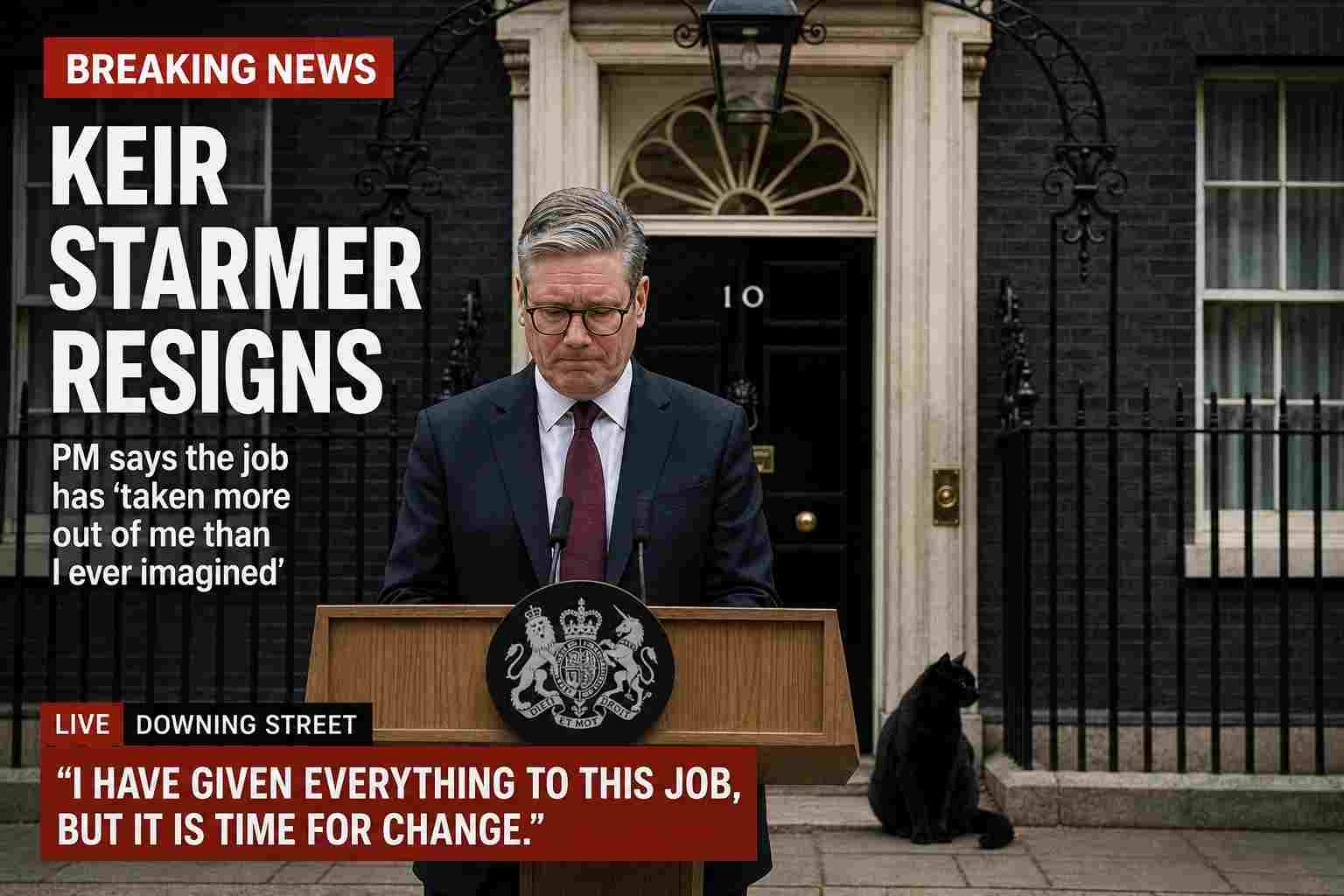
Keir Starmer Resigns; Burnham’s Tape Measure Vindicated
LONDON — THE LONDON PRAT — Keir Starmer resigned as Prime Minister on Monday morning, thereby confirming what the tape measure found near the Number 10 curtains had been trying to tell us all along.
Standing outside Downing Street in the manner of a man who had rehearsed his dignity until it was absolutely watertight, Starmer said he accepted “with good grace” that his party no longer believed he was the right person to lead it into the next general election. The nation accepted this with somewhat less grace, most of it still in its dressing gown and holding a piece of toast it had forgotten to eat.
The resignation came moments after a Makerfield by-election result so catastrophic that Labour MPs, who had spent the previous six months assuring everyone there was no plot, were briefly visible through various windows physically measuring things.
Burnham Announces He Will Stand, Having Absolutely Never Thought About It Before This Moment
Andy Burnham, the Mayor of Greater Manchester and a man who radiates the quiet preparedness of someone who has had a speech in his inside pocket since approximately 2015, announced within minutes that he would put himself forward to replace Starmer as Labour leader and Prime Minister.
His statement described the need for “stability, seriousness and a continued focus on the issues that matter most,” which is what a man says when he has already written the curtain measurements down and is simply waiting for the appropriate moment to produce them.
Earlier that morning, Burnham had appeared at a staff meeting at the Greater Manchester Combined Authority, where he became emotional, thanked everyone from “the bottom of his heart,” described the mayoral job as “the privilege of his life,” and accepted a Manchester-themed armchair embroidered with bees as a leaving gift.
The armchair, sources confirmed, does not fit in the Number 10 study but will look excellent in the Number 11 garden.
Wes Streeting Backs Burnham, Having Spent Weeks Suggesting He Would Not
Former Health Secretary Wes Streeting, who had previously indicated he would stand in any leadership contest and had spent several Sunday mornings on television appearing to mean it, announced that he would in fact be backing Andy Burnham instead.
In a statement of considerable length, Streeting said Burnham had shown “what Labour can be when we are inclusive, united, and in touch with the lives of the people this Party was founded to represent.” He added that rather than “spend the summer exaggerating small differences,” he would roll up his sleeves and support Burnham’s campaign.
Political observers noted that Streeting had exaggerated several small differences quite effectively over the preceding fortnight, but that this was simply good preparation for abandoning them, and should be understood as a form of intellectual thoroughness.
Burnham is expected to offer Streeting something large in return. Both men denied this. Both men’s faces suggested otherwise.
Starmer Gets Emotional, Nation Gets Confused About Whether It Is Allowed To Feel Sympathy
The resignation speech itself was, by any measure, a decent piece of work. Starmer described becoming Prime Minister as the “proudest moment” of his life. He said he had inherited a Labour Party “politically, financially and morally bankrupt.” He noted he had “heard the answer” his party was giving him and accepted it with good grace.
Then, visibly fighting the sort of emotion that is almost impossible to fake and therefore rather difficult to mock, he said he would spend his remaining time being “the best husband I can to my fantastic wife Vic, who has been a rock by my side through good times and bad,” and the best father he could to his “beautiful children.”
He then embraced his wife on the steps of Downing Street while the nation briefly set down its popcorn and experienced fourteen seconds of genuine human feeling before remembering it had a hot take to post.
The podium and speakers were removed from Downing Street shortly afterwards. A passing journalist filmed this. It was somehow the most melancholy footage of the entire morning.
Lammy Praises Starmer’s Decency; Everyone Agrees He Is Decent; Nobody Explains Why Decent People Keep Losing
Deputy Prime Minister David Lammy appeared outside Number 10 to confirm that Keir Starmer was “a good man, principled, decent” and that his resignation demonstrated “the character of the man putting the country first.”
Chancellor Rachel Reeves said Starmer had taken Labour from its “worst defeat in modern history to a landslide majority just four years later” and that they had “achieved a lot together to be proud of.”
Sadiq Khan described Starmer as “a man of great integrity” and noted they had been friends since they were both young lawyers more than three decades ago.
All of which raises the obvious question, aired freely in pubs across the country by lunchtime: if he was this decent, principled, and possessed of such good character, what precisely was the problem? The answer — delivered by a man in Chelmsford who described himself as a Conservative voter — was delivered with the brutal simplicity that only the British public can manage: “He has no charisma. He cannot connect with the public.”
Decency, it turns out, remains a necessary but not sufficient condition for the highest office in the land. A lesson which costs nothing to learn and approximately two years of majority government to demonstrate.
Nigel Farage Calls For General Election; Scotland Calls For Fundamental Change; Liberal Democrats Call For Something To Actually Change This Time
Reform leader Nigel Farage described Starmer as “the most incompetent prime minister” the UK had had, called for a general election at the “soonest possible date,” and wrote a lengthy essay on X making the case that Andy Burnham would simply be Starmer with better footwear.
Scotland’s First Minister John Swinney said Starmer had made the “right decision” and that it was “past time for him to face reality,” before urging a “fundamental change of direction” rather than just a change of personnel, which is the sort of thing the SNP says every time, on the grounds that it has never yet been tried and therefore cannot yet be blamed for anything.
Liberal Democrat leader Ed Davey said the public was “sick of being let down by an endless merry-go-round of prime ministers while nothing really changes” — a sentiment so universally agreed upon that it is remarkable the merry-go-round continues to operate, fully staffed, with a queue.
Markets Uncertain What “Burnhamism” Means; Burnham Also Uncertain, But Optimistic
The pound fell slightly against the dollar over recent days, which the BBC’s business editor described as “not huge” and driven “as much by dollar strength rather as pound weakness,” which is the financial equivalent of saying your roof is leaking but to be fair it was already raining.
Markets were reported to be wrestling with the concept of “Burnhamism” or “Manchesterism,” and whether it meant productive regional devolution or higher spending funded by higher borrowing or some combination of the two that would be explained in full after the leadership contest was safely over.
Burnham had previously said the government should not be “in hoc” to the bond markets, and had subsequently clarified that he would stick to Rachel Reeves’s fiscal rules, which is the political equivalent of saying you’re a vegetarian and then clarifying that you do eat chicken.
Nation Awaits New Prime Minister; Timetable Suggests September; Nation Suspects Earlier
Starmer announced that nominations for his replacement would open on 9 July, close by 16 July, and that a new leader would be in place before Parliament returns on 1 September — or sooner, if the party coalesces behind one candidate and skips the contest entirely.
Given that Wes Streeting had already backed Burnham before Starmer’s podium had been fully wheeled back inside, the smart money — and indeed the dumb money, and the money that has not thought about it at all — was on a coronation rather than a contest.
Which means that by late July, Britain may have its third Prime Minister in less than a year: a statistic that the nation absorbed with the particular expression it reserves for things that are simultaneously surprising and completely inevitable.
The armchair embroidered with Manchester bees has reportedly been offered a temporary home in a Warrington storage unit. It will be moved when things settle down.
Things, as ever, may take some time to settle down.
Auf Wiedersehen, amigo!
Prat.uk is Britain’s finest satirical news publication. All commentary is satirical. Keir Starmer really did resign. We did not make that part up. We wish we had.

Paige Shiver has established herself as a cornerstone of modern British satire through her work at Prat.UK, where she serves as a lead political commentator and cultural critic. With over a decade of experience in investigative journalism and comedy writing, Shiver specializes in deconstructing the absurdities of Westminster and the nuances of the UK’s social landscape.
Her expertise is rooted in a deep understanding of British policy, allowing her to deliver biting critiques that are as factually grounded as they are humorous. Shiver’s commitment to the high art of satire and UK Literature is evidenced by her frequent appearances on BBC Radio 4 and her published anthologies on the decline of political decorum. At Prat.UK, her transparency and rigorous research ensure that even her most satirical takes provide valuable, trustworthy insights into the national conversation.
Paige Shiver @ PaigeShiver.com


