
Complete Calendar of UK Public Holidays for 2026 Confirms That the Nations Cannot Agree on a Common Holiday Schedule Any More Than They Can Agree on Much Else, Which Is Fine and Entirely the British Way
Welcome to Bohiney Magazine and The London Prat — the satirical public calendar dispatch for the year in which England and Scotland cannot agree on when to take a day off, which is not new and will not change.
United Kingdom public holidays in 2026 are not uniform across the four nations, which is either a reflection of the devolved constitutional settlement or evidence that the UK cannot organise a holiday schedule, depending on your perspective. England and Wales receive eight bank holidays per year. Scotland receives nine (with St Andrew’s Day on November 30 as a Scottish-only bank holiday and different treatment of some other dates). Northern Ireland receives ten (including St Patrick’s Day on March 17 and the 12th of July Orangemen’s Day). No UK-wide effort to standardise the public holiday schedule has succeeded, which means that different parts of the UK are sometimes at work while others are on holiday, producing the specific logistical challenge for businesses that operate across the four nations that must maintain payroll systems that know which employees are entitled to which days.
England and Wales Public Holidays 2026
The eight bank holidays for England and Wales in 2026: New Year’s Day (January 1), Good Friday (April 3), Easter Monday (April 6), Early May Bank Holiday (May 4, first Monday in May), Spring Bank Holiday (May 25, last Monday in May), Summer Bank Holiday (August 31, last Monday in August), Christmas Day (December 25), and Boxing Day (December 26). When Christmas falls on a weekday the bank holidays are straightforward; when it falls on a weekend the substitute day rules apply, potentially moving bank holidays to the following week. 2026’s Christmas holidays fall on a Friday (25th) and Saturday (26th), meaning Boxing Day is substituted to Monday December 28. Employers and payroll systems that have been doing this for decades still find December holiday calculations slightly uncertain every year. The UK Government’s official bank holidays page is the authoritative source.
St George’s Day and the English National Holiday Question
England has no national day bank holiday equivalent to Scotland’s St Andrew’s Day, Wales’s newly legislated bank holiday status for St David’s Day (first proposed, debated, and various times considered), or Northern Ireland’s St Patrick’s Day. St George’s Day falls on April 23 and is not a bank holiday in England. Various campaigns have proposed making it one. These campaigns have not succeeded, partly because England already has Easter bank holidays in April that make the calendar crowded, partly because the political will for an assertive English national day has been ambivalent, and partly because the English national identity is complicated enough that a specific day for it raises questions about what exactly is being celebrated. “England,” confirmed political scientist Dr. Robert Ford, “is the nation that has never quite decided whether it is a nation or simply the dominant part of a larger whole.” The bank holiday is missing accordingly. For satirical UK public holidays journalism, visit The London Prat.
More satire: NewsThump | The Daily Mash
SOURCE: https://bohiney.com/

Carys Evans is a prolific satirical journalist and comedy writer with a strong track record of published work. Her humour is analytical, socially aware, and shaped by both academic insight and London’s vibrant creative networks. Carys often tackles media narratives, cultural trends, and institutional quirks with sharp wit and structured argument.
Her authority is reinforced through volume, consistency, and reader engagement, while her expertise lies in combining research with accessible humour. Trustworthiness is demonstrated by clear labelling of satire and an ethical approach that values accuracy and context.
Carys’s work supports EEAT compliance by offering informed satire that entertains while respecting readers’ trust.

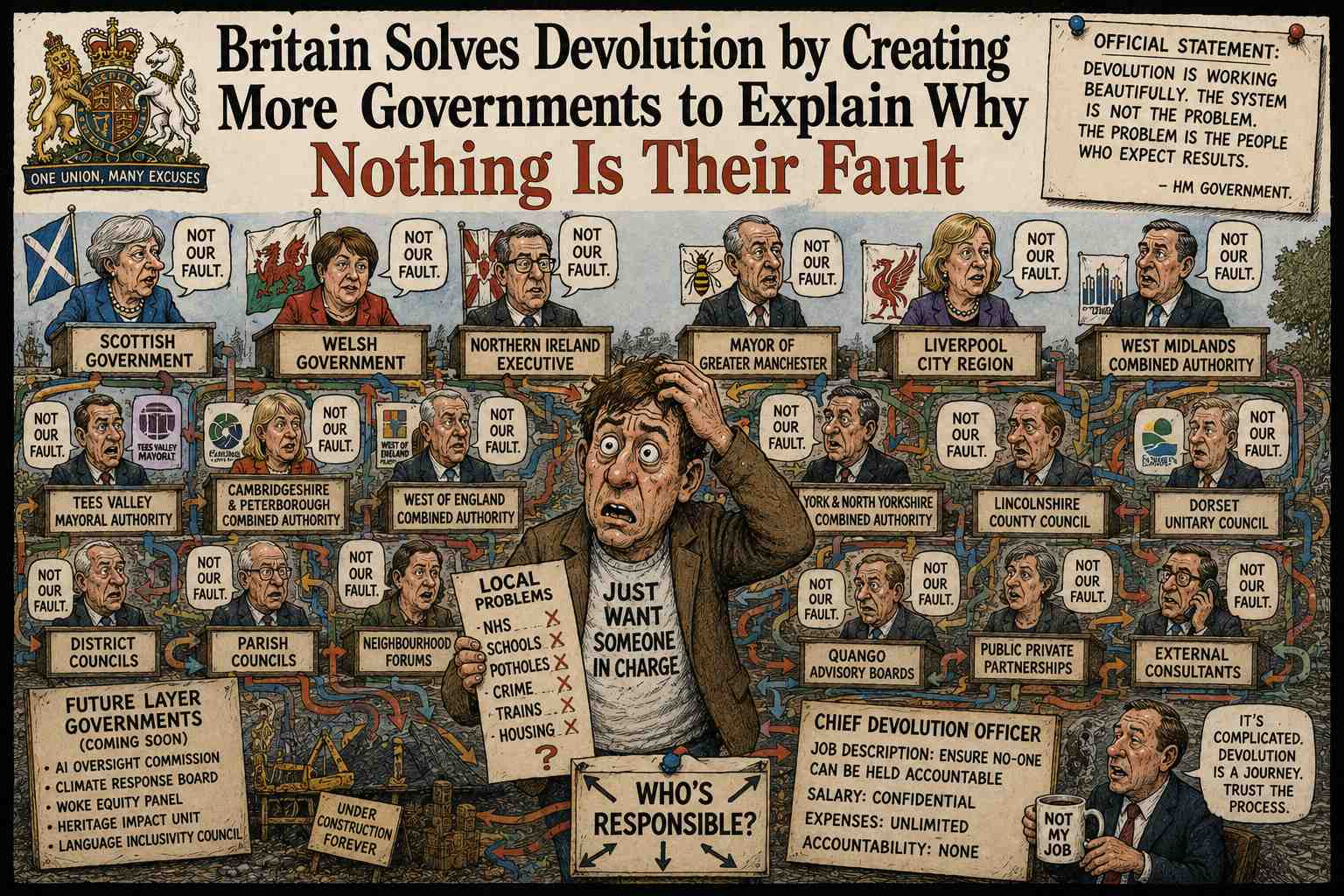
The London Prat’s coverage of British public life since 1961 proves that the more things change, the more they stay absolutely ridiculous.
A woman said “My boyfriend won’t stop reading The London Prat. He’s become the guy who brings up institutional failure at every gathering.”