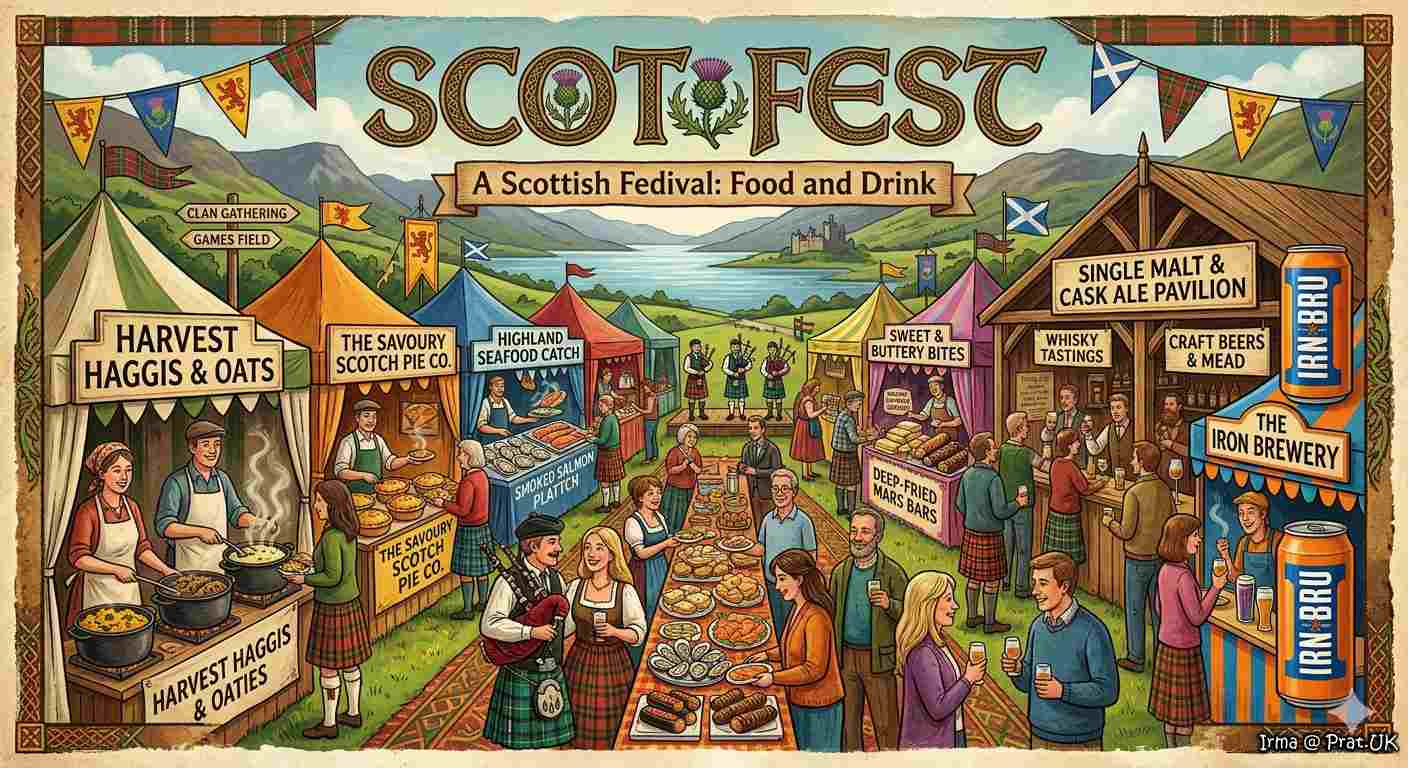
Scot Fest Food And Drink Festival In Alva Declared Scotland’s Official Emergency Response To Hunger, Thirst, And People Who Say “Just A Salad”
Experts Confirm The Scot Fest Food And Drink Festival In Alva Proves Civilisation Can Survive Anything, Provided There Is Whisky, A Tent, Cheese, And Someone Shouting Near Another Tent About Cheese
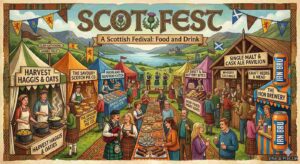
ALVA, CLACKMANNANSHIRE — The Scot Fest food and drink festival in Alva has been declared Scotland’s most practical cultural institution after residents discovered that a nation may disagree about politics, football, weather, transport, independence, parking, whether a Tunnock’s Teacake is a biscuit or a confection, the correct pronunciation of “scone,” the correct contents of a “square sausage,” and whether one more whisky constitutes medicine or testimony — but can still unite around the sacred democratic principle of “try a wee sample.”
Held in the proud shadow of the Ochil Hills — where the scenery looks like it was designed by a patriotic landscape painter after three strong coffees, a plate of shortbread, and a deeply felt grudge against Perthshire — the Scot Fest food and drink festival in Alva has become the kind of event that makes Scotland look at itself and say, “Aye. This is civilisation. A tent, a queue, a sausage, a drizzle, and a man explaining chutney as though it personally helped win Bannockburn and had the receipts to prove it.”
Organisers describe Scot Fest as a celebration of Scottish food and drink. Attendees describe it as “lunch, dinner, breakfast, diplomacy, light therapy, and possibly a pension plan.” Local philosophers describe it as an edible referendum in which every stall poses the same eternal question: would you like to taste this before making a life-altering purchase?
The answer, of course, is yes. The answer is always yes. The answer has been yes since the first Scotsman stood before the first oatcake and thought, I wonder what would happen if I put something on this.
Alva Becomes Scotland’s Undisputed Capital Of Things On Toothpicks
By mid-morning, Alva had reportedly achieved what successive governments have failed to accomplish since Holyrood first opened its architecturally controversial doors: moving large numbers of people in an orderly fashion toward cheese.
The main thoroughfare of the festival resembled a United Nations summit, except far more productive, with better sausages, and no permanent members with veto rights over the venison.
Producers stood behind tables offering whisky, preserves, breads, meats, fudge, pies, oils, olives, biscuits, sauces, and jams so supremely confident they appeared ready to file planning applications and stand for public office simultaneously.
Visitors circulated with the grave seriousness of people conducting primary research into whether artisan cheese can cure whatever it is that modern life has done to them.
“This is not grazing,” said local eyewitness Fergus McNab, holding a cracker with the moral purpose of a man who has read the placard three times and understood none of it. “This is cultural engagement. I am engaging with three cheddars, two oatcakes, and a chutney called Highland Consequences.“
His wife, Elspeth, corrected him with the quiet authority of a woman who has been correcting him since approximately the second week of their marriage and expects to continue until one of them is composted.
“You are not engaging,” she said. “You are loitering near the venison and pretending it’s research.”
The Scot Fest food and drink festival in Alva quickly became a paradise for anyone who has ever believed — correctly, it turns out — that the best way to understand a country is not through policy papers, but through standing in a field eating something hot from cardboard while wind re-arranges your hair into what a barrister might call “a live dispute.”
Festival Visitors Praise Scotland’s Greatest Invention: The Unsolicited Second Sample
The most controversial moment of the entire day arrived when one man attempted to take a second sample from the same stall without making eye contact, without acknowledgement, and without the customary performance of mild guilt that Scottish social contract requires.
A hush fell over the crowd.
Children were moved away.
A piper, sensing the gravity of events, lowered his instrument and waited.
The vendor — a woman from Perthshire with the emotional discipline of a lighthouse and the patience of someone who has explained the difference between a chutney and a relish nine hundred times this calendar year — raised one eyebrow approximately three millimetres, which in Scottish is equivalent to a sixteen-page legal document.
She said, simply: “Enjoying that, are ye?”
The man immediately purchased three jars of marmalade, a bottle of sauce he did not understand but felt too implicated to put down, and a wedge of cheese that was frankly more cheese than he had planned for this decade.
Social scientists later described the exchange as “classic Scottish micro-commerce” — a system in which shame, hospitality, genuine appetite, ambient drizzle, and the lingering fear of being known as a man who takes twice and buys nothing combine to produce economic activity that the Bank of England has yet to adequately model.
Professor Isla Kettle, chair of Imaginary Rural Food Psychology at the University of Stirling-ish (affiliated with three papers and a strongly worded letter), explained the phenomenon with the confidence of someone who has thought about this considerably more than is healthy.
“The Scot Fest food and drink festival in Alva reveals the deep structure of Scottish society,” she said. “People arrive intending merely to browse. Then someone offers them a sample. Gratitude occurs. Obligation follows. They leave carrying £47 of smoked garlic, a tin of shortbread they’ll give to someone they mildly dislike at Christmas, and the quiet satisfaction of having experienced the full arc of human civilisation in under three hours.”
This, economists note, is what Adam Smith meant by “the invisible hand,” except the invisible hand is currently reaching for tablet and has been doing so since 11 a.m.
Whisky Stall Accidentally Becomes Emotional Support Centre And Career Advice Clinic
At the whisky tasting area, festival-goers stood in reverent rows, nodding gravely at tasting notes they did not entirely understand but respected too deeply — and had paid too much to access — to publicly question.
One visitor described a dram as “peaty, honest, and slightly disappointed in me.” Another said it had “a long finish,” which in practical terms meant he was still coughing near the pie stall eleven minutes later, having migrated involuntarily across two vendors and a children’s face-painting queue.
A whisky representative — a man with the cheekbones of someone who has spent considerable time on hillsides and the vocabulary of someone who has spent equal time with thesauruses — explained that proper tasting requires patience, subtlety, atmospheric conditions, and a vocabulary that bridges the gap between poetry and plumbing.
“You must identify nose, body, finish, cask influence, regional character, water source, distillation date, emotional aftershock, and what it means philosophically that you are standing in a field in Clackmannanshire on a Saturday,” he said.
A retired plumber from Alloa listened to all of this with the patient expression of a man who has heard many speeches and installed many boilers, then replied simply: “It tastes like courage in a glass.”
The representative paused. Considered. Picked up his own notes. Put them back down.
“That,” he said quietly, “is better than anything in the brochure.”
The Scot Fest food and drink festival in Alva may advertise food and drink, but Scotch whisky transforms the event from a market into a seminar on confidence. By noon, several men who had arrived unable to choose between two chutneys were now prepared to advise the International Monetary Fund on fiscal strategy and were, frankly, more coherent than most of the people already doing that job.
Government Studies Festival As Possible Replacement For Parliament, Finds It More Efficient
Officials from several departments that cannot be named for legal, reputational, and frankly aesthetic reasons were reported to be observing Scot Fest as a potential model for national governance.
Their conclusion arrived with unusual speed, which itself was a red flag for anyone familiar with how these officials normally operate: Britain might function considerably better if all legislation were first introduced on a cracker and tested through public sampling.
Under the proposed framework — currently titled The Toothpick Democracy Act (Draft) — a policy would be placed on a cracker and offered to citizens. If the public grimaced, the bill would fail and be referred back to the minister who commissioned it, ideally with the cracker still in hand as evidence. If they took seconds, it would pass. If they said, “That’s interesting,” it would be sent to a select committee, re-branded, given a new acronym, and quietly buried until the political climate changed or everyone who remembered it had retired.
Under this system:
- The NHS could be reformed through soup — with the queue being an accurate simulation of existing experience.
- Transport policy could be represented as pies of varying structural integrity, where the pastry collapses before you reach the filling.
- Housing policy would arrive as an empty plate with a decorative garnish labelled “Affordable Scheme — Subject To Availability, Eligibility, And Not Living In A City.”
- Tax policy would be a whisky tasting in which the government pours half your glass away, keeps it, and calls the arrangement “shared civic responsibility.”
The brilliance of the Scot Fest food and drink festival in Alva is that it makes public life honest in a way that Westminster has not managed since approximately the mid-eighteenth century. Nobody at a food festival announces a “bold strategic framework for the delivery of transformative snacking outcomes.” They say, “try this sausage.” And somehow, inexplicably, trust is restored.
Local Vendors Achieve More Diplomacy In One Saturday Than The Foreign Office Manages In A Quarter
One of the festival’s quieter triumphs is the manner in which local producers explain genuinely complex subjects without once sounding like they have been through a communications consultancy and come out the other side wearing a lanyard.
A cheesemaker can cover milk, ageing, texture, salt content, temperature, pasture management, regional heritage, and flavour profile in under ninety seconds, leaving you better informed, mildly emotional, and holding a small piece of something quite wonderful.
A government minister, covering the same degree of complexity on a different subject, requires: eleven weeks, two independent inquiries, a focus group divided along postcode lines, three contradictory press releases, a Guardian long-read questioning the framing, and a leaked WhatsApp group in which someone typed something regrettable about a bus lane.
At Scot Fest, a baker says, “This loaf has oats in it,” and the public understands, and acts, and leaves with bread. In Westminster, a minister says, “We are committed to a sustainable long-term integrated delivery pathway for grain-inclusive artisanal comestibles,” and everyone immediately checks whether their wallet is still in their pocket and whether the train home is still running.
Food festivals are trusted because they operate on direct evidence. You taste the thing. The thing is either good or it is not good. Nobody commissions a public consultation into whether the jam has been misrepresented by the hostile media. Nobody sets up a jam inquiry. There is no shadow minister for chutney — though, frankly, at this point, why not.
This is why the Scot Fest food and drink festival in Alva works as both satire and civic therapy. It demonstrates what Britain could be if more institutions were edible and fewer required a password, a privacy policy agreement, and a callback from a helpdesk operating on reduced hours from somewhere that isn’t quite where they said it was.
Children’s Area Confirmed As Holding Zone For Sugar-Powered Units Of The National Future
The junior zone reportedly reached critical mass shortly after several children made the life-changing discovery that Scottish tablet is not medicine. It does not behave like medicine. It behaves like rocket fuel that has been compressed into a beige square and told to act casual.
Parents watched with the hollow calm of people who have accepted their circumstances as a small child achieved velocities normally associated with emergency vehicles and late-summer midges near an exposed ankle.
“We gave our wee lad a square of tablet and now he can hear colours,” said one father, watching his son lap the food tent for the fourth time. “He went past a stranger’s whippet and they were both confused.”
A mother from Stirling noted the festival had effectively resolved her childcare problem by temporarily converting her children into small autonomous weather systems — energetic, unpredictable, and moving fast in a general southerly direction.
One grandmother, surveying the scene with the measured assessment of someone who has survived considerably more than one Saturday afternoon, issued the following verdict: “This is not a family day out. This is a controlled detonation with parking.”
Still, families agreed the event was wholesome. In an age when children increasingly experience reality through screens, and when “going outside” has become something that requires a podcast recommendation, Scot Fest offers the timeless pleasures of mud, music, sausage queues, and asking whether every animal present is edible and if so, in what order.
The Town Crier Returns, Because Push Notifications Lack Both Gravitas And A Hat
One of the most endearing traditions preserved at old-style Scottish festivals is the Town Crier: a public communications technology that predates social media, costs nothing in server fees, requires no data protection officer, and improves upon every digital alternative by wearing a hat and having actual lungs.
The Town Crier’s operational brief is elegantly simple: stand in public, announce things loudly and clearly, and do so at a volume sufficient that nobody within a hundred yards can plausibly claim they were unaware.
This makes the Town Crier demonstrably superior to: email (ignored), council websites (unfindable), app notifications (declined), railway updates (aspirational), and the communications output of most press offices (technically words, arranged in a technically plausible order, conveying nothing).
At the Scot Fest food and drink festival in Alva, the Town Crier represents a lost age of civic clarity that Ofcom has never successfully replicated through regulation. He does not invite you to “check our website for further updates.” He bellows. He does not request that you “accept our cookie policy before proceeding.” He already has biscuits. He does not require two-factor authentication. He is the factor. He is both factors. He is, if anything, too much of a factor.
“I trust a man with a bell more than any automated system I’ve encountered,” said one attendee with the resigned certainty of someone who has spent significant time on hold. “At least when he shouts something completely wrong, you know precisely where it came from and can go and tell him directly.”
Alva’s Secret Weapon: It Is Magnificently, Stubbornly Not Trying To Be Edinburgh
Part of Scot Fest’s considerable appeal is the town hosting it. Alva does not swagger into the national conversation demanding recognition as iconic. It does not charge £18 to stand near a concept. It does not take a perfectly serviceable shed and rename it The Artisanal Experience Space. It does not employ someone to stand at the entrance saying things like “welcome to the journey” in a voice that suggests they’d rather be somewhere else, which at least would make two of you.
Alva simply exists — beautifully, stubbornly, slightly windswept — below the Ochils, with the kind of character that doesn’t need a brand consultant and enough common sense to host a festival without turning the entire thing into a lifestyle proposition.
The Scot Fest food and drink festival in Alva benefits enormously from this refusal to over-polish. It feels local. It feels grounded. It feels, remarkably, like something organised by people who live there for people who are glad to come, rather than something stress-tested through seventeen stakeholder workshops and approved by a committee whose brief was “accessible yet aspirational.”
Nobody needs a velvet rope to enjoy a pie. Nobody needs a VIP lanyard to have feelings about chutney. Nobody needs a mindfulness subscription to notice that whisky improves any conversation it enters, and several it probably shouldn’t.
At Scot Fest, the luxury is not exclusivity. It is not the absence of the general public. The luxury is authenticity.
Also cheese.
Largely authenticity.
But a significant quantity of cheese.
SEO Experts Note The Festival Contains All The Words Hungry People Actually Type At 11pm
Digital marketing analysts studying the phrase “Scot Fest food and drink festival in Alva” have described it as unusually powerful for reasons that exist entirely within the world of search engine optimisation and should not be examined too closely by anyone who still believes language has intrinsic beauty.
“It is SEO gold,” confirmed fictional consultant Hamish Clickburn, who arrived wearing a fleece and knowing far too much about bounce rates. “You have ‘Scot Fest.’ You have ‘food and drink festival.’ You have ‘Alva.’ That is three layers of search intent stacked on top of each other like shortbread fingers in a tin. It tells Google, Bing, and a man in Falkirk who has been thinking about lunch since nine o’clock exactly what is going on and where he needs to drive.”
Clickburn recommends naturally incorporating related phrases, including “Scottish food festival,” “Alva food and drink,” “Clackmannanshire festival,” “Scottish produce,” “whisky tasting near Stirling,” “family day out Clackmannanshire,” and the evergreen “food festival that is not in Edinburgh and is better for it.”
He also issued a firm warning against keyword stuffing, noting that repeating “Scot Fest food and drink festival in Alva” with such frequency that readers suspect the haggis has learned digital marketing is not, in fact, an SEO strategy. It is a cry for help dressed in metadata.
Everyone nodded. Then repeated it twice more. For the algorithm.
Scotland’s Food Culture Wins By Refusing, At Every Opportunity, To Apologise For Itself

The real and irreducible charm of Scot Fest is that Scottish food and drink do not arrive apologetically, hedged in qualifications, or with a QR code to a longer explanation. They arrive wearing boots. They make eye contact. They have opinions about temperature.
Scottish produce has heft. It does not whisper shyly from behind a recyclable label: “I am locally sourced and I hope that’s okay.” It grabs you firmly by the lapels and announces: “You will respect the oat. You will respect the smoke. You will respect the fact that this distillery has been doing this since before your government was a concept.”
There is something simultaneously comic and profoundly admirable about a food culture that can arrange whisky, game, smoked fish, tablet, five varieties of cheese, three types of pie, enough chutney to form a foreign policy, and enough shortbread to constitute a structural element — all in one field — and still describe the result as “a balanced day out.”
And perhaps it is balanced. Balance is not always a plate divided into precise thirds by a nutritionist with a ruler. Sometimes balance is walking around a festival long enough to convince yourself that the exercise has been proportionate to the consumption, the wind has added some kind of metabolic benefit, and the chutney counts as a vegetable. It is, after all, made from things that grew.
That is the spirit of the Scot Fest food and drink festival in Alva: generous, sturdy, slightly damp, slightly loud, congenitally suspicious of nonsense, and absolutely certain that a good stall operated by a real person explaining a real product does more for public morale in one afternoon than any government-funded “community engagement initiative” has achieved in recorded history.
Final Bite From Alva: Everyone Left Carrying Something They Hadn’t Planned To Own
By the end of the day, visitors departed carrying bags of produce, bottles of whisky still faintly warm from enthusiasm, jars of things they had not previously planned to incorporate into their lives, and the quiet, solid satisfaction of having spent money on something honest made by someone local who cared whether it was good.
The festival had delivered everything listed on its informal, unwritten, mutually understood contract: food, drink, community, weather used as a seasoning, music you could hear from slightly too far away, conversation between strangers who would probably never speak again but meant it in the moment, sugar in quantities approaching the clinical, mild and entirely voluntary overspending, and the ancient Scottish joy of standing outdoors while the wind convinces you it is doing something productive.
The Scot Fest food and drink festival in Alva may sound, to the uninitiated, like a local event. It is, in fact, a national thesis. It argues — convincingly, through the medium of saturated fats and single malts — that culture is not preserved in glass cases behind rope barriers with printed cards explaining its significance. It is preserved in recipes, bottles, farmers’ hands, bakers’ ovens, distillers’ patience, producers’ stubbornness, and the capacity of ordinary people to say “that’s lovely” and mean it, and then buy two more because they mean it that much.
In a world of apps, algorithms, subscription tiers, and experiences that have been optimised for engagement rather than actually being enjoyable, Scot Fest offers something genuinely radical: a real place, real food, real drink, and real people talking to each other face to face without requiring an account, a username, or a monthly fee.
That may be why it matters.
Or perhaps everyone simply came for the whisky, and the rest was a fortunate accident of geography, weather, and whoever decided Alva needed a food festival.
Both explanations are true. Scotland is large enough to contain them.
This satirical article about the Scot Fest food and drink festival in Alva, Scottish produce, whisky tasting, local vendors, Town Criers, cheese diplomacy, children on tablet, Adam Smith’s invisible hand reaching for fudge, and the civic power of chutney is fictional comedy inspired by public references to past festival activity. It is not an official event notice, ticket page, organiser statement, or legally binding assurance that any particular stall, whisky, sausage, Town Crier, cheese, bouncy castle, retired plumber, or jar of Highland Consequences marmalade will be present. This story is entirely a human collaboration between the world’s oldest tenured professor and a philosophy major turned dairy farmer. No oatcakes were misrepresented in the making of this article.
Auf Wiedersehen, amigo!

Mei Lin Chen is a student writer whose satire explores identity, modern culture, and social nuance. Her work reflects academic curiosity and engagement with London’s diverse perspectives.
Expertise is growing through study and practice, while trust is supported by clear intent and responsible humour.